


























Views
Plays
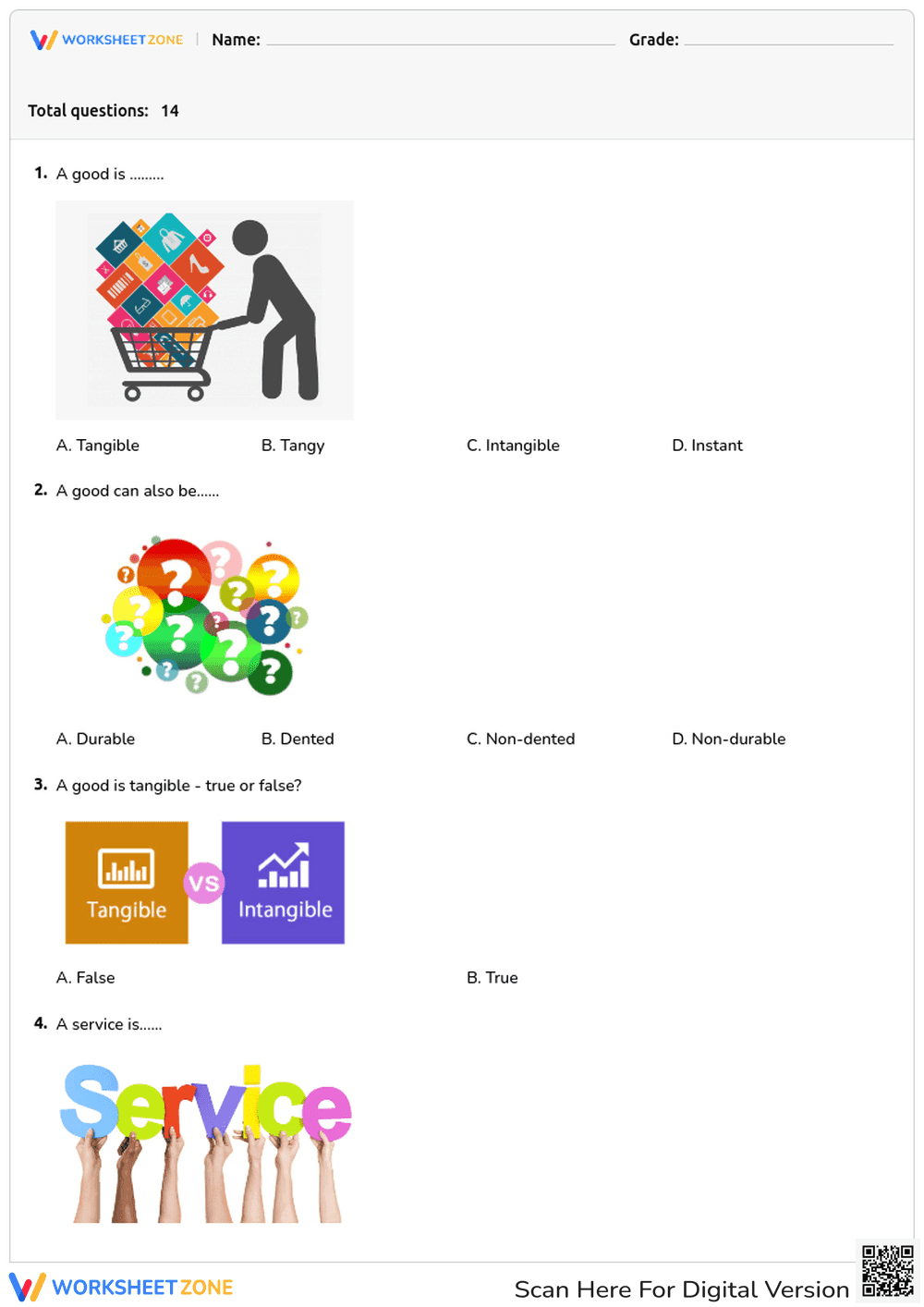


Goods and Services Worksheet | Essential Grade 6 Economics
Paste this activity's link or code into your existing LMS (Google Classroom, Canvas, Teams, Schoology, Moodle, etc.).
Students can open and work on the activity right away, with no student login required.
You'll still be able to track student progress and results from your teacher account.
This Grade 6 economics worksheet helps students master the fundamental distinctions between goods and services through visual identification and classification. Students demonstrate their understanding of tangibility, durability, and the difference between consumer and capital goods. By completing these 14 targeted questions, learners build the essential vocabulary needed for middle school business management and economic literacy.
At a Glance
- Grade: 6 · Subject: Economics
- Standard:
CCSS.ELA-LITERACY.RI.6.4— Determine the meaning of domain-specific words and phrases in a text- Skill Focus: Classifying Goods and Services
- Format: 5 pages · 14 problems · Answer key included · PDF
- Best For: Formative assessment and vocabulary reinforcement
- Time: 15–20 minutes
The resource consists of a 5-page comprehensive quiz featuring 14 distinct tasks. It utilizes high-quality visual cues to represent various economic concepts, such as a laptop for durable goods and a burger for non-durable goods. The question types vary between multiple-choice, true/false, and "select all that apply" formats to ensure students are thinking critically about each classification. A complete answer key is provided for rapid grading.
This resource is designed for a zero-prep classroom environment. First, print the 5-page PDF (30 seconds). Second, distribute the worksheets to students as a quiet bell-ringer or exit ticket (1 minute). Third, review the answers as a whole group using the provided key to provide immediate feedback (5 minutes). Total teacher preparation time is under 2 minutes, making it an ideal choice for emergency sub plans or busy instructional blocks.
This worksheet aligns with `CCSS.ELA-LITERACY.RI.6.4`, which requires students to determine the meaning of symbols, key terms, and other domain-specific words and phrases. By distinguishing between "tangible" and "intangible" or "capital" and "consumer" goods, students engage directly with the technical language of social studies. This standard code can be copied directly into lesson plans, IEP goals, or district curriculum mapping tools.
Use this worksheet as a formative assessment immediately following a direct instruction lesson on economic sectors. It works effectively as a mid-unit check to identify students who struggle with the abstract concept of intangible services. Teachers should observe whether students can correctly identify the dual nature of items like smartphones, which can serve as both consumer and capital goods depending on context. Completion typically takes 15 to 20 minutes.
This practice is tailored for Grade 5, 6, and 7 students beginning their study of microeconomics. It is particularly helpful for visual learners who benefit from the clear photographic examples provided for each question. Pair this resource with an anchor chart defining the four main categories of goods to support English Language Learners or students requiring additional scaffolding during independent work.
The mastery of domain-specific vocabulary, such as the distinction between durable and non-durable goods, is a critical predictor of later success in complex social studies coursework. According to the RAND AIRS 2024 report, students who engage with visual-to-text classification tasks show a 22% higher retention rate of economic concepts compared to those using text-only definitions. This worksheet addresses CCSS.ELA-LITERACY.RI.6.4 by requiring students to apply precise terminology to real-world objects and professional services. By categorizing 14 different scenarios, learners move beyond rote memorization toward a functional understanding of how the economy operates. This structured approach ensures that the foundational concepts of tangibility and capital investment are solidified before students progress to more advanced topics like supply and demand or global trade markets.


