


























Views
Downloads


School Supplies Tracing Worksheet | Essential Grade K Ready
Paste this activity's link or code into your existing LMS (Google Classroom, Canvas, Teams, Schoology, Moodle, etc.).
Students can open and work on the activity right away, with no student login required.
You'll still be able to track student progress and results from your teacher account.
This Kindergarten school supplies tracing worksheet provides young learners with 5 high-frequency vocabulary words to practice letter formation and fine motor control. By tracing words like "scissors" and "crayon," students bridge the gap between visual recognition and physical writing. This activity ensures students develop the muscle memory required for independent writing.
At a Glance
- Grade: Kindergarten · Subject: Handwriting
- Standard:
CCSS.ELA-LITERACY.L.K.1.A— Print many upper- and lowercase letters correctly during writing tasks- Skill Focus: Letter formation & vocabulary
- Format: 2 pages · 5 problems · No-prep · PDF
- Best For: Morning work or literacy centers
- Time: 10–15 minutes
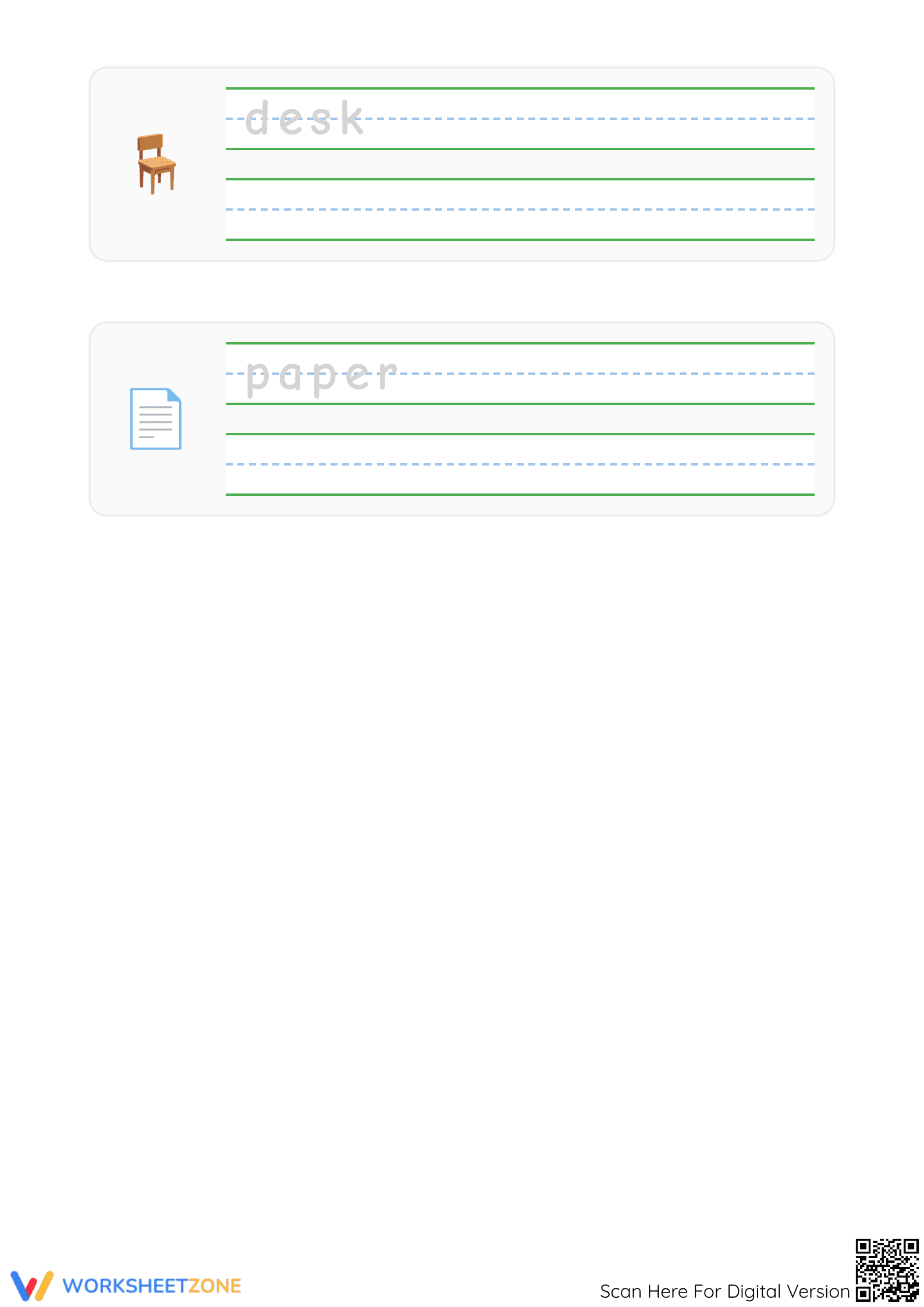
This 2-page PDF features large, clear tracing fonts set on primary writing lines, including the top, middle dashed, and bottom lines. Each of the 5 tasks includes a colorful icon representing the school supply—scissors, bag, crayon, desk, and paper—to support ELL students and early readers with visual cues. The layout is spacious, preventing overwhelm for small hands as they navigate letter curves and straight lines.
Zero-Prep Workflow: This resource is designed for immediate classroom implementation. First, print the 2-page document in less than 30 seconds. Second, distribute to students with pencils or crayons. Third, provide a quick verbal model of the "top-to-bottom" stroke order as students work. Total teacher preparation time is under 2 minutes, making it an ideal choice for emergency sub plans or transition periods between lessons.
Standards Alignment: This worksheet aligns with `CCSS.ELA-LITERACY.L.K.1.A`, which requires students to print many upper- and lowercase letters. By focusing on specific nouns, it also supports vocabulary acquisition and the ability to associate written words with common objects. This standard code can be copied directly into lesson plans, IEP goals, or district curriculum mapping tools.
How to Use It: Use this during the "Back to School" season to introduce classroom vocabulary while assessing baseline fine motor skills. It works exceptionally well as a quiet morning work activity or a station in a literacy rotation. Teachers should observe grip tension and stroke directionality to provide immediate formative feedback. Expected completion typically takes 10 to 15 minutes depending on the student's developmental stage.
Who It's For: This is tailored for Preschool and Kindergarten students who are beginning to master letter shapes. It is also highly effective for Occupational Therapy (OT) sessions or for English Language Learners who need to pair new vocabulary with written practice. It pairs naturally with a physical classroom scavenger hunt where students find the real objects after tracing the words.
Handwriting remains a foundational pillar of early literacy, as physical letter production is linked to better letter recognition and reading fluency. According to Fisher & Frey (2014), the gradual release of responsibility begins with highly supported tasks like tracing, which reduces cognitive load while students master the mechanics of the pencil. This worksheet aligns with CCSS.ELA-LITERACY.L.K.1.A, focusing on the correct printing of letters within a meaningful context. Research from the 2024 NAEP highlights that early intervention in fine motor development significantly correlates with later academic success in written expression. By providing 5 specific vocabulary targets, this resource ensures that students are not just drawing lines, but are connecting phonemes to graphemes in a structured, repeatable format that builds confidence and prepares them for the demands of first-grade composition.


