


























Views
Downloads

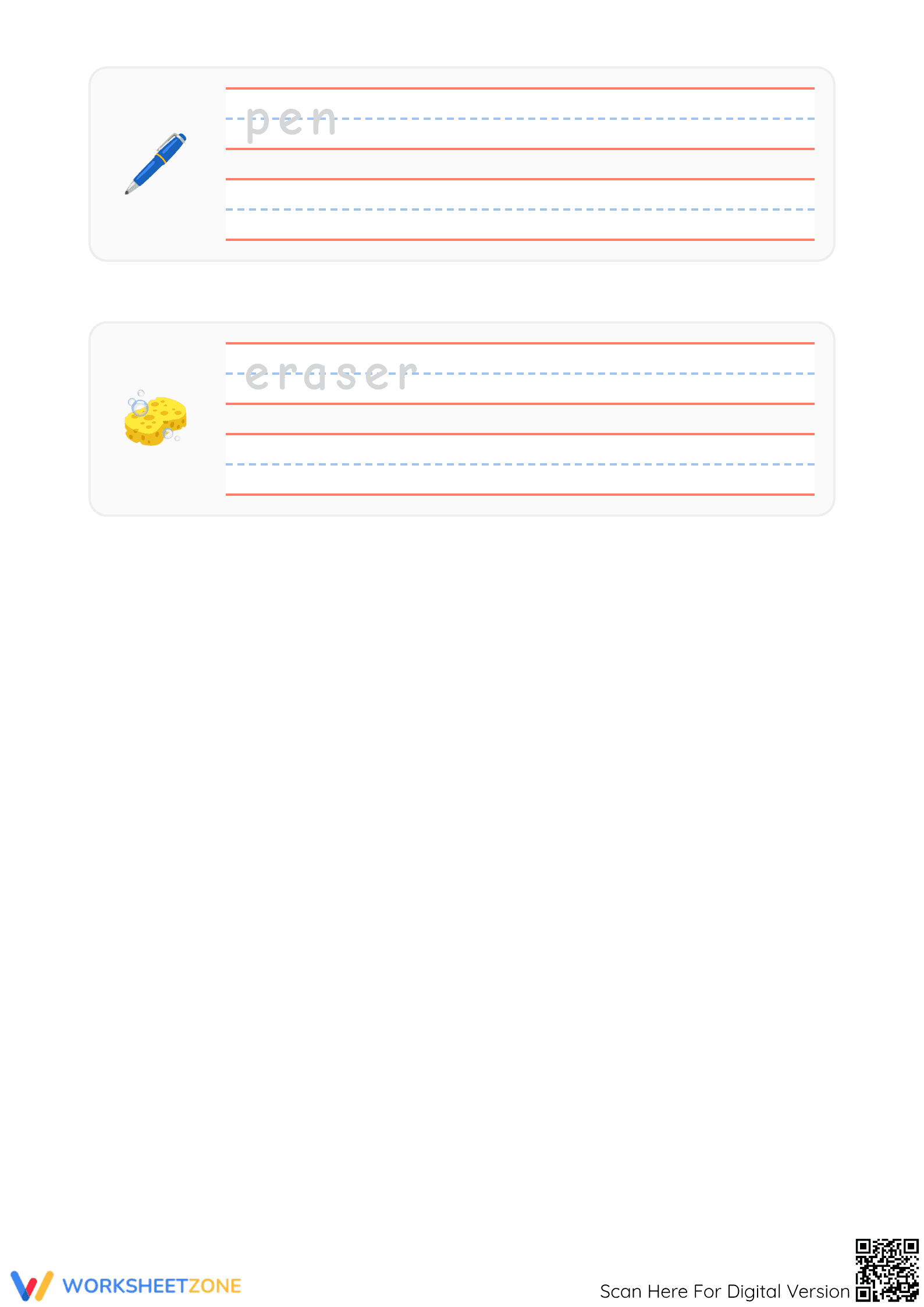

Stationery Words Tracing — Printable Kindergarten Worksheet
Paste this activity's link or code into your existing LMS (Google Classroom, Canvas, Teams, Schoology, Moodle, etc.).
Students can open and work on the activity right away, with no student login required.
You'll still be able to track student progress and results from your teacher account.
This print-and-go handwriting worksheet helps early learners practice fine motor skills and letter formation by tracing common school supply vocabulary. Students will trace lowercase letters to spell familiar words, building both their handwriting confidence and their foundational reading skills in one simple activity.
At a Glance
- Grade: Kindergarten · Subject: ELA
- Standard:
CCSS.ELA-LITERACY.L.K.1.A— Print many upper- and lowercase letters- Skill Focus: Handwriting and word tracing
- Format: 2 pages · 5 problems · No answer key needed · PDF
- Best For: Morning work or literacy centers
- Time: 10–15 minutes
This two-page resource features five distinct tracing tasks centered around everyday stationery items. Each section includes a helpful visual icon paired with the corresponding vocabulary word written in a traceable, dashed primary font. The words are placed on standard handwriting lines with a dashed midline to guide proper letter height. Students trace the words "pencil," "book," "ruler," "pen," and "eraser," with extra blank lines provided for independent practice.
Zero-Prep Workflow
This resource is designed for immediate classroom implementation.
- Print (1 minute): Download the PDF and print the two pages. The design is ink-friendly.
- Distribute (1 minute): Hand out during morning arrival or literacy centers.
- Review (3 minutes): Briefly model how to trace the first word, emphasizing starting at the top line.
With a total teacher prep time of under two minutes, this is an ideal activity for emergency sub plans.
Standards Alignment
This worksheet is aligned to CCSS.ELA-LITERACY.L.K.1.A, which requires students to print many upper- and lowercase letters. By tracing these specific vocabulary words, students practice the continuous strokes and spatial awareness necessary for legible handwriting. Both standard codes can be copied directly into lesson plans, IEP goals, or district curriculum mapping tools.
How to Use It
This tracing activity fits perfectly into a morning work routine. Place the worksheet on students' desks before they arrive so they can immediately begin practicing their handwriting as they settle into the classroom. Alternatively, use it as an independent station during literacy centers. As a formative assessment tip, observe students while they trace to ensure they are using a proper pencil grip and forming letters from top to bottom, rather than bottom to top. Expected completion time is between 10 and 15 minutes.
Who It's For
This resource is primarily designed for Preschool and Kindergarten students who are developing their fine motor skills and learning to write lowercase letters. It is also highly beneficial for occupational therapy sessions or special education students who need structured, guided practice with letter boundaries. Pair this worksheet with a read-aloud about the first day of school or a classroom tour of where school supplies are kept to reinforce the vocabulary.
Developing automaticity in letter formation is a critical precursor to fluent writing and reading comprehension. This worksheet targets CCSS.ELA-LITERACY.L.K.1.A, helping students print many upper- and lowercase letters through guided tracing practice. According to Fisher & Frey (2014), providing students with structured, scaffolded opportunities to practice foundational skills significantly reduces cognitive load, allowing them to eventually focus on higher-order text generation rather than the mechanics of writing. By tracing familiar stationery words on guided primary lines, early learners build the muscle memory required for legible handwriting. This targeted repetition ensures that students internalize correct letter proportions and directional strokes. Integrating this focused motor practice into daily routines supports long-term literacy development and prepares young students for more complex writing tasks in the future.


