




























Views
Downloads


Printable Word Tracing Worksheet | Grade K ELA

Paste this activity's link or code into your existing LMS (Google Classroom, Canvas, Teams, Schoology, Moodle, etc.).
Students can open and work on the activity right away, with no student login required.
You'll still be able to track student progress and results from your teacher account.
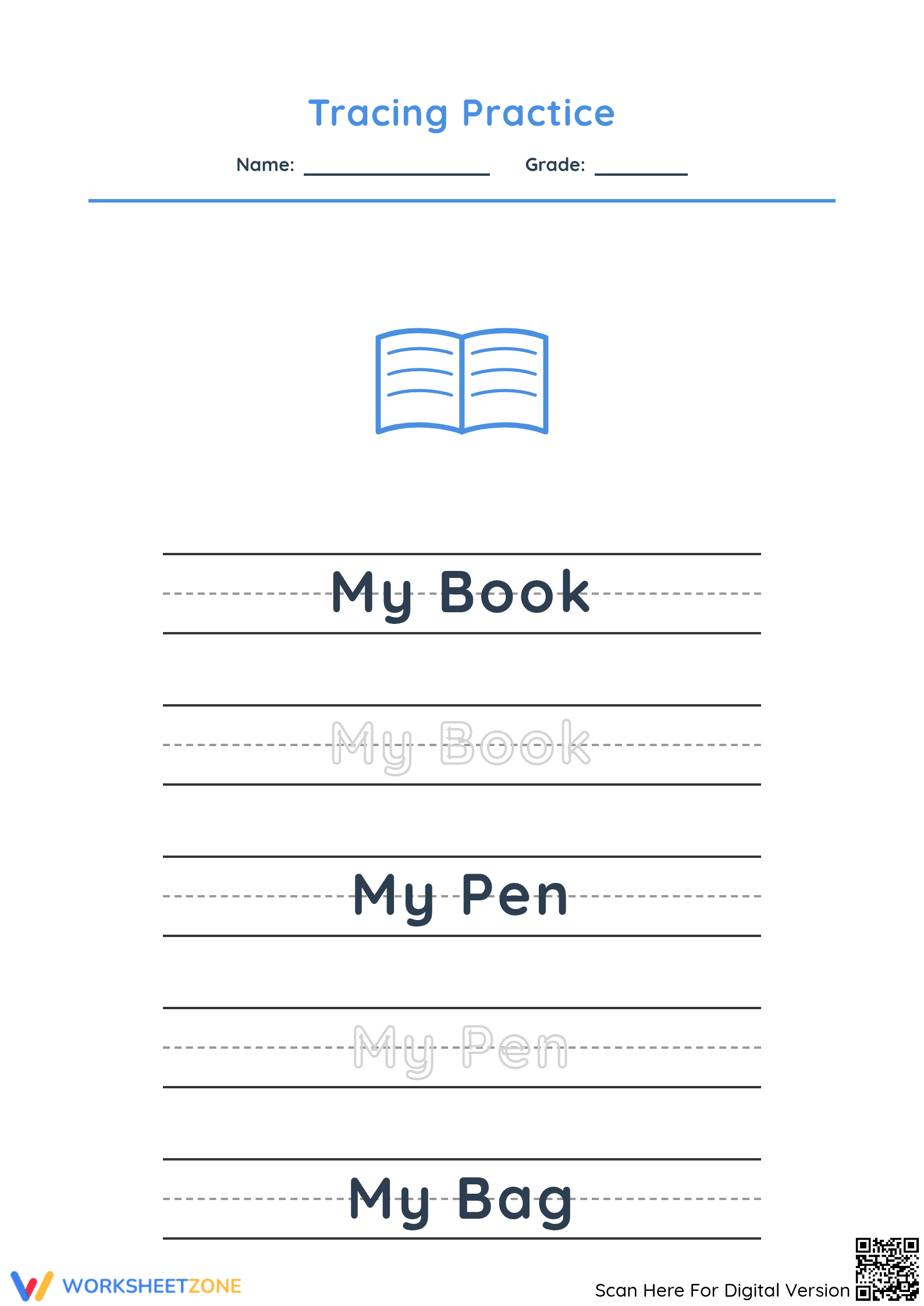
This foundational handwriting worksheet helps early learners develop fine motor control and letter formation skills by tracing familiar school-themed words. Students practice writing "My Book," "My Pen," and "My Bag" on primary-lined paper, building the muscle memory required for confident, legible printing in Kindergarten and beyond.
At a Glance
- Grade: K · Subject: ELA
- Standard:
CCSS.ELA-LITERACY.L.K.1.A— Print many upper- and lowercase letters- Skill Focus: Word Tracing and Handwriting
- Format: 2 pages · 6 problems · No answer key · PDF
- Best For: Independent morning work
- Time: 10–15 minutes
This two-page printable features six distinct handwriting tasks focused on common classroom vocabulary. Each target phrase is presented on standard primary dashed lines to guide proper letter height and placement. The resource includes a clear, distraction-free layout with a simple book icon to provide visual context without overwhelming young readers. No answer key is required for this straightforward tracing activity.
This resource is structured to support early writers through a clear progression of skills:
- Guided practice: Students first observe the solid, correctly formed target words ("My Book," "My Pen," "My Bag") on the primary lines to understand proper letter proportions.
- Supported practice: Next, learners trace the outlined versions of the same words, relying on the provided visual boundaries to guide their pencil strokes.
- Independent practice: Finally, students can use the remaining blank space on the primary lines to attempt writing the words without tracing scaffolds.
This gradual-release approach mirrors the proven "I Do, We Do, You Do" instructional model for early literacy.
Aligned to primary standard CCSS.ELA-LITERACY.L.K.1.A, this activity requires students to print many upper- and lowercase letters accurately. It also supports foundational reading skills by reinforcing left-to-right directionality and basic word recognition. Both standard codes can be copied directly into lesson plans, IEP goals, or district curriculum mapping tools.
This tracing activity is highly effective as a morning work assignment as students settle into the classroom. It also serves as a quiet, focused task during literacy center rotations. While students are working, teachers can conduct quick formative assessments by observing pencil grip, stroke direction, and adherence to the dashed midline. Expect students to complete both pages in approximately 10 to 15 minutes.
This resource is designed primarily for Kindergarten students and Pre-K learners who are ready to transition from tracing single letters to full words. It is also an excellent intervention tool for first-grade students requiring additional fine motor support or occupational therapy practice. Pair this worksheet with a read-aloud about school supplies to build vocabulary context before writing.
Developing automaticity in handwriting is a critical precursor to expressive writing and overall literacy success. According to Fisher & Frey (2014), providing structured, repetitive practice with immediate visual models significantly improves students' ability to form letters accurately and efficiently. This worksheet directly targets CCSS.ELA-LITERACY.L.K.1.A, requiring students to print many upper- and lowercase letters within the context of meaningful words. By focusing on familiar vocabulary like "My Book" and "My Pen," the activity reduces cognitive load, allowing early learners to concentrate entirely on their fine motor execution and spatial awareness on the page. Consistent engagement with guided tracing tasks builds the essential muscle memory needed to transition from supported letter formation to independent, legible writing in early elementary classrooms.


