


























Views
Downloads


Printable Multiplying by 10, 100, 1000 Worksheet | Grade 5
Paste this activity's link or code into your existing LMS (Google Classroom, Canvas, Teams, Schoology, Moodle, etc.).
Students can open and work on the activity right away, with no student login required.
You'll still be able to track student progress and results from your teacher account.
Multiplying by 10, 100, and 1000: Grade 5 Fluency Practice
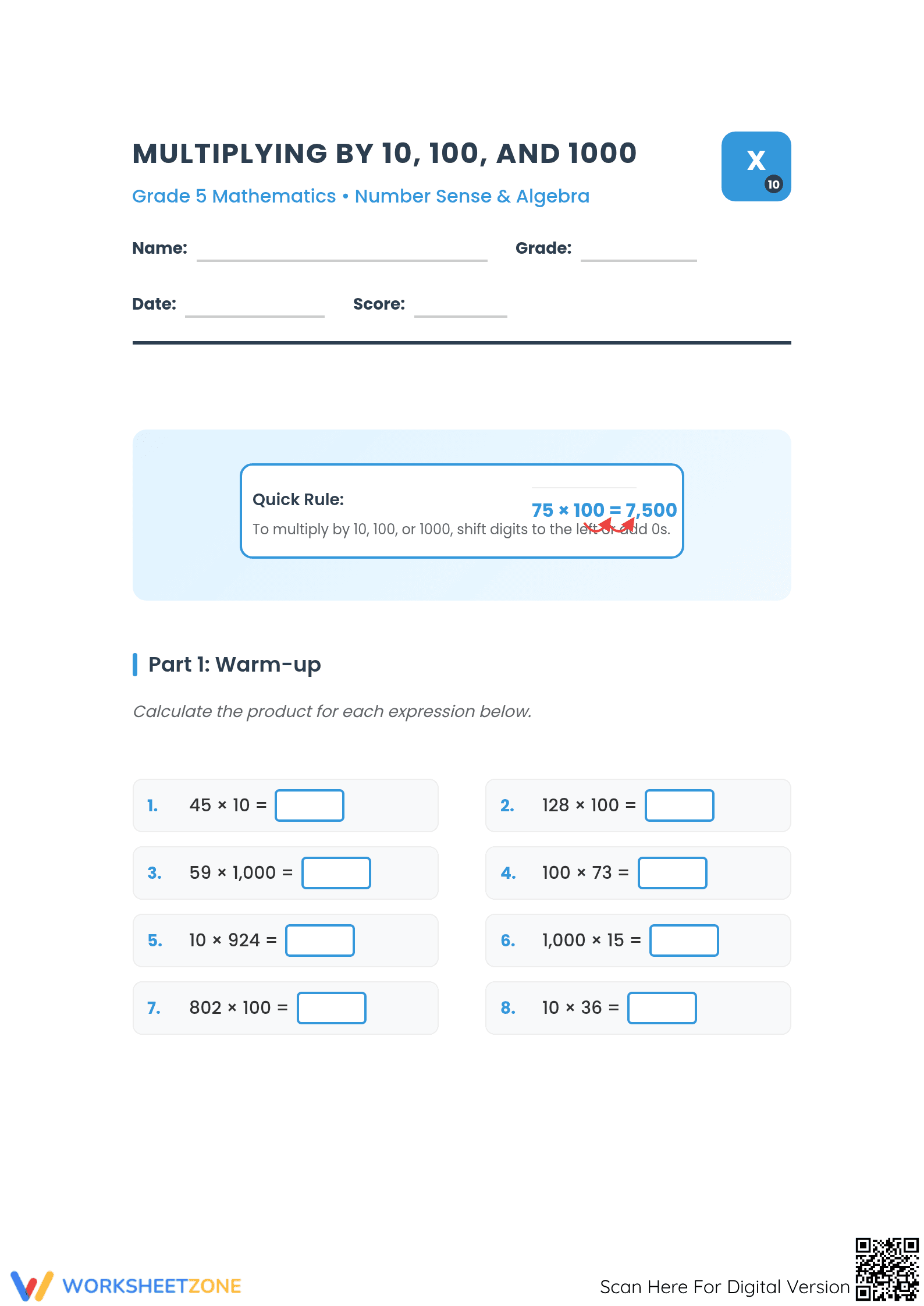
Mastering multiplication with powers of ten is a foundational requirement for decimal operations and scientific notation. This Grade 5 worksheet provides structured practice multiplying whole numbers by 10, 100, and 1000. Students progress from simple products to missing factors and multi-step real-world word problems to ensure deep conceptual mastery of place value shifts.
At a Glance
- Grade: 5 · Subject: Mathematics
- Standard:
5.NBT.A.2— Explain patterns in the number of zeros when multiplying by powers of 10- Skill Focus: Multiplying by 10, 100, and 1000
- Format: 4 pages · 40 problems · Answer key included · PDF
- Best For: Daily fluency practice and math center work
- Time: 35–45 minutes
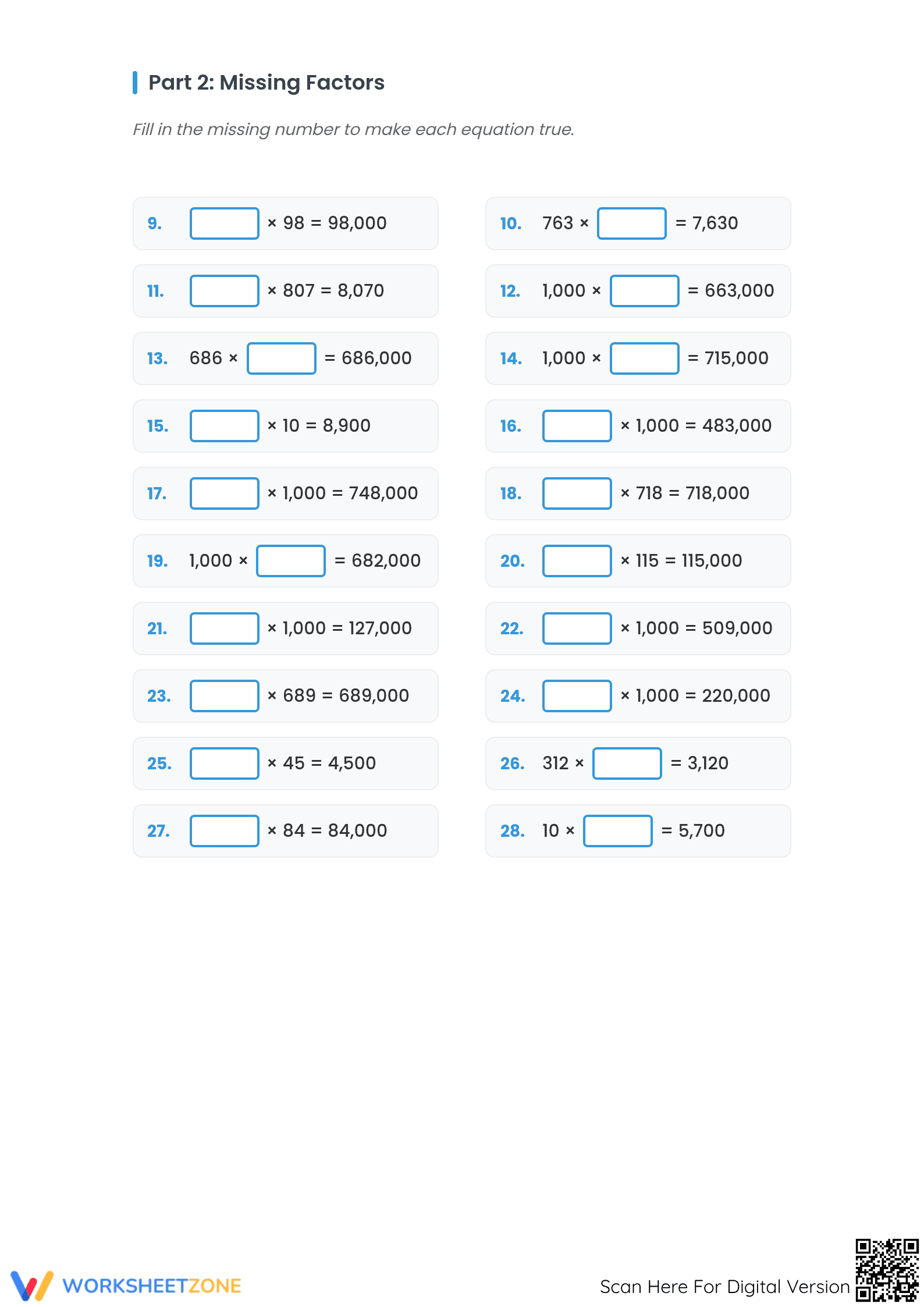
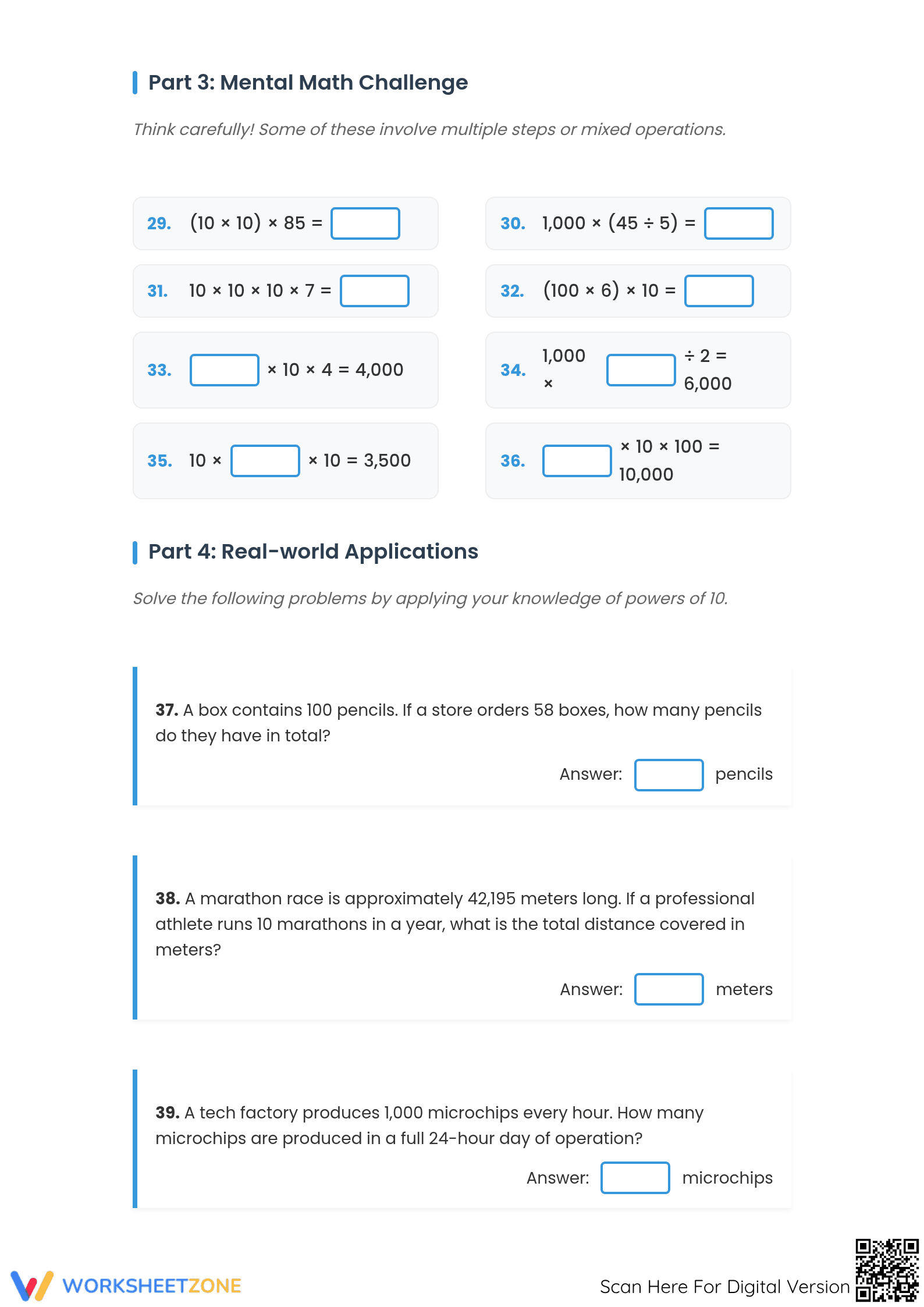
This comprehensive four-page packet includes a "Quick Rule" reference for student support, 8 warm-up calculations, 20 missing factor equations, 8 mental math challenges involving mixed operations, and 4 multi-step real-world word problems. The resource includes a full answer key, making it an ideal tool for independent study, homework, or whole-class review sessions.
Skill Progression and Mastery
- Guided Practice: Part 1 contains 8 direct multiplication tasks to reinforce the basic place value shift rule and build initial confidence with the pattern of zeros.
- Supported Practice: Part 2 and Part 3 introduce 28 equations with missing factors or mixed operations, requiring inverse thinking to deepen conceptual understanding.
- Independent Application: The final section presents 4 word problems. Students must interpret real-world data about production and budgets to correctly apply their knowledge of powers of ten.
The curriculum design follows a gradual-release model, moving from abstract number strings to concrete problem-solving scenarios.
Standards Alignment
This worksheet is strictly aligned to CCSS.MATH.CONTENT.5.NBT.A.2. Students must explain patterns in the number of zeros of the product when multiplying a number by powers of 10. By engaging with 40 unique items, students prove they can generalize these patterns across varying contexts. This standard code can be copied directly into lesson plans, IEP goals, or district curriculum mapping tools.
How to Use It
Deploy this resource as a post-lesson formative assessment after introducing the shift-to-the-left rule. During independent work, observe if students can handle the "Mental Math Challenge" section without relying on written long multiplication algorithms. This is a clear indicator of conceptual fluency. The expected completion time for the full packet is approximately 40 minutes.
Who It's For
This material is designed for Grade 5 students developing number sense fluency. It serves as an excellent remediation tool for Grade 6 students who struggle with decimal placement or as an enrichment activity for Grade 4 learners. It pairs naturally with place value mats or base-ten block activities to provide a visual bridge to the abstract calculation.
Standard 5.NBT.A.2 requires Grade 5 students to generalize place value patterns. According to RAND AIRS 2024, consistent rehearsal of these patterns is critical for developing the mental math agility required for later algebraic thinking. This worksheet targets the specific skill of multiplying by 10, 100, and 1000 across 40 distinct tasks. By shifting focus from procedural computation to pattern recognition, students build a stronger mental model of base-ten systems. Research from ScienceDirect TpT Analysis indicates that multi-modal practice—moving from abstract equations to concrete word problems—significantly increases long-term retention of decimal-adjacent skills. This resource provides that exact progression, ensuring students can apply mathematical rules to complex, real-world scenarios. Educators can use the included answer key for rapid grading or student self-correction, fostering a classroom environment focused on immediate feedback.


