


























Views
Downloads


Grade 3 Multiplication — Printable No-Prep Worksheet
Paste this activity's link or code into your existing LMS (Google Classroom, Canvas, Teams, Schoology, Moodle, etc.).
Students can open and work on the activity right away, with no student login required.
You'll still be able to track student progress and results from your teacher account.
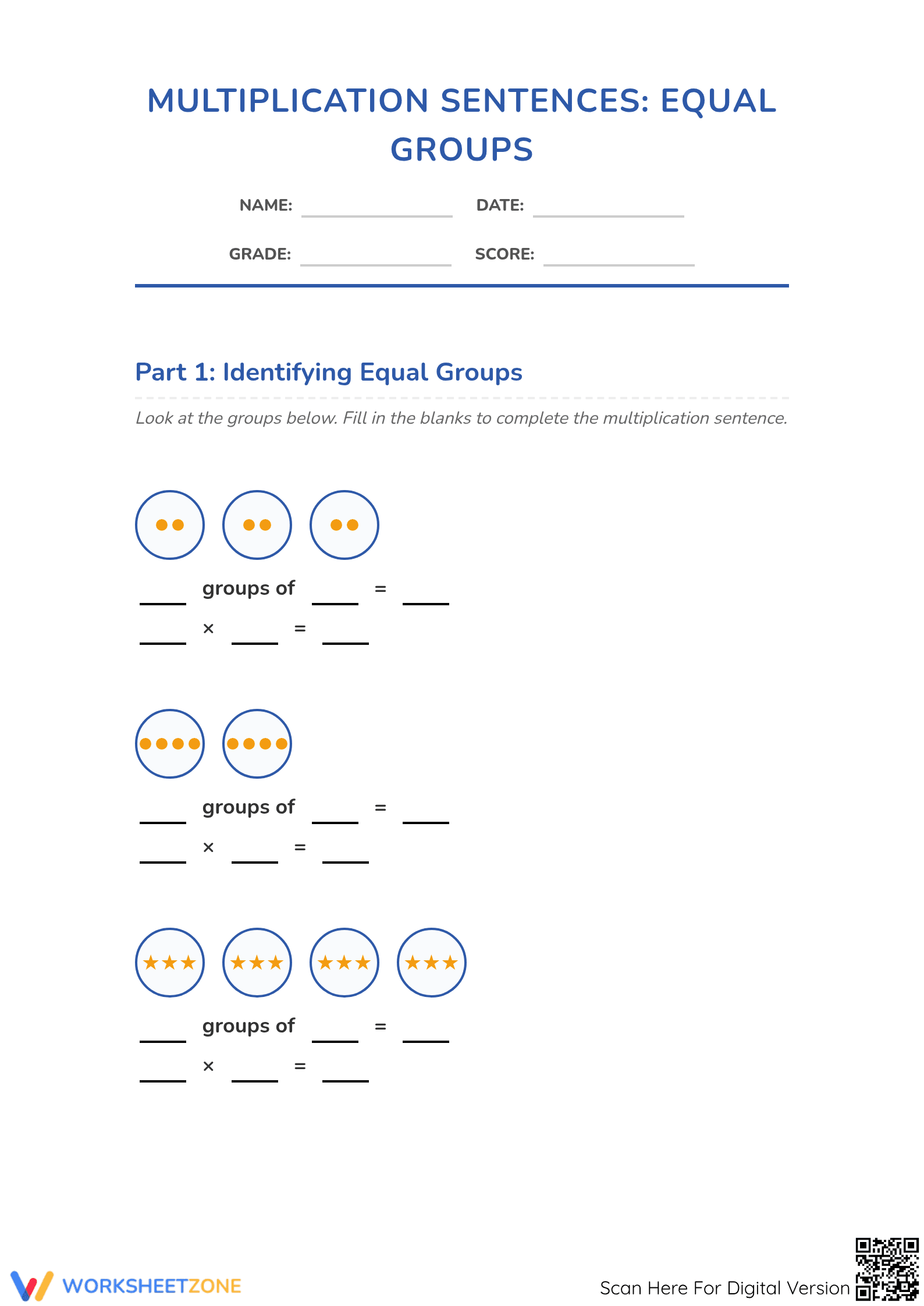
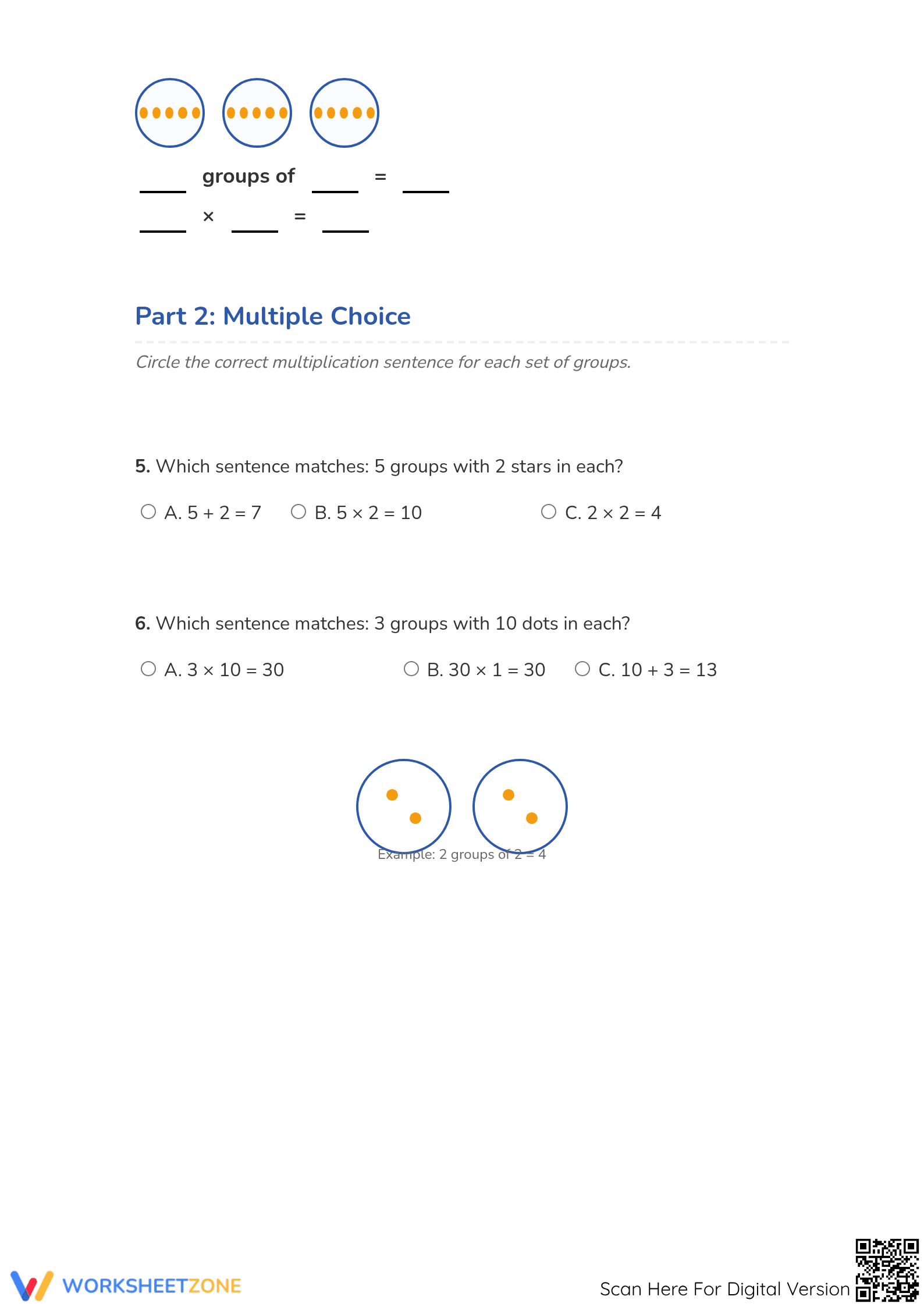
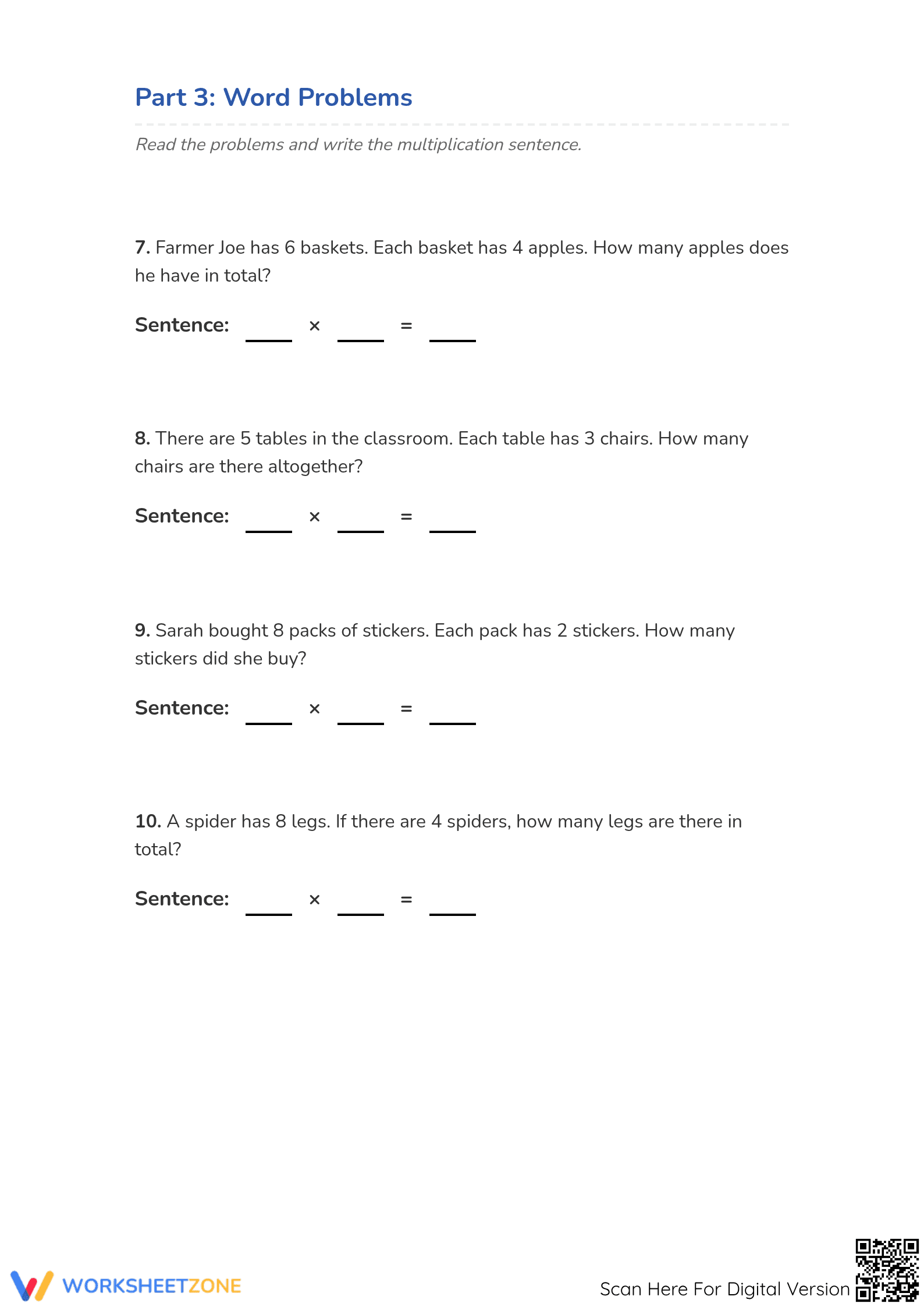
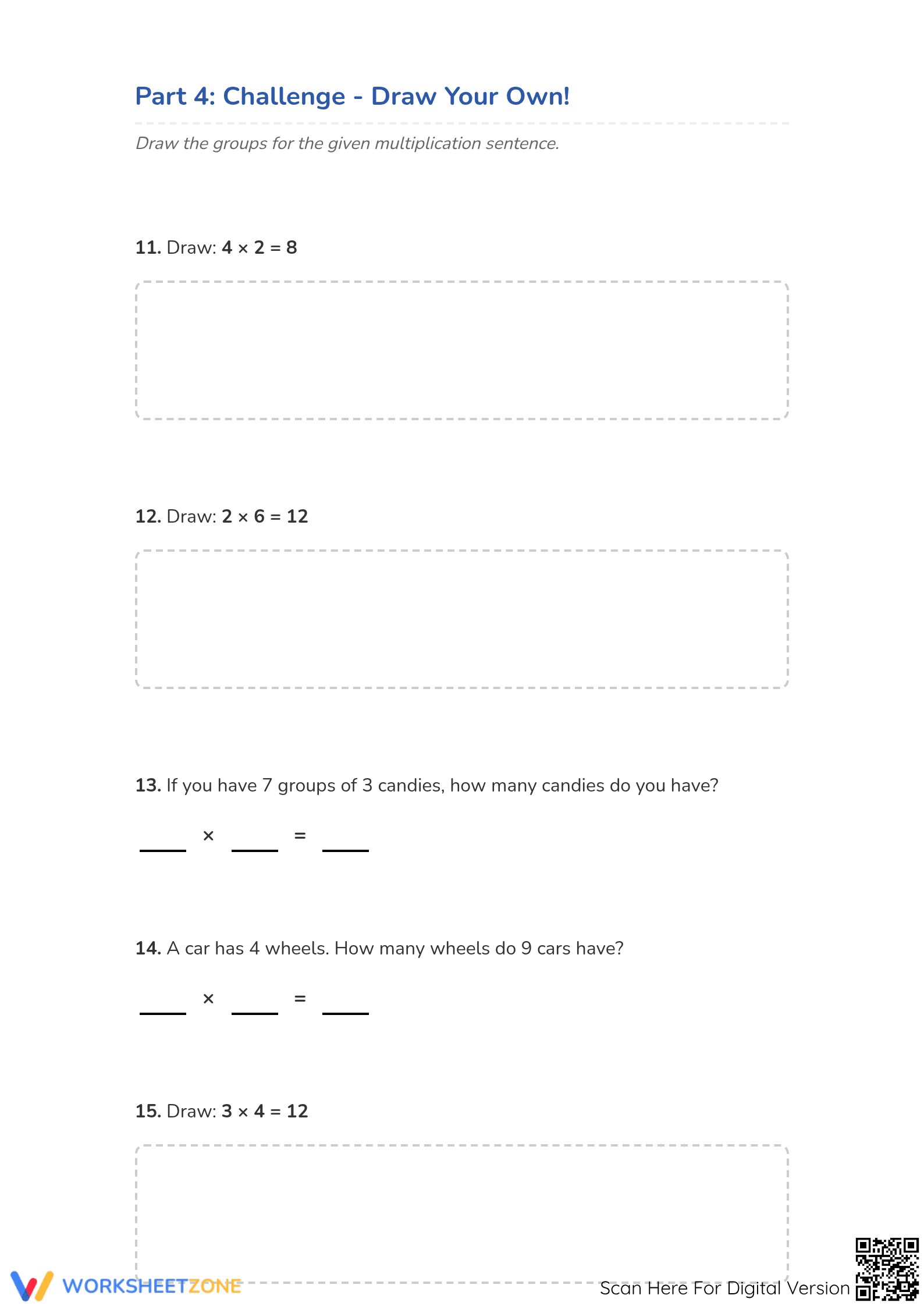
This worksheet gives Grade 3 students practice interpreting equal groups as multiplication. Through clear visual examples, learners write and solve equations, building a foundational understanding of multiplication. It is an excellent resource for introducing the concept or for independent reinforcement, directly aligning with core early math skills.
At a Glance
- Grade: 3 · Subject: Math
- Standard:
CCSS.MATH.CONTENT.3.OA.A.1— Interpret products of whole numbers, e.g., 5x7 as 5 groups of 7.- Skill Focus: Writing multiplication sentences from equal groups
- Format: 5 pages · 16 problems · Answer key included · PDF
- Best For: Initial instruction, independent practice, or homework
- Time: 15–25 minutes
This 5-page PDF contains four pages with 16 distinct problems where students translate visual groups into equations. The final page is a complete answer key for quick grading, making it simple for teachers or parents to check student work and provide immediate feedback on their progress.
Zero-Prep Workflow
This resource is built for efficiency, requiring minimal prep. The workflow is direct:
- Print (1 min): Formatted for standard paper.
- Distribute (1 min): Ready for immediate use as a warm-up, class activity, or homework.
- Review (5 mins): Use the included key to review answers.
Total teacher time is under 10 minutes, making it ideal for substitute plans or any time a reliable, standards-aligned activity is needed without setup.
Standards Alignment
Directly aligned with CCSS.MATH.CONTENT.3.OA.A.1, this worksheet has students "Interpret products of whole numbers" by converting visual groups into equations, matching the standard's core demand. The code can be copied directly into lesson plans, IEP goals, or curriculum maps for easy documentation.
How to Use It
Use this worksheet to model the process during a whole-group lesson or assign it for independent practice after instruction. For a quick formative check, observe how students translate the pictures into factors; this can reveal common misconceptions about multiplication's structure. Expect completion in 15-25 minutes.
Who It's For
Primarily for 3rd graders starting multiplication, this also serves as review for 4th graders or intervention for students needing more support. The clear visuals are beneficial for diverse learners. For a tactile extension, pair this worksheet with physical counters to connect the concrete objects to the abstract equations.
This worksheet offers targeted practice for CCSS.MATH.CONTENT.3.OA.A.1, helping students connect the foundational concept of equal groups to formal multiplication sentences. By repeatedly visualizing and then writing equations, students build the procedural fluency and conceptual understanding necessary for future mathematical success. The RAND AIRS 2024 report on elementary mathematics emphasizes that early, consistent exposure to concrete representations of multiplication is a strong predictor of a student's ability to solve more complex, multi-step problems later on. This activity directly applies that research, translating evidence-based principles into a practical classroom tool. It effectively bridges the gap between seeing groups of objects and writing a product, serving as an essential step in developing number sense around multiplicative thinking and moving learners from additive to multiplicative reasoning.


