


























Views
Downloads
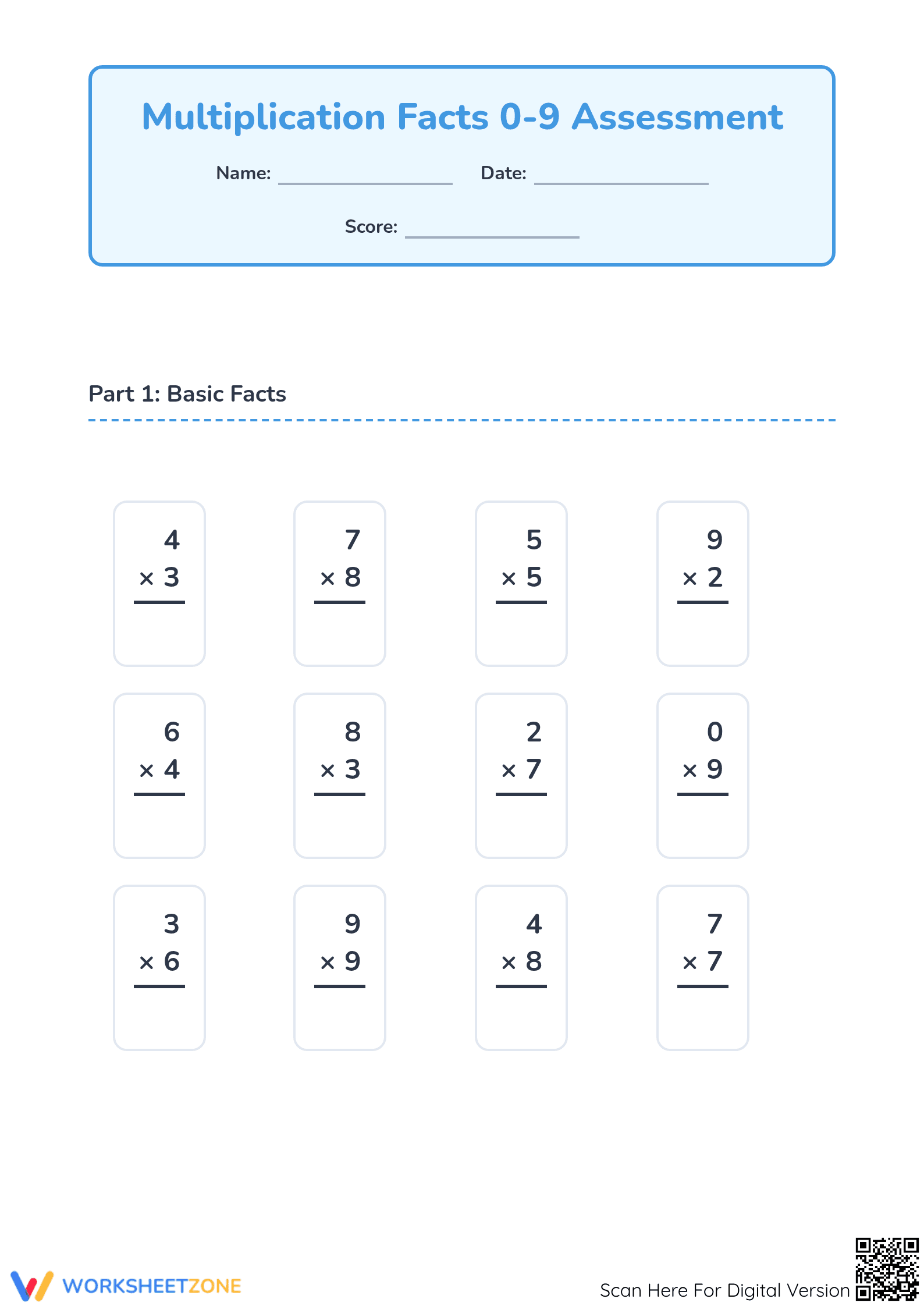
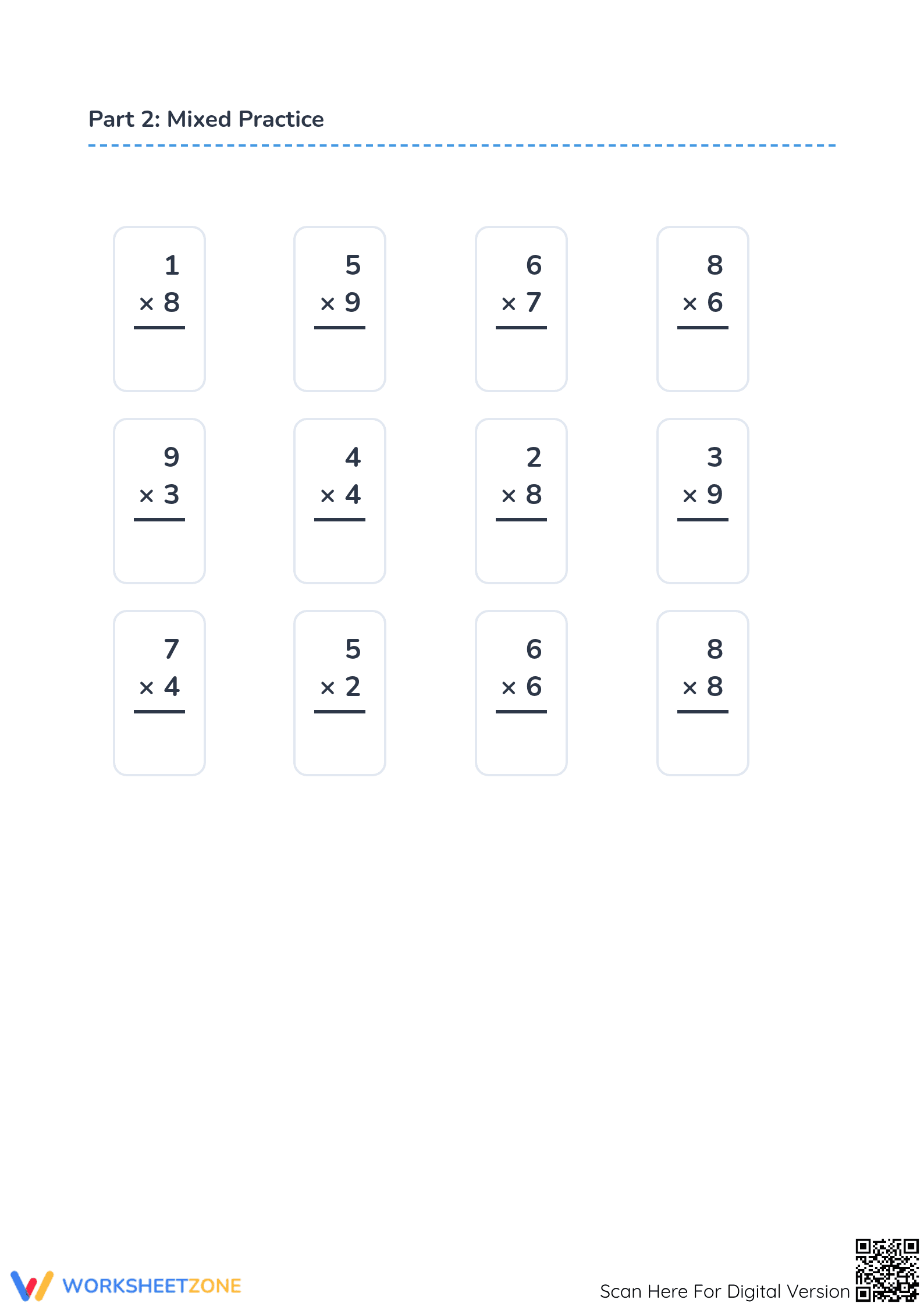

Aligned Grade 3 Multiplication Assessment: 3.OA.C.7 Worksheet
Paste this activity's link or code into your existing LMS (Google Classroom, Canvas, Teams, Schoology, Moodle, etc.).
Students can open and work on the activity right away, with no student login required.
You'll still be able to track student progress and results from your teacher account.
This Grade 3 multiplication assessment ensures students demonstrate total mastery of multiplication facts from zero through nine. By solving 24 targeted problems, learners solidify their conceptual understanding of factors and products. This worksheet provides a clear snapshot of student fluency, enabling educators to identify specific gaps in automaticity before moving to multi-digit operations.
At a Glance
- Grade: 3 · Subject: Math
- Standard:
3.OA.C.7— Fluently multiply and divide within 100 using strategies and properties of operations- Skill Focus: Multiplication Facts 0–9
- Format: 2 pages · 24 problems · Answer key included · PDF
- Best For: Formative assessment and fluency progress monitoring
- Time: 10–15 minutes
This comprehensive assessment is divided into two structured sections. Part 1 focuses on basic multiplication facts, establishing a baseline of recall for single-digit factors. Part 2 provides mixed practice to ensure students can maintain accuracy when factors are presented in varied sequences. The document consists of two clean, high-contrast pages with 24 problems total, accompanied by a full answer key for rapid grading.
Tasks on this worksheet provide evidence for three levels of mastery. Students answering fewer than 18 problems are Approaching mastery, requiring additional scaffolded practice. Those solving 18 to 22 problems are Meeting the standard, demonstrating reliable recall. Students with 23 or 24 correct answers are Exceeding expectations, ready for advanced division or multi-step word problems. Results can be entered directly into gradebooks or IEP progress reports.
The primary focus is `3.OA.C.7`, which requires students to "fluently multiply and divide within 100, using strategies such as the relationship between multiplication and division or properties of operations." This worksheet isolates the multiplication component of this standard to ensure foundational stability. Both standard codes can be copied directly into lesson plans, IEP goals, or district curriculum mapping tools.
Use this resource as a formal summative assessment at the conclusion of a multiplication unit or as a "pulse check" during mid-unit instruction. During the activity, observe if students are using finger-counting or if they have achieved direct recall; this observation tip helps distinguish between strategy-use and true automaticity. Most third-grade students will complete the 24 problems within a 10-to-15-minute testing window.
This assessment is intended for general education third graders, though it serves as an excellent remedial tool for fourth or fifth-grade students requiring fluency intervention. It pairs naturally with an interactive multiplication chart or direct instruction on the Commutative Property. For students with IEPs, the clear vertical layout minimizes visual distractions and provides ample workspace for students who may still need to draw quick dots.
The transition from additive thinking to multiplicative reasoning is a foundational milestone in elementary mathematics. According to research published in the RAND AIRS 2024 report, students who achieve high levels of automaticity with multiplication facts 0-9 are significantly more likely to succeed in complex middle-school algebraic concepts. This worksheet aligns with the instructional frameworks advocated by Fisher & Frey (2014), which emphasize that frequent, low-stakes assessment builds the cognitive endurance necessary for higher-order problem-solving. By isolating multiplication facts within the 3.OA.C.7 standard, educators provide the essential distributive practice required to move mathematical facts from short-term memory into long-term storage. This assessment serves as a verified data point for instructional grouping and intervention planning, ensuring that every learner receives the specific level of support needed to reach the 80% accuracy threshold required for Grade 3 mathematical proficiency and future STEM success.


