


























Views
Downloads



Essential Grade 4 Math: Multiplication Cards for Number Talks
Paste this activity's link or code into your existing LMS (Google Classroom, Canvas, Teams, Schoology, Moodle, etc.).
Students can open and work on the activity right away, with no student login required.
You'll still be able to track student progress and results from your teacher account.
This Essential Grade 4 multiplication worksheet helps students master multi-digit multiplication strategies through visual array models and number talks. By describing how they see and group dot patterns, students transition from simple counting to sophisticated mental math strategies. This resource is designed to spark mathematical discourse while solidifying foundational operations and algebraic thinking.
At a Glance
- Grade: 4 · Subject: Math
- Standard:
4.NBT.B.5— Multiply a whole number of up to four digits by a one-digit whole number- Skill Focus: Multiplication Array Strategies
- Format: 3 pages · 13 problems · Answer key included · PDF
- Best For: Small group number talks and warm-ups
- Time: 15–20 minutes
What's Inside
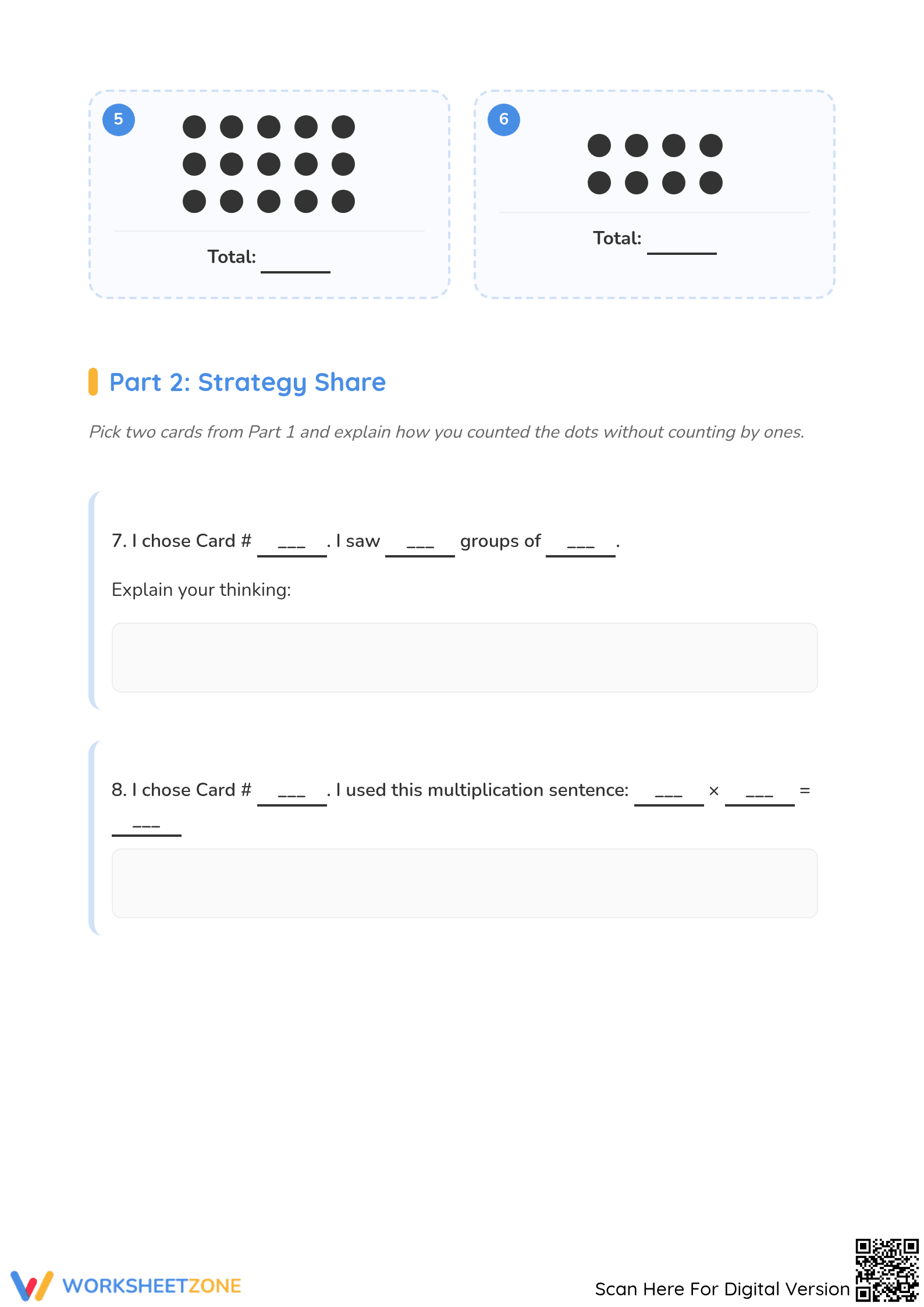
This comprehensive three-page packet includes 13 structured tasks designed to elicit various multiplication strategies. Page one features six initial array cards where students identify total dot counts based on visual patterns. Page two prompts students to share their specific strategies for two chosen cards, requiring them to write multiplication sentences and explain their thinking. The final page presents four challenge arrays and a bonus drawing task, ensuring a complete cycle from observation to application. A full answer key is provided for immediate feedback.
Zero-Prep Workflow
- Print (30 seconds): Download the PDF and print copies for your entire class or small group sessions.
- Distribute (1 minute): Hand out the cards as a morning warm-up or as the primary resource for a guided Number Talk session.
- Review (30 seconds): Use the included answer key to quickly verify student responses or to facilitate a whole-class strategy share-out.
Total teacher preparation time is under two minutes, making this an ideal resource for substitute plans or last-minute lesson enhancements.
Standards Alignment
The primary alignment is to `4.NBT.B.5`: Multiply a whole number of up to four digits by a one-digit whole number, and multiply two two-digit numbers, using strategies based on place value and the properties of operations. This worksheet also supports `4.OA.A.1` by helping students interpret a multiplication equation as a comparison. Both standard codes can be copied directly into lesson plans, IEP goals, or district curriculum mapping tools.
How to Use It
Use this resource during the "Number Talk" portion of your math block. Display one of the array cards from page one and give students a quiet thumb-to-chest signal when they have found the total and a strategy. Observe which students are counting by ones versus those using rows or sub-groups. This worksheet typically takes 15 to 20 minutes to complete if including a brief group discussion.
Who It's For
This resource is specifically designed for Grade 4 students but is highly effective for Grade 3 students beginning array work or Grade 5 students needing a visual refresher. It is an excellent fit for Tier 2 intervention groups. Pair this worksheet with a physical set of counters or an anchor chart showing different ways to see groups (e.g., "I saw 3 rows of 4").
Research from Fisher & Frey (2014) emphasizes that oral language and mathematical discourse are critical for internalizing abstract operations like multiplication. This worksheet facilitates that process by requiring students to explain their thinking in `4.NBT.B.5` contexts. By using arrays, students move through the Concrete-Representational-Abstract (CRA) sequence, which is proven to increase long-term retention of multiplication facts. Teachers can use the strategy-sharing section as a formative assessment to identify which students have moved beyond additive thinking into multiplicative reasoning. This resource bridges the gap between rote memorization and true conceptual understanding, providing the visual scaffolding necessary for all learners to succeed in complex math tasks.


