


























Views
Downloads


Printable Multiple Meaning Words Worksheet for Kindergarten ELA
Paste this activity's link or code into your existing LMS (Google Classroom, Canvas, Teams, Schoology, Moodle, etc.).
Students can open and work on the activity right away, with no student login required.
You'll still be able to track student progress and results from your teacher account.
Mastering multiple meaning words is a foundational step in early literacy development. This printable Kindergarten ELA worksheet helps students distinguish between common homonyms like "bark," "dip," and "park" through visual cues and simple definitions. By connecting words to varied contexts, young learners build the mental flexibility required for advanced reading comprehension and fluent communication.
At a Glance
- Grade: Kindergarten · Subject: ELA
- Standard:
CCSS.ELA-LITERACY.L.K.4.A— Identify new meanings for familiar words and apply them accurately- Skill Focus: Multiple Meaning Words (Homonyms)
- Format: 3 pages · 8 problems · Answer key included · PDF
- Best For: Independent centers and vocabulary practice
- Time: 15–20 minutes
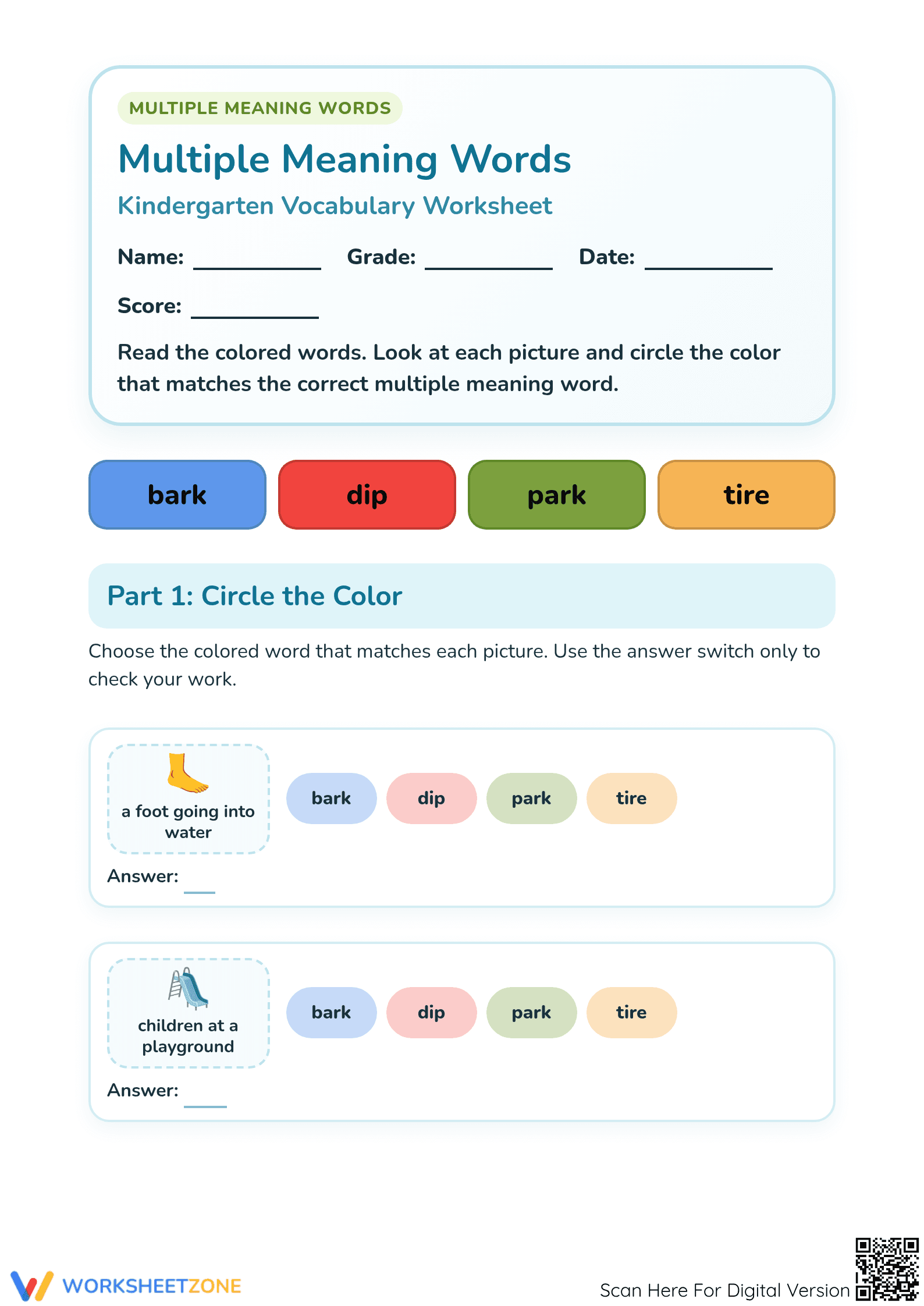
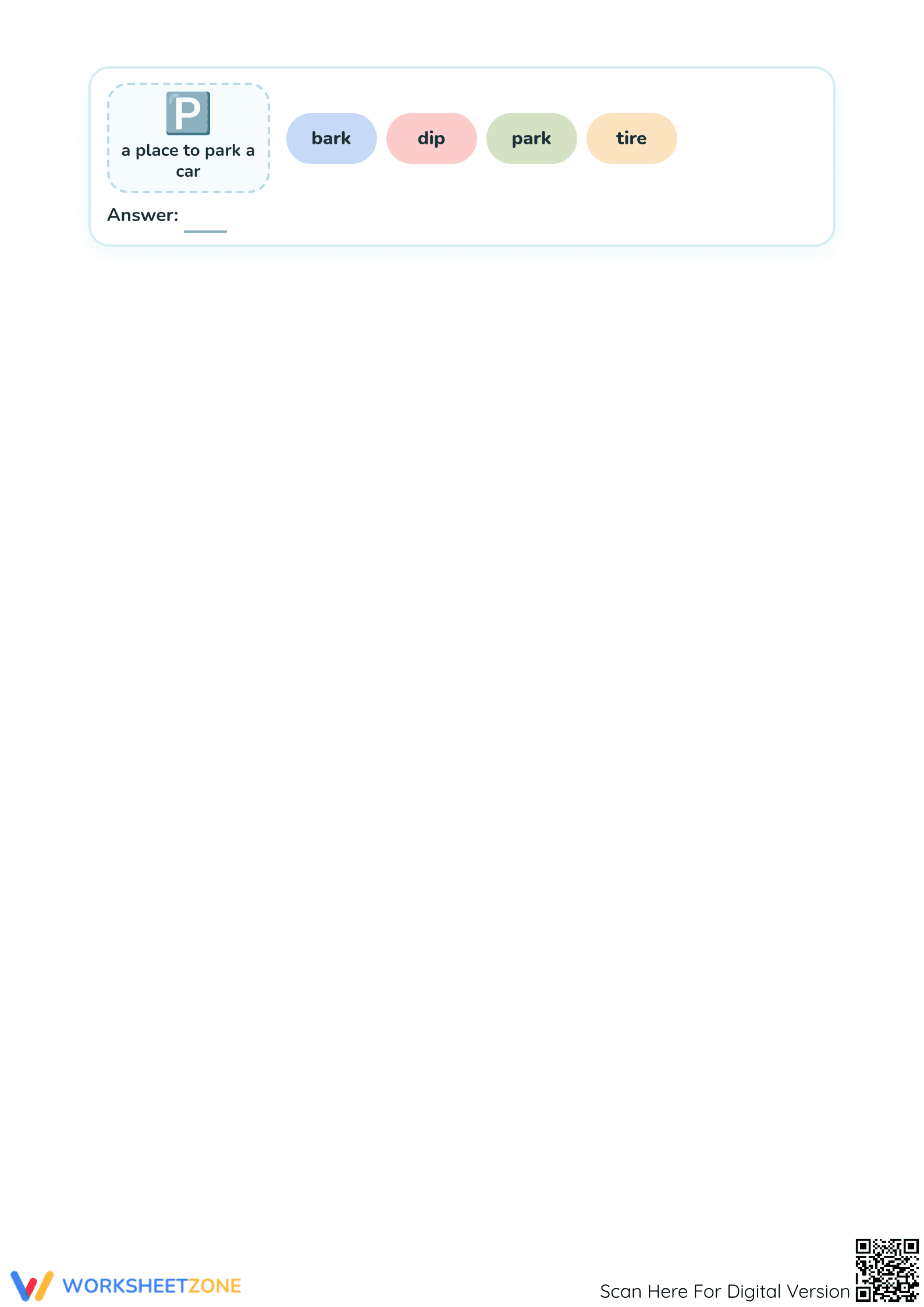
This comprehensive three-page resource features eight distinct vocabulary challenges designed specifically for early learners. Each task presents a clear, high-contrast illustration paired with a simple phrase defining a specific word usage. Students engage with the material by selecting the correct color-coded homonym—bark, dip, park, or tire—that matches the pictured concept. The packet includes a full answer key to facilitate quick checking and immediate student feedback.
The zero-prep design of this worksheet ensures it integrates into any lesson plan in under two minutes. First, print the three-page PDF in color to utilize the essential color-matching cues. Second, distribute the sheets to students with minimal instructions, as the "Circle the Color" task is self-explanatory. Finally, use the provided answer key to review responses individually or as a whole class. This streamlined workflow makes it an ideal choice for emergency substitute plans or busy morning work rotations.
The primary focus of this worksheet is CCSS.ELA-LITERACY.L.K.4.A, which requires students to identify new meanings for familiar words. By exploring how "tire" refers to both a car wheel and a feeling of sleepiness, students demonstrate linguistic adaptability. This resource also supports broader language standards by reinforcing phonemic awareness and print concepts. Both standard codes can be copied directly into lesson plans, IEP goals, or district curriculum mapping tools.
This worksheet is most effective when used as a formative assessment during the "You Do" phase of a vocabulary lesson. After introducing the concept of homonyms with physical objects, assign these pages to gauge individual understanding. Another effective use case is as a literacy center activity where students work in pairs to discuss why a specific word fits two different pictures. Teachers should observe if students are relying on the illustrations or reading the definitions to identify the correct meaning.
Designed for Kindergarten students, this resource is also appropriate for Grade 1 review or English Language Learners (ELL) requiring visual vocabulary support. The use of clear icons makes it accessible for students who are still developing decoding skills. This worksheet pairs naturally with an anchor chart showing homonym pairs to provide a visual scaffold for students who struggle with word memory.
Research by Fisher & Frey (2014) emphasizes that vocabulary instruction is most effective when it includes varied exposures to word meanings in meaningful contexts. This worksheet directly applies this principle by presenting CCSS.ELA-LITERACY.L.K.4.A concepts through a multi-modal approach that combines text, color-coding, and visual imagery. By requiring students to distinguish between multiple meanings of the same phonetic string, the resource builds the lexical depth necessary for later success in reading informational and literary texts. According to findings in the ScienceDirect TpT Analysis, structured practice with multiple meaning words significantly reduces ambiguity during independent reading sessions. Providing students with eight focused tasks ensures they transition from surface-level recognition to a more nuanced understanding of English semantics. This evidence-based design helps Kindergarten educators bridge the gap between basic word recognition and complex vocabulary application in early childhood classrooms.


