


























Views
Downloads

Printable Blood Type Genetics Worksheet | Grade 9 Biology
Paste this activity's link or code into your existing LMS (Google Classroom, Canvas, Teams, Schoology, Moodle, etc.).
Students can open and work on the activity right away, with no student login required.
You'll still be able to track student progress and results from your teacher account.
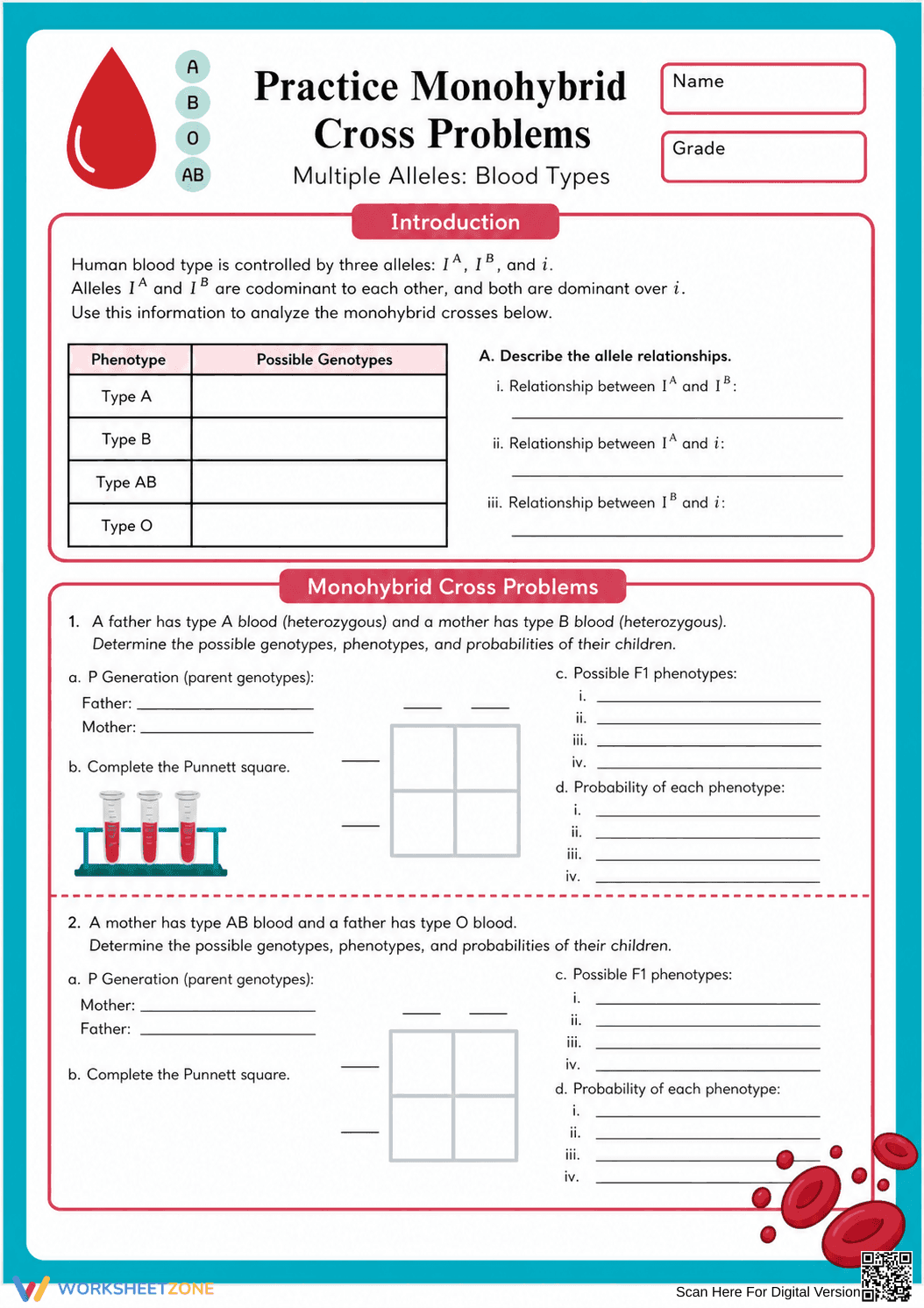
This Grade 9 biology worksheet gives students targeted practice with multiple alleles and codominance by calculating human blood type inheritance. By completing these structured Punnett square problems, learners will accurately predict offspring genotypes and phenotypes while calculating the probability of specific genetic traits.
At a Glance
- Grade: 9 · Subject: Biology
- Standard:
HS-LS3-3— Apply probability concepts to explain trait variation- Skill Focus: Monohybrid crosses and multiple alleles
- Format: 1 page · 3 tasks · Answer key included · PDF
- Best For: Independent practice or homework
- Time: 15–20 minutes
This single-page resource features a clear introductory reference table outlining the relationship between blood type phenotypes and their possible genotypes. Following the introduction, students will find two comprehensive, multi-step monohybrid cross problems. Each problem requires learners to identify parent genotypes, complete a four-box Punnett square, list all possible F1 generation phenotypes, and calculate the exact probability for each outcome. A complete answer key is included for fast grading.
Zero-Prep Workflow
This resource is designed for immediate classroom implementation with absolutely no teacher setup required.
- Print (1 minute): Simply print the single-page PDF and the accompanying answer key.
- Distribute (1 minute): Hand out the worksheet. The built-in introduction provides all the necessary background information on codominance and multiple alleles.
- Review (3 minutes): Use the provided answer key to quickly check student calculations and Punnett square accuracy.
With a total teacher prep time of under two minutes, this worksheet is highly suitable for emergency sub plans or spontaneous review sessions.
Standards Alignment
This worksheet aligns directly with HS-LS3-3: Apply concepts of statistics and probability to explain the variation and distribution of expressed traits in a population. It also supports foundational understanding of Mendelian genetics and complex inheritance patterns. Both standard codes can be copied directly into lesson plans, IEP goals, or district curriculum mapping tools.
How to Use It
Deploy this worksheet immediately after direct instruction on codominance and multiple alleles to solidify student understanding. It serves as an excellent independent practice assignment or a focused homework task. As a formative assessment observation tip, watch how students set up the axes of their Punnett squares; ensuring they correctly separate the parent alleles is crucial for accurate probability calculations. Most students will complete the entire page within 15 to 20 minutes.
Who It's For
This resource is primarily designed for high school biology students mastering complex genetics concepts. The built-in reference table provides excellent scaffolding for learners who struggle to memorize genotype-phenotype relationships, making it accessible for diverse learning needs. It pairs perfectly with a direct instruction lesson on human blood types or a visual anchor chart detailing the differences between dominant, recessive, and codominant traits.
Integrating structured probability exercises into genetics instruction significantly improves student comprehension of complex inheritance patterns. According to a ScienceDirect TpT Analysis, providing students with immediate, relatable contexts—such as human blood typing—enhances their ability to apply abstract mathematical concepts to biological phenomena. This resource directly supports HS-LS3-3 by requiring learners to apply probability concepts to explain trait variation. When students actively construct Punnett squares and calculate the statistical likelihood of specific phenotypes, they move beyond rote memorization and develop genuine scientific reasoning skills. The explicit connection between multiple alleles and observable traits helps solidify foundational genetics knowledge. By utilizing targeted practice materials that combine clear reference data with rigorous application tasks, educators can effectively bridge the gap between theoretical genetics and practical, real-world biological outcomes, ensuring deeper long-term retention of the material.


