


























Views
Plays

Grade 10 Money and Credit Essential Quiz Worksheet
Paste this activity's link or code into your existing LMS (Google Classroom, Canvas, Teams, Schoology, Moodle, etc.).
Students can open and work on the activity right away, with no student login required.
You'll still be able to track student progress and results from your teacher account.
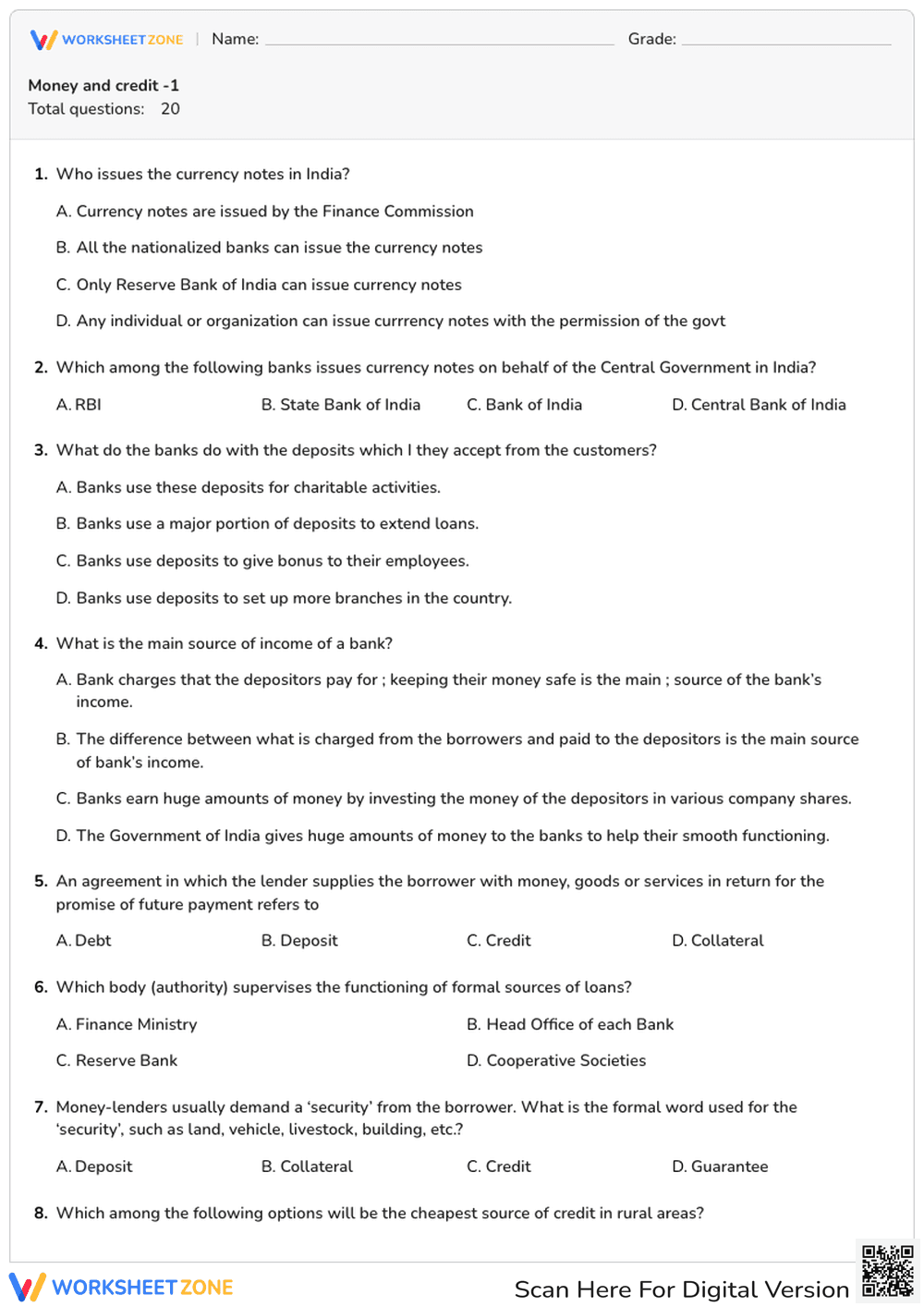
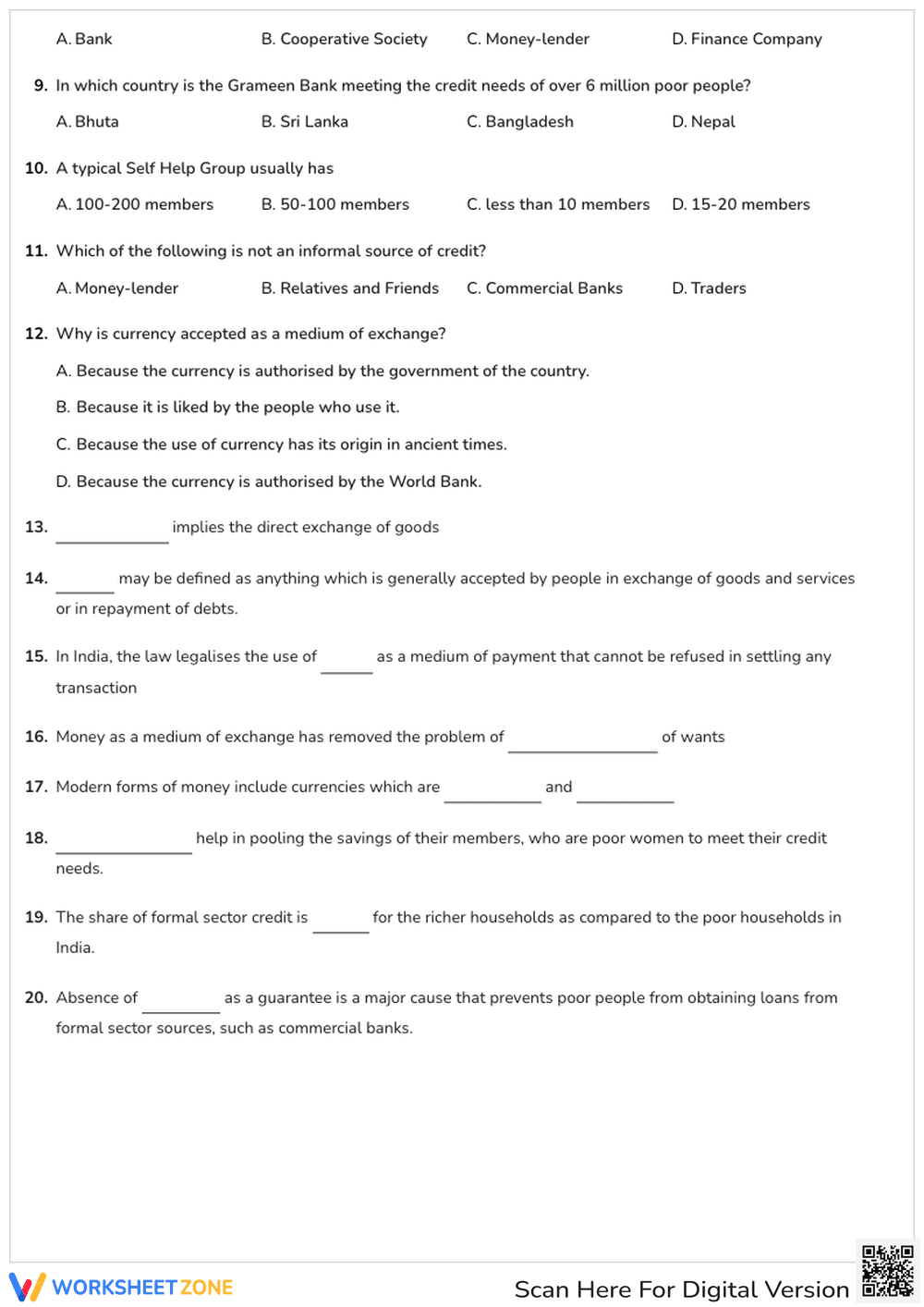
This Grade 10 economics worksheet provides a comprehensive assessment of money and credit systems. Students will demonstrate their understanding of banking operations, currency regulation, and the distinction between formal and informal credit sources. By completing these 20 targeted questions, learners solidify their grasp of how financial institutions facilitate economic stability and individual growth.
At a Glance
- Grade: 10 · Subject: Economics
- Standard:
HSS-EC.12.3— Analyze the role of financial institutions in a market economy- Skill Focus: Financial Literacy & Banking
- Format: 2 pages · 20 problems · Answer key included · PDF
- Best For: Formative assessment or unit review
- Time: 25–35 minutes
What's Inside: This two-page resource features a balanced mix of assessment styles to ensure thorough comprehension. The first section contains 12 multiple-choice questions focusing on the Reserve Bank of India (RBI), the mechanics of bank deposits, and the definition of collateral. The second section provides 8 fill-in-the-blank items that require students to recall specific terminology such as the barter system, Self Help Groups (SHGs), and the Grameen Bank model.
Zero-Prep Workflow:
- Print: Select the 2-page PDF and print enough copies for your class in under 1 minute.
- Distribute: Hand out the worksheets as a quiet bell-ringer or a mid-unit quiz with zero teacher setup required.
- Review: Use the included answer key to grade or facilitate a peer-review session to discuss the nuances of credit and debt in approximately 10 minutes.
Standards Alignment: This worksheet aligns with HSS-EC.12.3, which requires students to evaluate the functions of financial institutions and the impact of credit on economic participation. It specifically addresses how central regulators manage currency and how banks mediate between savers and borrowers. This standard code can be copied directly into lesson plans, IEP goals, or district curriculum mapping tools.
How to Use It: Assign this worksheet as a summative quiz after completing direct instruction on financial sectors. It also serves as an excellent study guide for end-of-term exams. For a formative assessment observation, check if students can correctly identify the difference between formal and informal credit sources in the fill-in-the-blank section. Expected completion time is 25 to 35 minutes.
Who It's For: This resource is designed for Grade 10 students studying social studies or economics. It is particularly useful for classrooms focusing on global banking models or national financial systems. It pairs naturally with a classroom anchor chart detailing the functions of a central bank or a lecture on the history of currency.
The HSS-EC.12.3 standard requires students to evaluate the functions of financial institutions and the impact of credit on economic participation. This worksheet addresses these requirements by testing knowledge on currency issuance, interest rate mechanics, and the role of central banks in supervising formal credit sectors. According to the RAND AIRS 2024 report on financial literacy in secondary education, structured assessments that combine multiple-choice recall with fill-in-the-blank conceptual application significantly improve long-term retention of economic terminology. By identifying the differences between collateral-based lending and informal credit, students develop the critical thinking skills necessary for managing real-world financial environments. This resource provides the necessary scaffolding to move students from basic definitions to an understanding of systemic economic oversight. The inclusion of 20 distinct items ensures a broad sampling of the curriculum, making it a reliable tool for measuring student mastery of essential economic principles.


