


























Views
Downloads
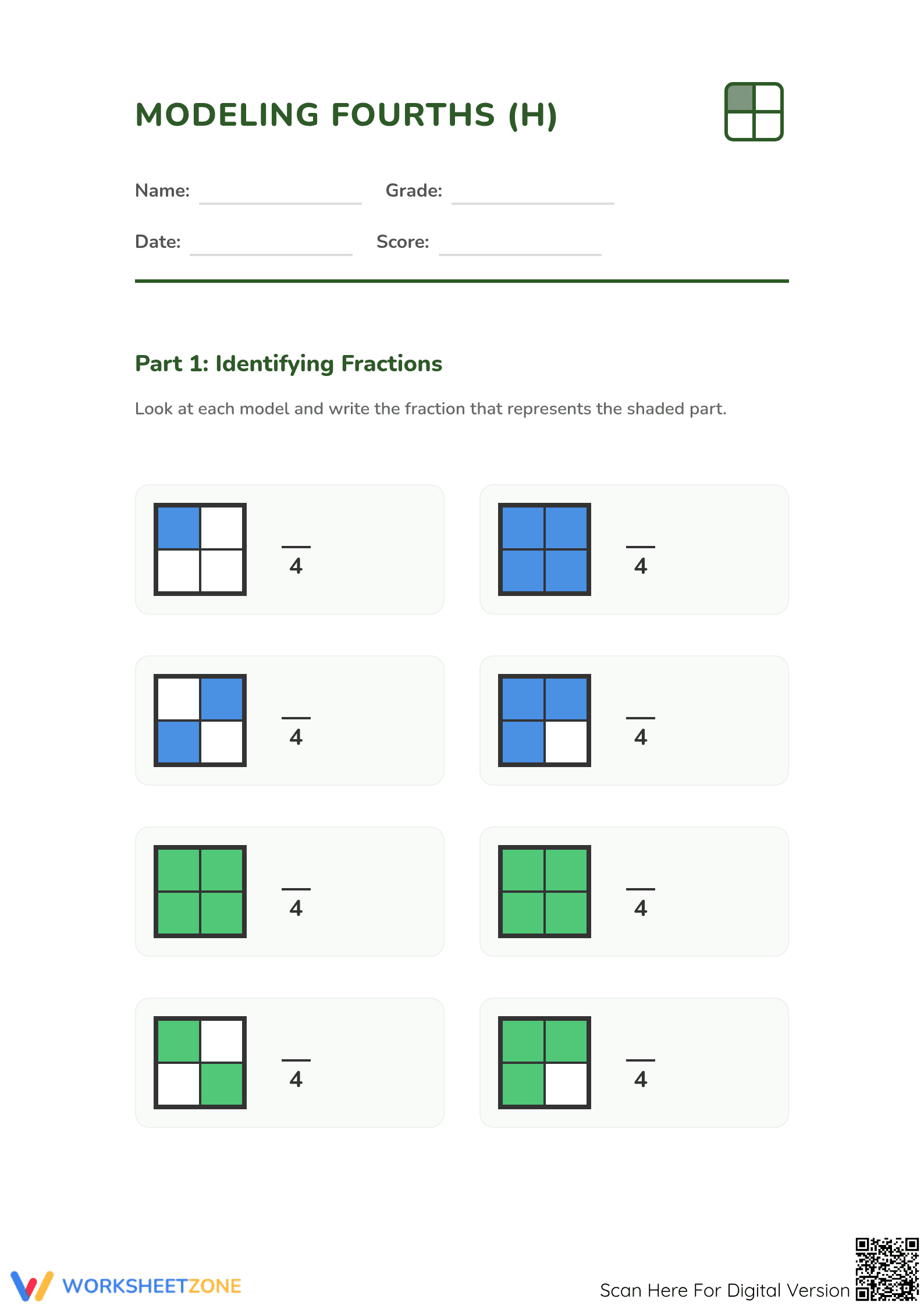


Printable Modeling Fourths Worksheet | Grade 3 Math
Paste this activity's link or code into your existing LMS (Google Classroom, Canvas, Teams, Schoology, Moodle, etc.).
Students can open and work on the activity right away, with no student login required.
You'll still be able to track student progress and results from your teacher account.
This Grade 3 math worksheet provides targeted practice for students learning to represent fractions using area models. By identifying shaded regions in 2x2 rectangular grids and solving contextual word problems, learners develop a concrete understanding of fourths as equal parts of a whole. This resource ensures students can confidently name and shade fractional units.
At a Glance
- Grade: 3 · Subject: Math
- Standard:
CCSS.MATH.CONTENT.3.NF.A.1— Understand a fraction 1/b as the quantity formed by 1 part- Skill Focus: Modeling fractions (fourths) with area models
- Format: 4 pages · 24 problems · Answer key included · PDF
- Best For: Independent practice and formative assessment
- Time: 20–30 minutes
What's Inside
This comprehensive 4-page PDF includes 18 identification tasks where students write the correct numerator for shaded rectangles. It also features 4 "Shade the Model" exercises covering 1/4 through 4/4 and two realistic word problems involving chocolate bars and pizza. The structured layout includes a clear name and score header, making it an excellent tool for tracking individual student progress.
Skill Progression
- Guided Practice: 18 initial problems focus on identifying fractions of a 2x2 grid, providing the denominator to scaffold student success as they determine the numerator.
- Supported Practice: 4 tasks require students to active shade blank models based on given fractions, shifting the cognitive load from recognition to representation.
- Independent Practice: Two word problems challenge students to draw their own models and solve for the fraction, applying their knowledge to real-world scenarios without visual prompts.
This resource follows a gradual-release model, moving from visual identification to independent application.
Standards Alignment
The primary standard addressed is CCSS.MATH.CONTENT.3.NF.A.1: "Understand a fraction 1/b as the quantity formed by 1 part when a whole is partitioned into b equal parts; understand a fraction a/b as the quantity formed by a parts of size 1/b." This worksheet specifically targets the visualization and modeling component of the standard. This standard code can be copied directly into lesson plans, IEP goals, or district curriculum mapping tools.
How to Use It
Use this worksheet as a mid-lesson check during your fractions unit to gauge student understanding of equal parts. During the activity, observe if students accurately count shaded regions or if they struggle with the 2x2 orientation. Expect most Grade 3 students to complete the full 4-page set in approximately 25 minutes during independent work time or as a homework assignment.
Who It's For
This resource is designed for general education Grade 3 students and can be used for RTI Tier 2 interventions for older students needing fraction remediation. Pair this worksheet with physical 2x2 plastic tiles or square counters to provide a tactile bridge for kinesthetic learners.
The CCSS.MATH.CONTENT.3.NF.A.1 standard requires students to transition from seeing numbers as whole units to understanding parts of a whole, a critical shift in mathematical reasoning. Research from the NAEP highlights that students who master area models in third grade show significantly higher proficiency in fraction multiplication and division in later years. This worksheet focuses on the fundamental skill of modeling fourths using rectangles, providing the structured repetition necessary for cognitive encoding. By integrating word problems with visual tasks, the resource supports the "Concrete-Representational-Abstract" sequence advocated by Fisher & Frey (2014) to build deep conceptual understanding. Educators can utilize these 24 tasks to verify that learners have moved beyond simple counting to recognizing the relationship between shaded parts and the partitioned whole body.


