


























Views
Downloads



Printable Fractions Modeling Worksheet | Grade 3-5 Math
Paste this activity's link or code into your existing LMS (Google Classroom, Canvas, Teams, Schoology, Moodle, etc.).
Students can open and work on the activity right away, with no student login required.
You'll still be able to track student progress and results from your teacher account.
This comprehensive fractions worksheet helps Grade 3-5 students master the concept of fractional parts through visual rectangle models. By shading and identifying segments, learners bridge the gap between abstract numbers and concrete area models, ensuring a deep understanding of how numerators and denominators represent parts of a single whole unit.
At a Glance
- Grade: 3–5 · Subject: Math
- Standard:
CCSS.MATH.CONTENT.3.NF.A.1— Understand a fraction as parts of a whole partitioned into equal parts- Skill Focus: Visualizing fractions using area models
- Format: 5 pages · 17 problems · Answer key included · PDF
- Best For: Independent practice and formative assessment tasks
- Time: 20–30 minutes
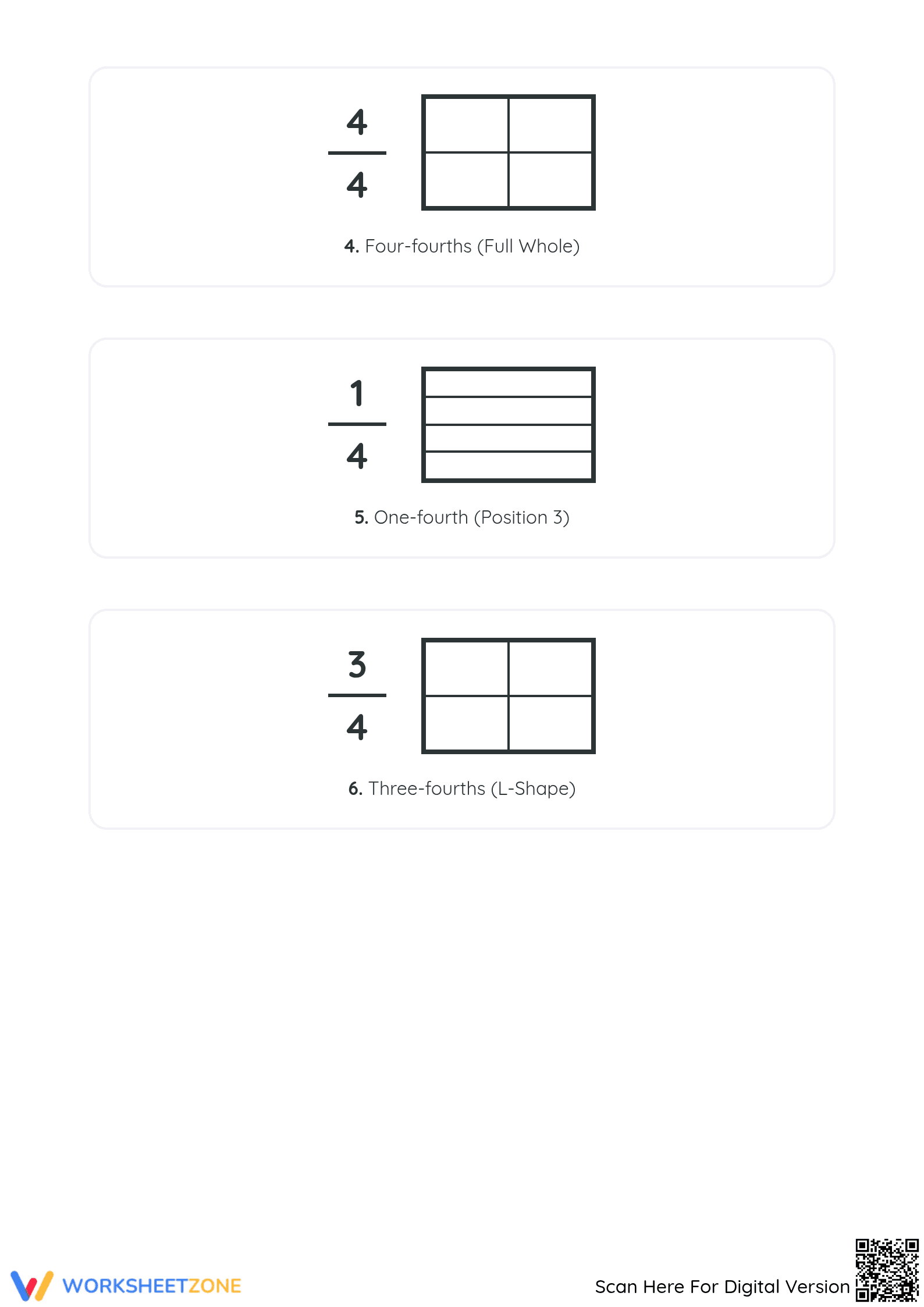
This 5-page PDF packet contains 17 structured tasks designed to build fluency with unit and non-unit fractions. The first two parts focus on active modeling, where students shade rectangles divided into fourths, fifths, and sixths. The final section reverses the cognitive demand, asking students to identify and write the numerical fraction represented by pre-shaded models.
Skill Progression
- Guided practice: The initial tasks provide clear labels and simple 2x2 or 1x4 grids, allowing students to focus on the shading process for 6 introductory problems.
- Supported practice: Middle tasks introduce more complex denominators, including fifths and sixths in varied vertical and horizontal layouts across 6 additional exercises.
- Independent practice: The final 5 tasks remove the numerical prompt, requiring students to independently analyze shaded regions and write the corresponding fraction or equivalent whole.
This progression follows the gradual-release model, moving from scaffolded shading to independent identification.
Standards Alignment
The resource aligns with CCSS.MATH.CONTENT.3.NF.A.1, focusing on understanding a fraction a/b as the quantity formed by 'a' parts of size 1/b. It also supports 4.NF.A.1 by laying the visual groundwork for equivalent fractions. Both standard codes can be copied directly into lesson plans, IEP goals, or district curriculum mapping tools.
How to Use It
Assign this worksheet during the independent practice phase of a lesson on area models to observe how students handle non-standard grid orientations. A useful formative-assessment observation tip is to check if students count the total number of partitions before shading the numerator. Completion usually takes 20–30 minutes for most elementary students.
Who It's For
This resource is ideal for third through fifth-grade students beginning their fraction journey. It pairs naturally with a lesson on fraction bars or a physical manipulative activity to reinforce the concept of equal-sized parts within a fixed whole.
The CCSS.MATH.CONTENT.3.NF.A.1 standard emphasizes the conceptual understanding of fractions as a result of partitioning a whole into equal-sized segments. This worksheet supports this development by requiring students to interact with rectangle models in multiple orientations, reinforcing the skill of representing part-to-whole relationships visually. According to the RAND AIRS 2024 report on mathematics instructional materials, the use of diverse visual representations—such as the horizontal, vertical, and grid-based rectangles found in this resource—is critical for preventing student misconceptions about fraction magnitude. By moving from shading predefined areas to identifying shaded regions, the resource facilitates the cognitive shift from concrete visualization to abstract numerical representation. This structural approach ensures that learners develop a robust internal model of fractional units, which is essential for success in later operations with rational numbers. Educators can rely on this aligned resource to provide the high-quality, structured practice necessary for building foundational mathematical fluency.


