


























Views
Downloads



Modeling Fractions with Rectangles | Essential Grade 3 Math
Paste this activity's link or code into your existing LMS (Google Classroom, Canvas, Teams, Schoology, Moodle, etc.).
Students can open and work on the activity right away, with no student login required.
You'll still be able to track student progress and results from your teacher account.
Help your third graders master the visual representation of fractions with this comprehensive modeling worksheet. By using rectangular area models, students transition from identifying shaded parts to drawing their own fractional representations. This resource ensures students understand that fractions represent parts of a single whole body, building a solid foundation for future fraction arithmetic and comparison tasks.
At a Glance
- Grade: 3 · Subject: Math
- Standard:
CCSS.MATH.CONTENT.3.NF.A.1— Understand a fraction 1/b as the quantity formed by 1 part when a whole is partitioned.- Skill Focus: Rectangular Fraction Models
- Format: 5 pages · 22 problems · Answer key included · PDF
- Best For: Small group instruction or independent practice
- Time: 25–35 minutes
What's Inside
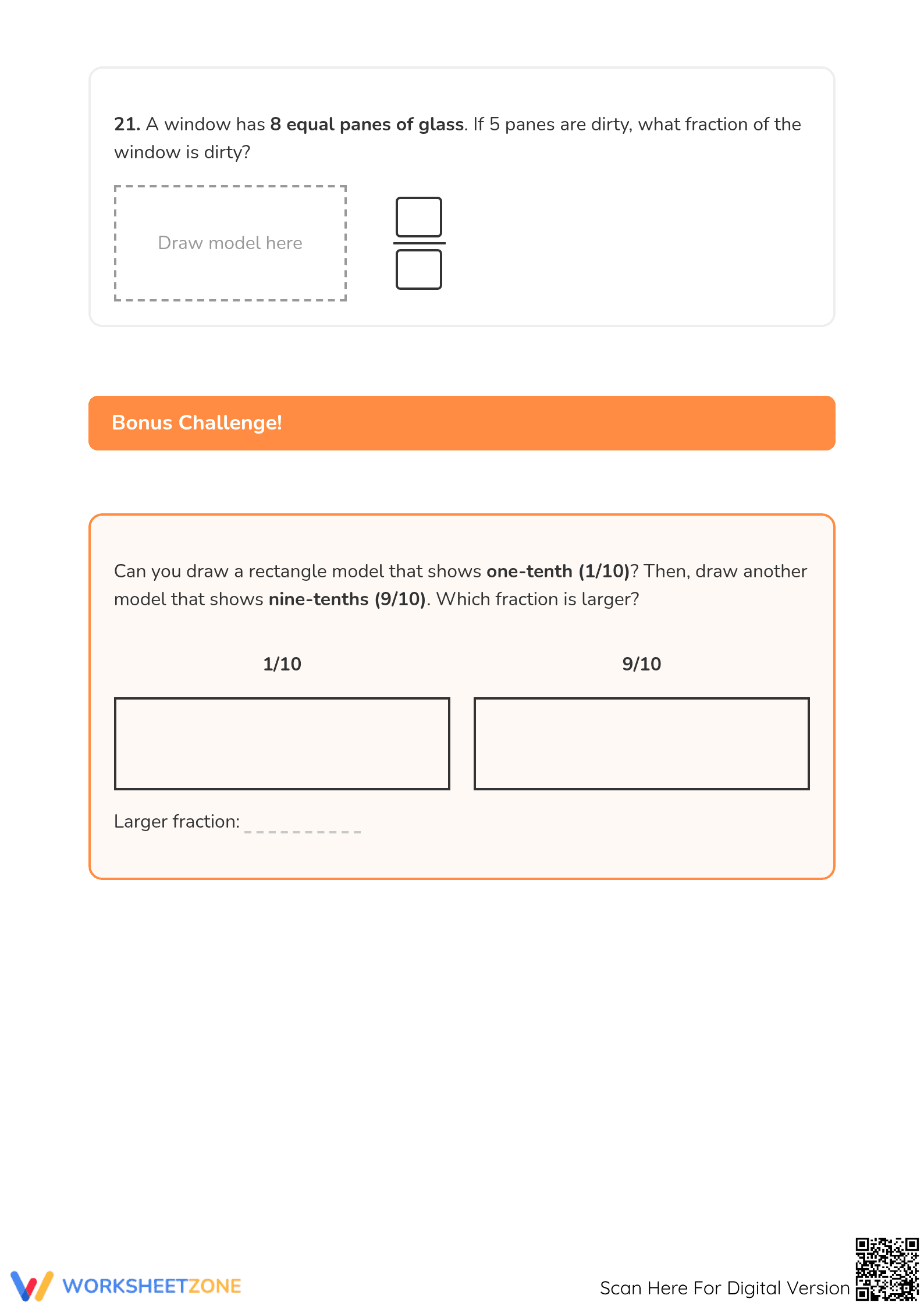
This 5-page PDF contains a rigorous sequence of 22 problems designed to cement fraction fluency. Students begin with identifying fractions from pre-partitioned models, move to shading specific values, and eventually progress to partitioning their own rectangles. The set concludes with multi-step word problems and a high-order bonus challenge comparing 1/10 and 9/10. A complete answer key is provided for rapid grading.
Skill Progression
- Guided Practice: 8 problems provide partitioned rectangles where students identify the numerator and denominator using clear visual cues and boxes.
- Supported Practice: 4 problems require shading pre-partitioned models, while 6 problems ask for manual partitioning with specified denominators.
- Independent Practice: 3 multi-step word problems and a comparison challenge require students to translate text into models without scaffolds.
This sequence supports a gradual-release instructional model, moving from teacher-led I Do to student-driven You Do tasks.
Standards Alignment
This resource is aligned with CCSS.MATH.CONTENT.3.NF.A.1. This standard requires students to understand a fraction as the quantity formed by parts of a partitioned whole. By focusing on the relationship between shaded segments and total parts, this bridges the gap between visuals and notation. Standard codes can be copied directly into lesson plans, IEP goals, or district curriculum mapping tools.
How to Use It
Use this worksheet during the practice phases of a lesson on fractions. It serves as a formative assessment tool; observe problem 13 to see if students partition a rectangle into five equal segments accurately. This indicates mastery of spatial reasoning alongside mathematical understanding. Expect completion in roughly 30 minutes during a standard math block.
Who It's For
This practice set is ideal for Grade 3 students or as an intervention for Grade 4. It pairs naturally with physical fraction tiles or an anchor chart. The word problems provide an entry point for English Language Learners by providing context-rich scenarios like brownies and gardens that are easy to visualize.
The use of rectangular area models is a proven instructional strategy for developing early fraction sense. Research from the RAND AIRS 2024 report emphasizes that visual representations, such as the ones featured in this 5-page CCSS.MATH.CONTENT.3.NF.A.1 worksheet, are critical for students to recognize that fractions represent specific quantities rather than just two unrelated numbers. By progressing from identification to self-generated partitioning, students build the cognitive schema necessary for more complex operations. The inclusion of word problems further validates this approach by applying fractional concepts to real-world contexts, a method supported by recent NAEP data on student performance in rational number reasoning. This resource provides a structured, standards-aligned pathway for students to demonstrate proficiency in identifying and modeling fractions using equal-sized segments of a rectangular whole, ensuring they are prepared for high-stakes assessments and future mathematical challenges.


