


























Views
Downloads


Printable Modeling Fractions with Groups of Shapes Worksheet
Paste this activity's link or code into your existing LMS (Google Classroom, Canvas, Teams, Schoology, Moodle, etc.).
Students can open and work on the activity right away, with no student login required.
You'll still be able to track student progress and results from your teacher account.
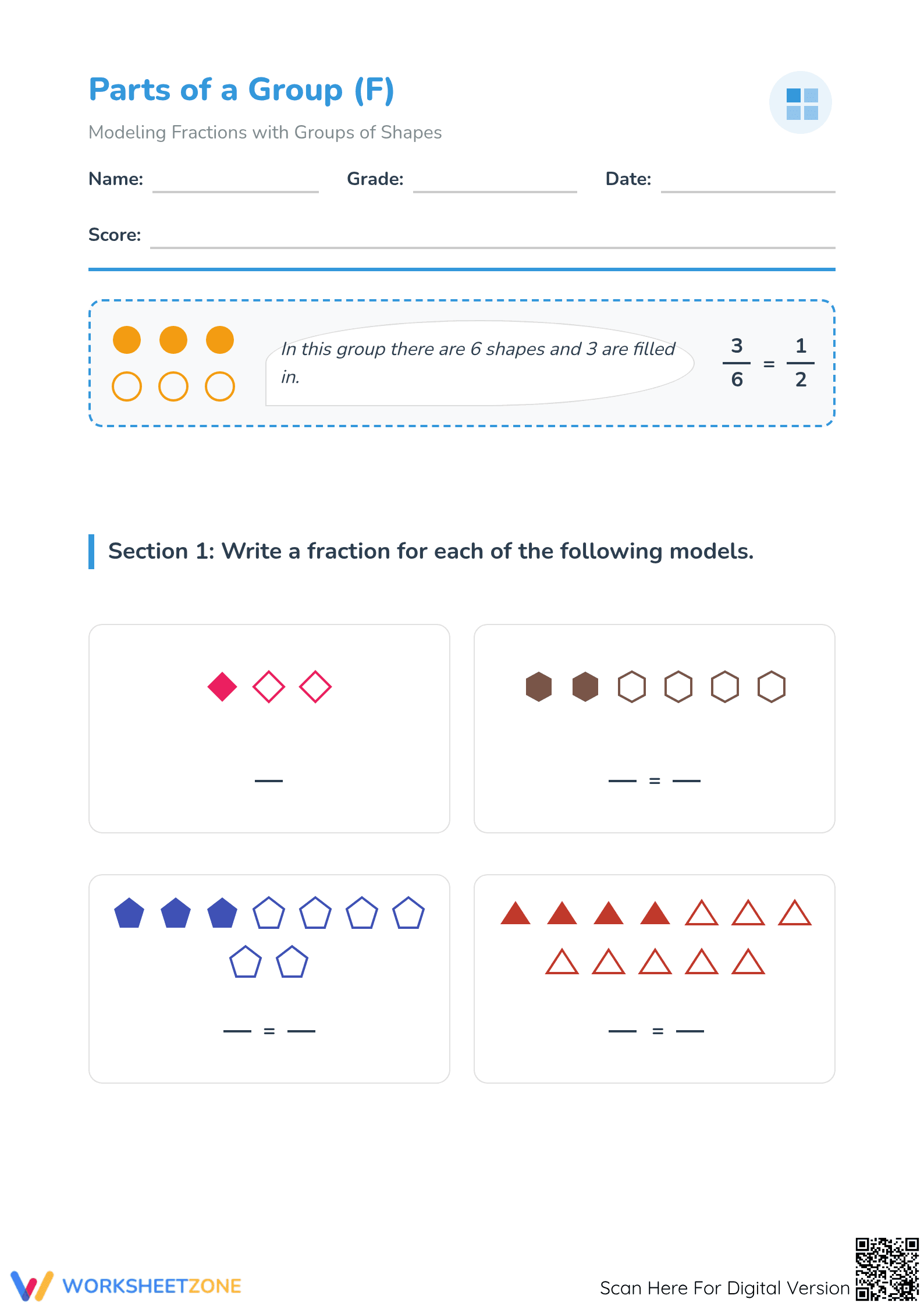
This comprehensive 4-page math worksheet helps students master the concept of fractions as parts of a set or group. By using familiar geometric shapes, learners visualize how numerators represent specific subsets while denominators define the total group size. Students transition from identifying existing models to creating their own, ensuring a deep conceptual understanding of fractional relationships.
At a Glance
- Grade: 3–5 · Subject: Math (Fractions)
- Standard:
CCSS.MATH.CONTENT.3.NF.A.1— Identify how numerators and denominators represent parts of a whole set- Skill Focus: Modeling fractions with groups of shapes
- Format: 4 pages · 16 problems · Answer key included · PDF
- Best For: Small group instruction and independent practice
- Time: 25–40 minutes
This resource contains sixteen targeted problems across four distinct sections. The first two pages focus on identifying and writing fractions from visual models, including complex sets with multiple shapes. The third page challenges students to draw missing shapes to complete specific fractional values. The final page introduces advanced group modeling, pushing learners to think critically about larger sets and varied configurations.
Skill Progression
- Guided practice: The first six problems provide clear visual models where students simply identify the shaded subset and total count to form a fraction.
- Supported practice: The next four problems require students to apply their knowledge to larger, more varied groups of shapes with less scaffolding.
- Independent practice: The final six problems require students to generate their own models or solve advanced grouping scenarios without prompts.
This progression ensures students master the fundamental "part-to-whole" ratio before moving to abstract symbols using a gradual release of responsibility model.
Standards Alignment
The primary focus aligns with `CCSS.MATH.CONTENT.3.NF.A.1`, which requires students to understand a fraction a/b as the quantity formed by a parts of size 1/b. It also supports 4.NF.A.1 through its inclusion of equivalent fraction examples in the instructional header. Both standard codes can be copied directly into lesson plans, IEP goals, or district curriculum mapping tools.
How to Use It
Use this worksheet during the guided practice phase of a lesson on fractions. Observe if students confuse the number of shaded shapes with the number of unshaded shapes when writing the numerator. It also serves as an excellent formative assessment tool after direct instruction. Expect most Grade 3 and 4 students to complete the full 4-page set within 35 minutes.
Who It's For
This resource is designed for elementary students in grades 3 through 5 who are beginning their journey with fractional concepts. It is particularly beneficial for visual learners and students requiring concrete representations of abstract math. Pair this worksheet with physical manipulatives like pattern blocks or counting bears to provide a tactile bridge to the on-paper tasks.
Effective math instruction relies on visual representations to bridge the gap between concrete objects and abstract numerical symbols. This worksheet leverages geometric modeling to solidify the concept of fractions as parts of a group, a critical precursor to operating with rational numbers. By requiring students to both identify and draw sets, the resource engages dual-coding mechanisms that enhance long-term retention of mathematical properties. According to Fisher & Frey (2014), the gradual release of responsibility model employed here moving from recognition to production is essential for developing student agency in STEM subjects. The alignment with CCSS.MATH.CONTENT.3.NF.A.1 ensures that learners are building a foundation compatible with rigorous state and national assessments. This 4-page set provides sufficient repetition to achieve fluency in fraction identification while maintaining high engagement through varied shape sets. It is a reliable tool for classroom teachers and interventionists seeking evidence-based practice materials.


