




























Views
Downloads

Printable Mixed Numbers to Decimals Math Worksheet Grade 6-7

Paste this activity's link or code into your existing LMS (Google Classroom, Canvas, Teams, Schoology, Moodle, etc.).
Students can open and work on the activity right away, with no student login required.
You'll still be able to track student progress and results from your teacher account.
This comprehensive math worksheet provides targeted practice for Grade 6 and Grade 7 students learning to convert mixed numbers into their decimal equivalents. By bridging the gap between fractional parts and decimal place value, students develop essential fluency in rational number representation. This tool ensures learners can confidently move between numerical formats for advanced calculations.
At a Glance
- Grade: 6–7 · Subject: Math · Decimals
- Standard:
7.NS.A.2.d— Convert a rational number to a decimal using long division and recognize patterns- Skill Focus: Mixed number to decimal conversion
- Format: 4 pages · 64 problems · Answer key included · PDF
- Best For: Focused independent practice and homework reinforcement
- Time: 20–35 minutes
What's Inside
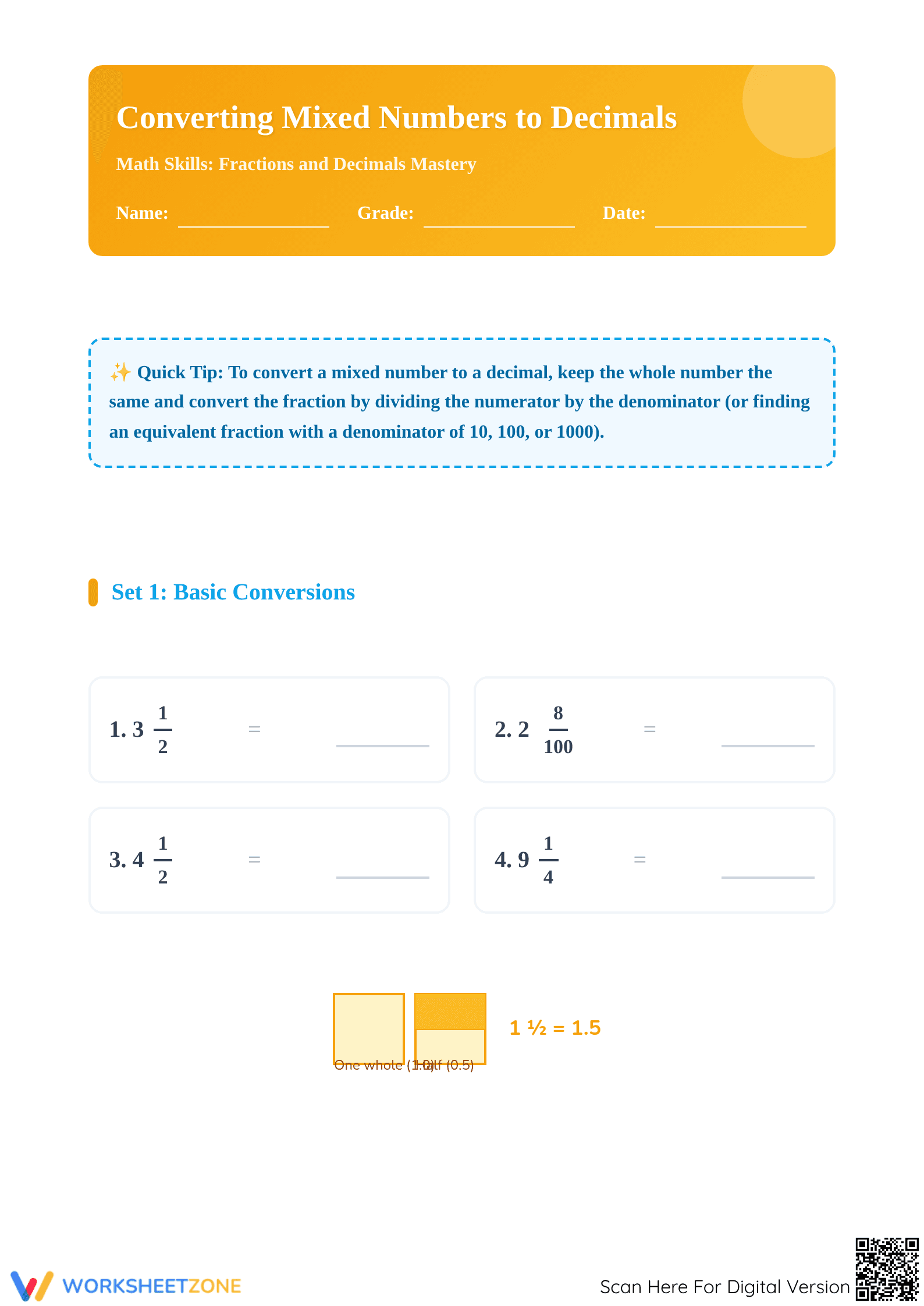
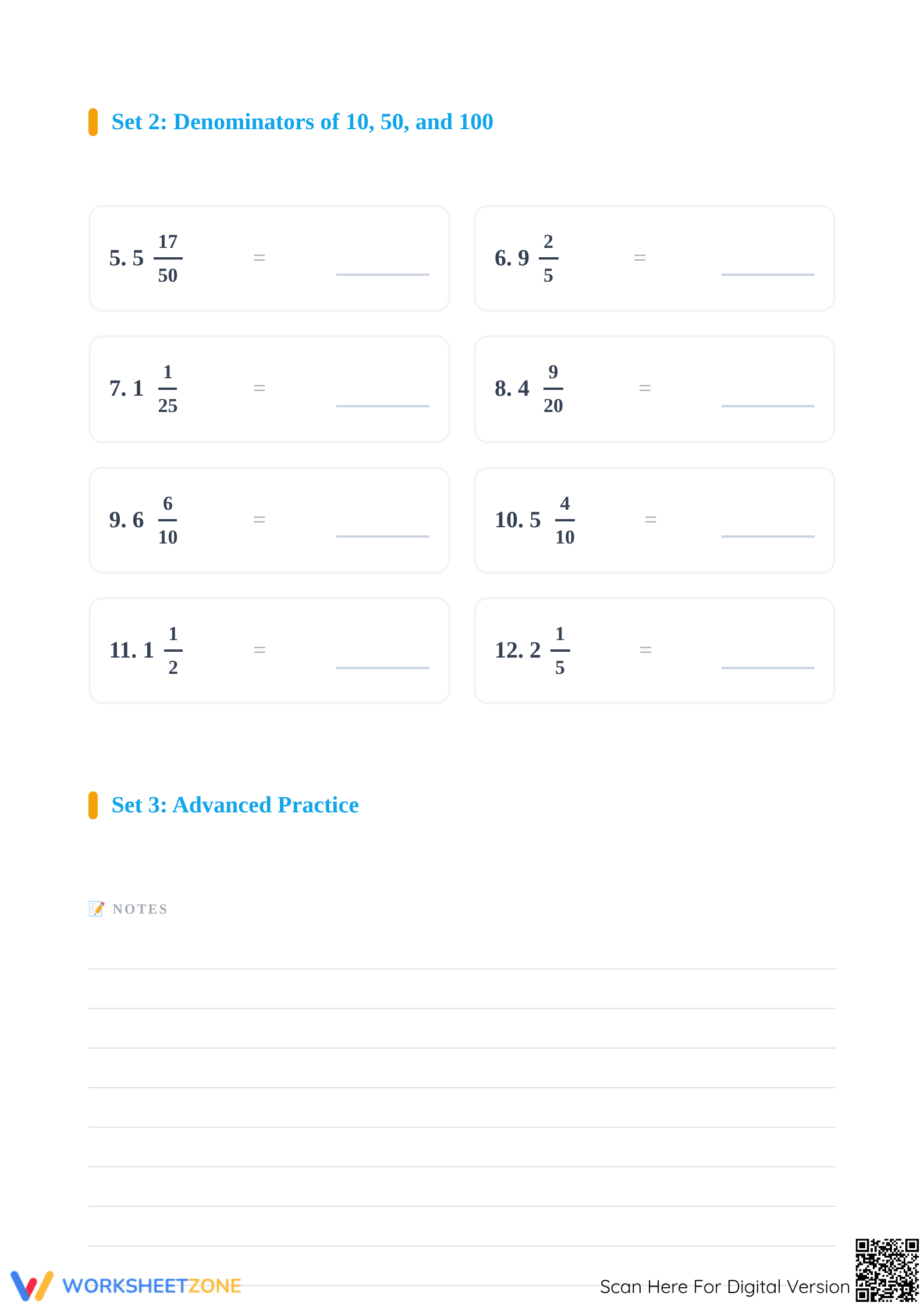
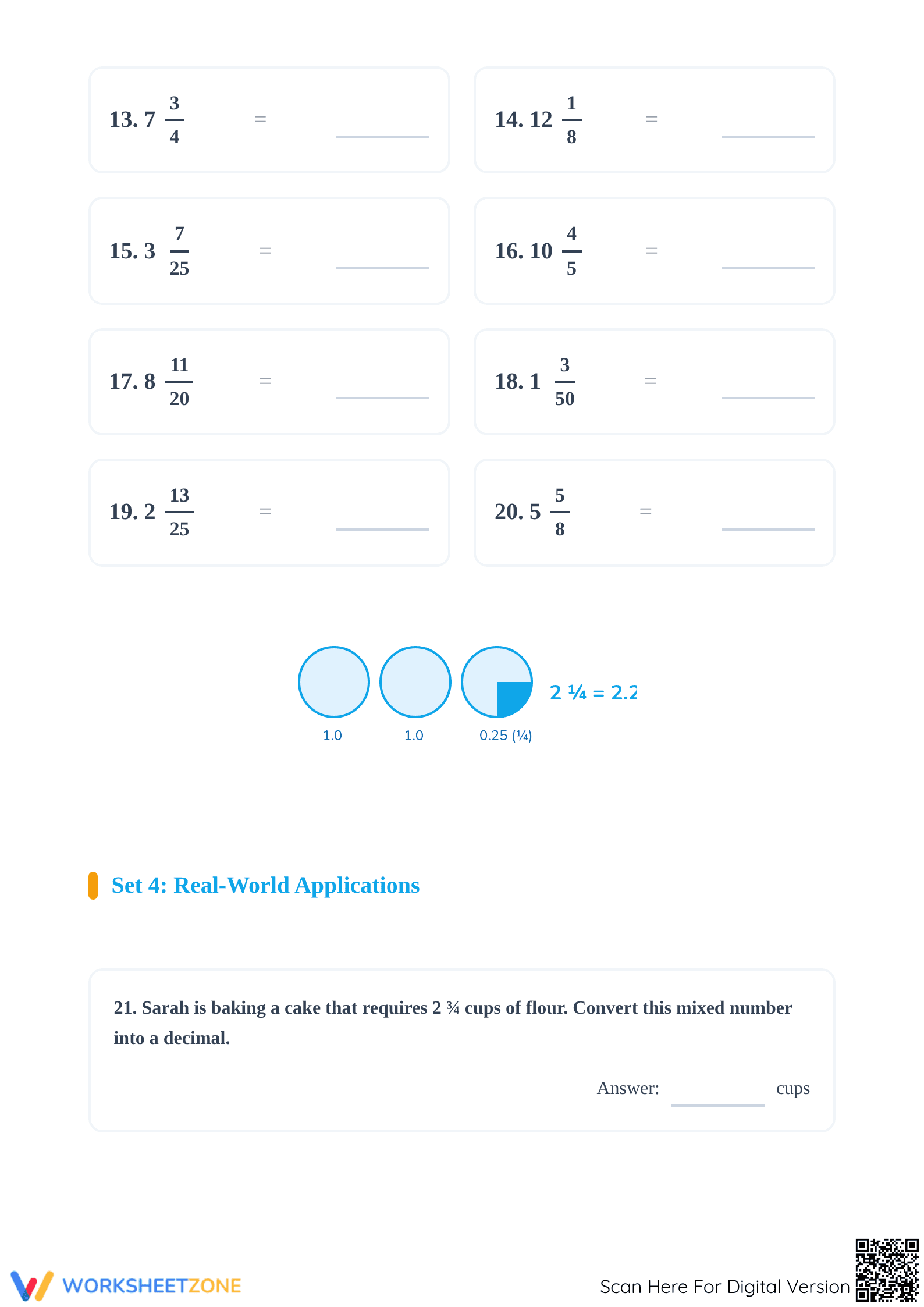
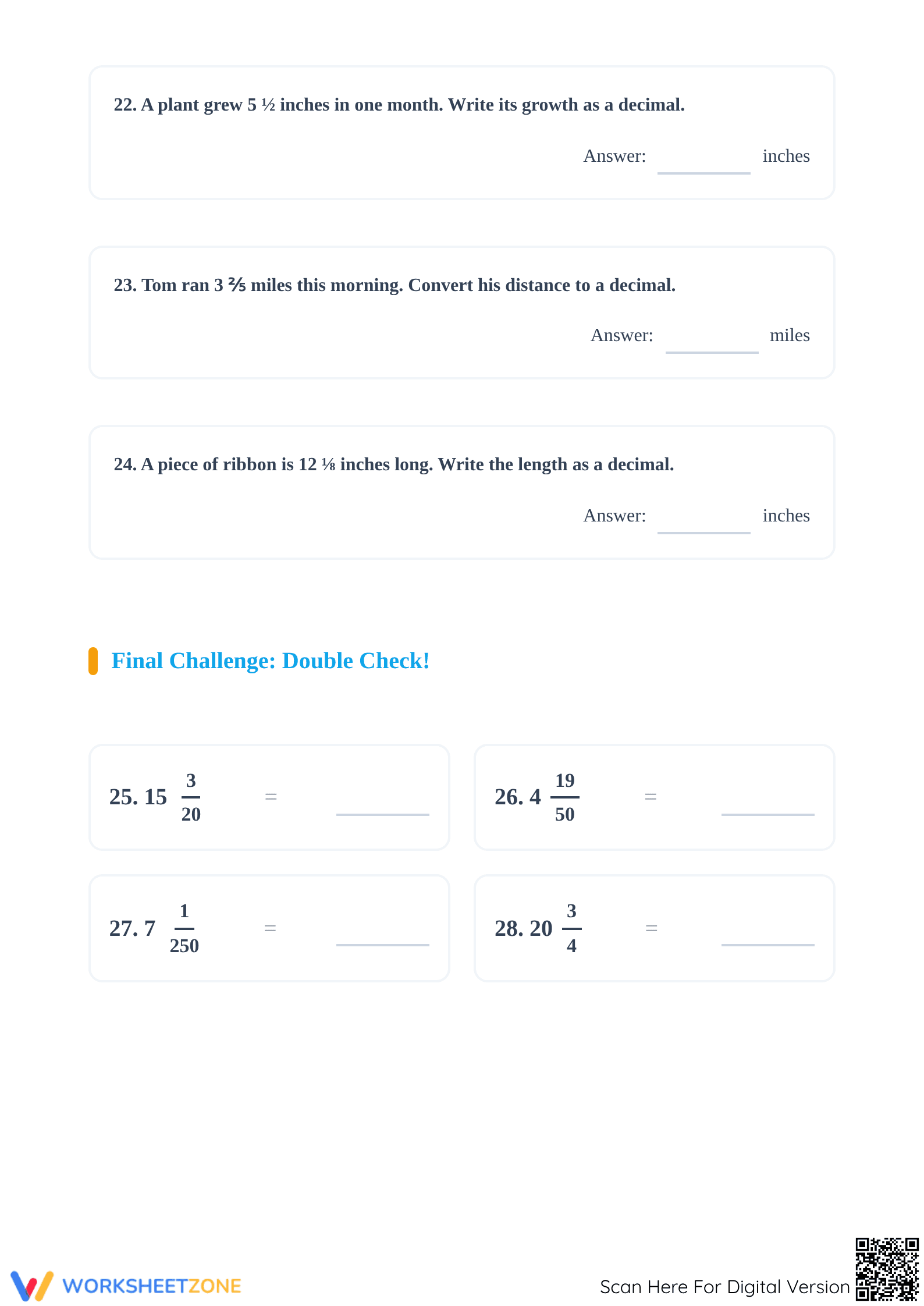
This resource contains four distinct pages, each featuring 16 problems structured into a clean, two-column layout. Students are presented with mixed numbers featuring common denominators like 2, 4, 5, and 10, alongside more challenging ones such as 8, 20, and 25. The generous white space allows for clear student work, and the included multi-page answer key makes grading or self-correction immediate and accurate.
Skill Progression
- Guided practice: The initial problems utilize denominators that easily relate to tenths and hundredths, allowing students to visualize the conversion process through equivalent fractions.
- Supported practice: Mid-level tasks introduce denominators like 8 and 20, requiring students to use either long division or scaling techniques to find the terminating decimal value.
- Independent practice: The final pages offer a high volume of varied problems to cement the algorithm into long-term memory, ensuring students achieve automaticity with common rational conversions.
This structure follows a gradual-release model to transition students from conceptual understanding to procedural mastery.
Standards Alignment
This resource is directly aligned to `7.NS.A.2.d`: "Convert a rational number to a decimal using long division; know that the decimal form of a rational number terminates in 0s or eventually repeats." Mastery of this standard is a critical prerequisite for success in pre-algebra. Both standard codes can be copied directly into lesson plans, IEP goals, or district curriculum mapping tools.
How to Use It
Assign this worksheet as a focused follow-up to a direct instruction lesson on long division or fraction-decimal equivalency. For a formative assessment, observe students as they work through the first column; if they struggle to scale denominators, prompt them to use long division as a universal strategy. The high task count makes it suitable for timed fluency drills or multi-day homework assignments.
Who It's For
This worksheet is ideal for Grade 6 and Grade 7 students in general education settings, as well as Grade 8 students requiring remediation in rational number operations. It pairs naturally with a conversion anchor chart or a lesson on terminating versus repeating decimals. The structured format also supports students with executive functioning needs by providing a predictable, repetitive task flow.
Aligned with the NAEP framework, this worksheet develops fundamental mathematical literacy by fostering procedural fluency in converting mixed numbers to decimals. This practice, supported by research (Fisher & Frey, 2014), frees cognitive resources for higher-order problem-solving. The 64 targeted tasks directly address the 7.NS.A.2.d standard, building essential scaffolding for understanding the real number system and preparing students for algebraic reasoning. These structured exercises ensure students meet middle school standards.


