


























Views
Downloads

Missing Numbers to 30 Worksheet | Printable Math Guide
Paste this activity's link or code into your existing LMS (Google Classroom, Canvas, Teams, Schoology, Moodle, etc.).
Students can open and work on the activity right away, with no student login required.
You'll still be able to track student progress and results from your teacher account.
This "Missing Numbers Up to 30" worksheet helps young learners master number sequencing and recognition through a variety of engaging exercises. By filling in blanks and matching words to numerals, students solidify their understanding of the base-ten system. This resource is designed to build foundational fluency in early elementary mathematics.
At a Glance
- Grade: K–1 · Subject: Math
- Standard:
K.CC.A.2— Count forward beginning from a given number within the known sequence- Skill Focus: Number sequencing and recognition up to 30
- Format: 2 pages · 35 problems · Answer key included · PDF
- Best For: Independent practice or morning work
- Time: 15–20 minutes
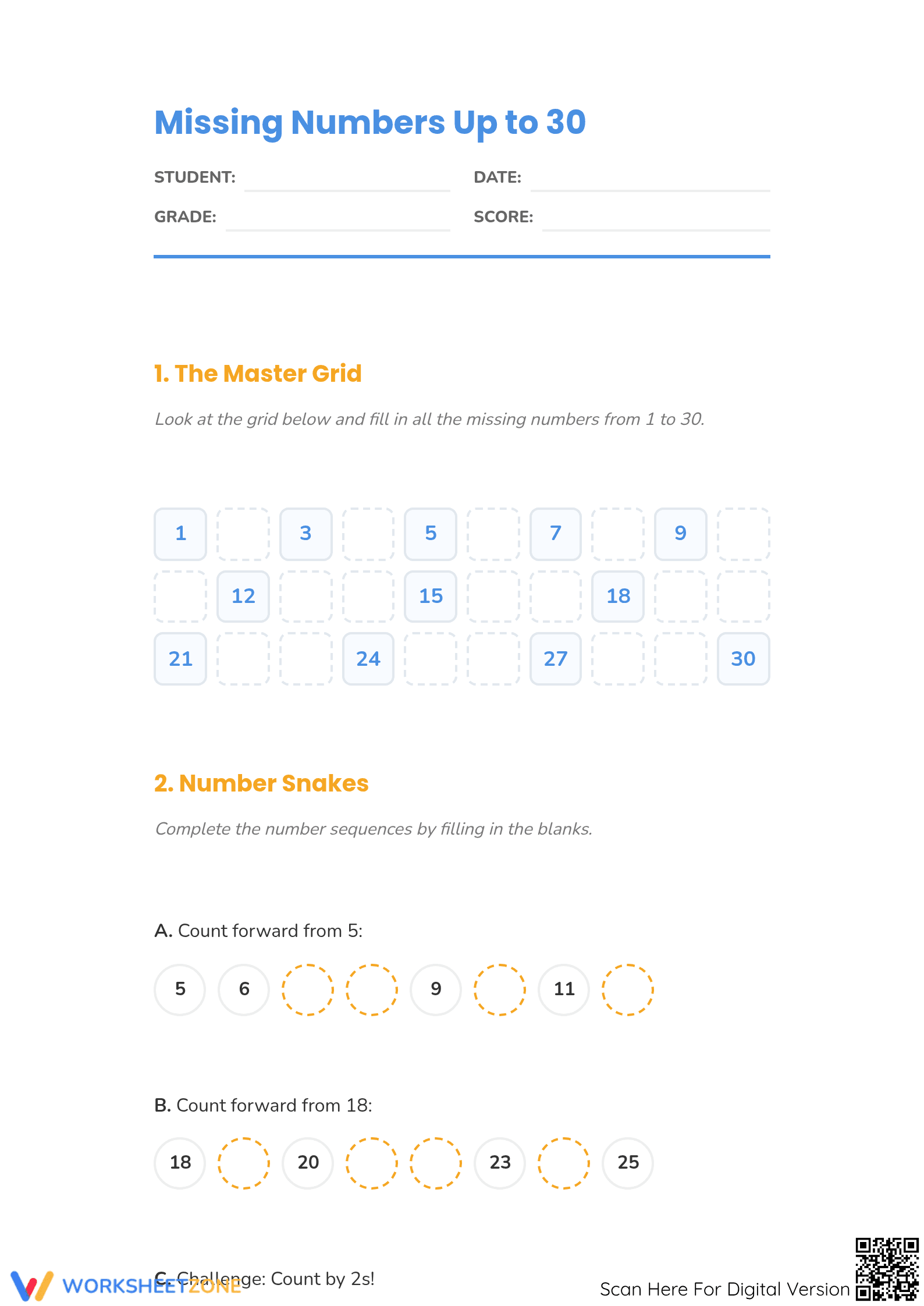
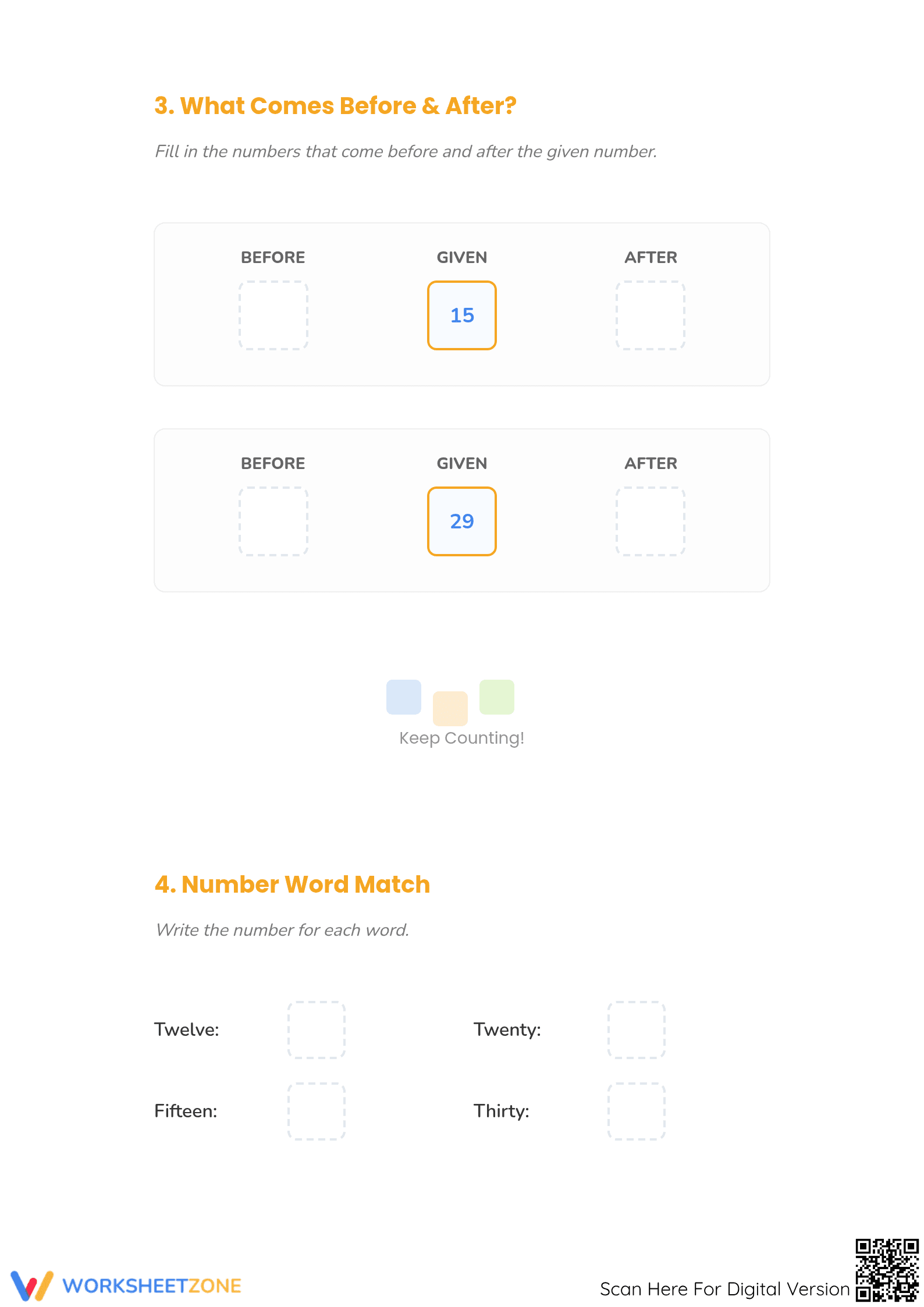
This two-page PDF features four distinct sections: a "Master Grid" for whole-sequence practice, "Number Snakes" for counting forward, "Before & After" for relative position, and a "Number Word Match" for literacy integration. It includes a comprehensive answer key for quick grading and a clear, distraction-free layout optimized for printing.
Skill Progression
- Guided Practice: The Master Grid provides a 1-30 framework with frequent anchors, allowing students to orient themselves within the sequence while filling in 15 missing values.
- Supported Practice: Number Snakes and Before/After tasks provide starting points (like 5 or 18) and require students to apply counting logic across shorter, focused sequences.
- Independent Practice: The Number Word Match challenges students to decode text (e.g., "Twelve") and represent it numerically, demonstrating a higher level of cognitive transfer.
This gradual-release approach moves from visual scaffolding to independent conceptual application, following the "I Do, We Do, You Do" instructional model.
Standards Alignment
The primary standard addressed is `K.CC.A.2`: "Count forward beginning from a given number within the known sequence (instead of having to begin at 1)." Additionally, it supports `K.CC.A.3` by requiring students to write numbers from 0 to 20 (and beyond to 30) to represent a number of objects or positions. Both standard codes can be copied directly into lesson plans, IEP goals, or district curriculum mapping tools.
How to Use It
Use this worksheet as a formative assessment after introducing the numbers 21-30. It works exceptionally well as a "morning work" activity to settle students into the math block. Teachers should observe if students are counting from one each time or "counting on" from the provided anchors, which provides valuable data on their level of number sense development. Expected completion time is 15-20 minutes.
Who It's For
This resource is tailored for Kindergarten and early Grade 1 students. It is also an excellent intervention tool for older students who need targeted practice with bridging tens (e.g., 19 to 20). Pair this worksheet with a 1-100 pocket chart or a physical number line for students who require additional visual or tactile support.
The "Missing Numbers Up to 30" worksheet is meticulously designed to support the development of counting and cardinality, specifically targeting the `K.CC.A.2` standard. Research by Fisher & Frey (2014) emphasizes the importance of the gradual release of responsibility in early literacy and numeracy, a principle reflected in this worksheet's progression from a heavily scaffolded grid to independent word-matching tasks. By focusing on the 1-30 range, the resource bridges the critical gap between basic counting and the mastery of the base-ten system, a prerequisite for more complex operations. The inclusion of number words further integrates mathematical symbols with linguistic representations, enhancing overall cognitive fluency. This comprehensive approach ensures that students not only memorize sequences but also understand the relative position and value of numbers. Educators can rely on this vetted structure to provide high-quality, research-backed practice that aligns with state and national frameworks for early childhood mathematics education.


