




























Views
Downloads
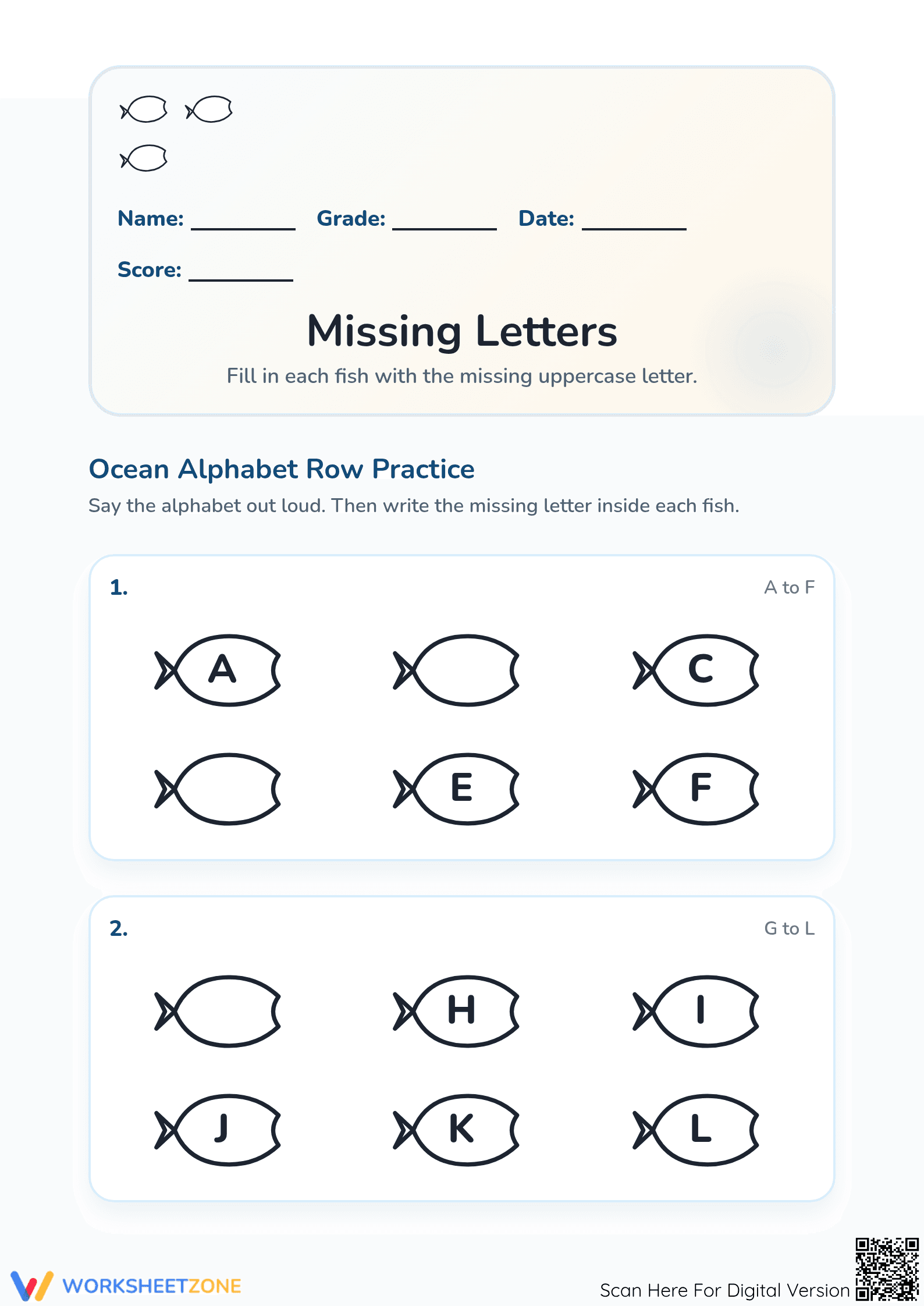


Printable Missing Letters Alphabet Worksheet | Preschool

Paste this activity's link or code into your existing LMS (Google Classroom, Canvas, Teams, Schoology, Moodle, etc.).
Students can open and work on the activity right away, with no student login required.
You'll still be able to track student progress and results from your teacher account.
Mastering the sequence of the alphabet is a fundamental building block for early literacy development. This Essential Missing Letters worksheet provides preschool students with a structured way to practice uppercase letter recognition and alphabetical order through engaging, ocean-themed activities. By completing these exercises, learners solidify their understanding of the ABC sequence, preparing them for future reading success.
At a Glance
- Grade: Preschool · Subject: ELA
- Standard:
CCSS.ELA-LITERACY.RF.K.1.D— Identify and name uppercase letters in alphabetical sequence- Skill Focus: Alphabetical Order & Letter Recognition
- Format: 3 pages · 12 tasks · Answer key included · PDF
- Best For: Literacy centers and early morning work
- Time: 15–20 minutes
This comprehensive three-page PDF features 26 ocean-themed graphic organizers shaped like fish to represent the full alphabet. Students encounter five distinct sections of row practice where they must identify and write eight missing uppercase letters. Additionally, the worksheet includes a specialized Bonus Letter Check section with four tasks that challenge students to identify the letter that belongs between two others, reinforcing relative sequencing skills. A complete answer key is provided for quick evaluation.
Skill Progression
- Guided Practice: The worksheet begins with task rows A-L, providing a high density of provided letters (10 out of 12) to scaffold the initial sequencing process.
- Supported Practice: Students transition to rows M-Z, where the number of anchors decreases, requiring more independent recall of the alphabetical string and the production of several missing letters.
- Independent Practice: The Bonus Letter Check removes the surrounding context entirely, asking students to generate the middle letter of a three-letter sequence without a full row for reference.
This scaffolded approach ensures that students build confidence before tackling isolated sequencing challenges through a classic I Do, We Do, You Do instructional model.
Standards Alignment
The primary standard addressed is `CCSS.ELA-LITERACY.RF.K.1.D`, which requires students to recognize and name all upper- and lowercase letters of the alphabet. This worksheet specifically targets the identification and production of uppercase letters within their traditional sequence. Both standard codes can be copied directly into lesson plans, IEP goals, or district curriculum mapping tools to ensure instructional accountability.
How to Use It
Use this worksheet as a formative assessment during your literacy block after introducing the alphabet song. A teacher can observe students as they work, noting which specific letter transitions, such as Q-R-S, cause hesitation. It also serves as an excellent Fast Finisher activity or a quiet sub-plan resource that requires zero teacher preparation time beyond printing the document.
Who It's For
This resource is designed for preschool learners, though it is equally effective for Kindergarten students needing extra reinforcement or ESL/ELL students learning the English alphabet for the first time. It pairs naturally with an alphabet anchor chart or a classroom read-aloud of an ABC book to provide a cohesive learning experience.
Research from EdReports 2024 emphasizes that systematic practice with letter recognition and alphabetical sequence is critical for developing phonological awareness in early childhood. This worksheet aligns with evidence-based practices by providing repetitive, scaffolded opportunities for students to engage with the symbolic representation of the English language. By focusing on uppercase letters in isolation, the resource reduces cognitive load, allowing students to focus purely on the sequence and form of the characters. Fisher & Frey (2014) highlight the importance of guided release in early literacy, a principle reflected in the transition from row-based practice to isolated letter checks. Utilizing this standard-aligned tool ensures that Preschool and Kindergarten classrooms meet the benchmarks necessary for transition into phonics instruction.


