


























Views
Downloads

Printable Miss Antrobus Poem Worksheet | Grade 6-7 ELA
Paste this activity's link or code into your existing LMS (Google Classroom, Canvas, Teams, Schoology, Moodle, etc.).
Students can open and work on the activity right away, with no student login required.
You'll still be able to track student progress and results from your teacher account.
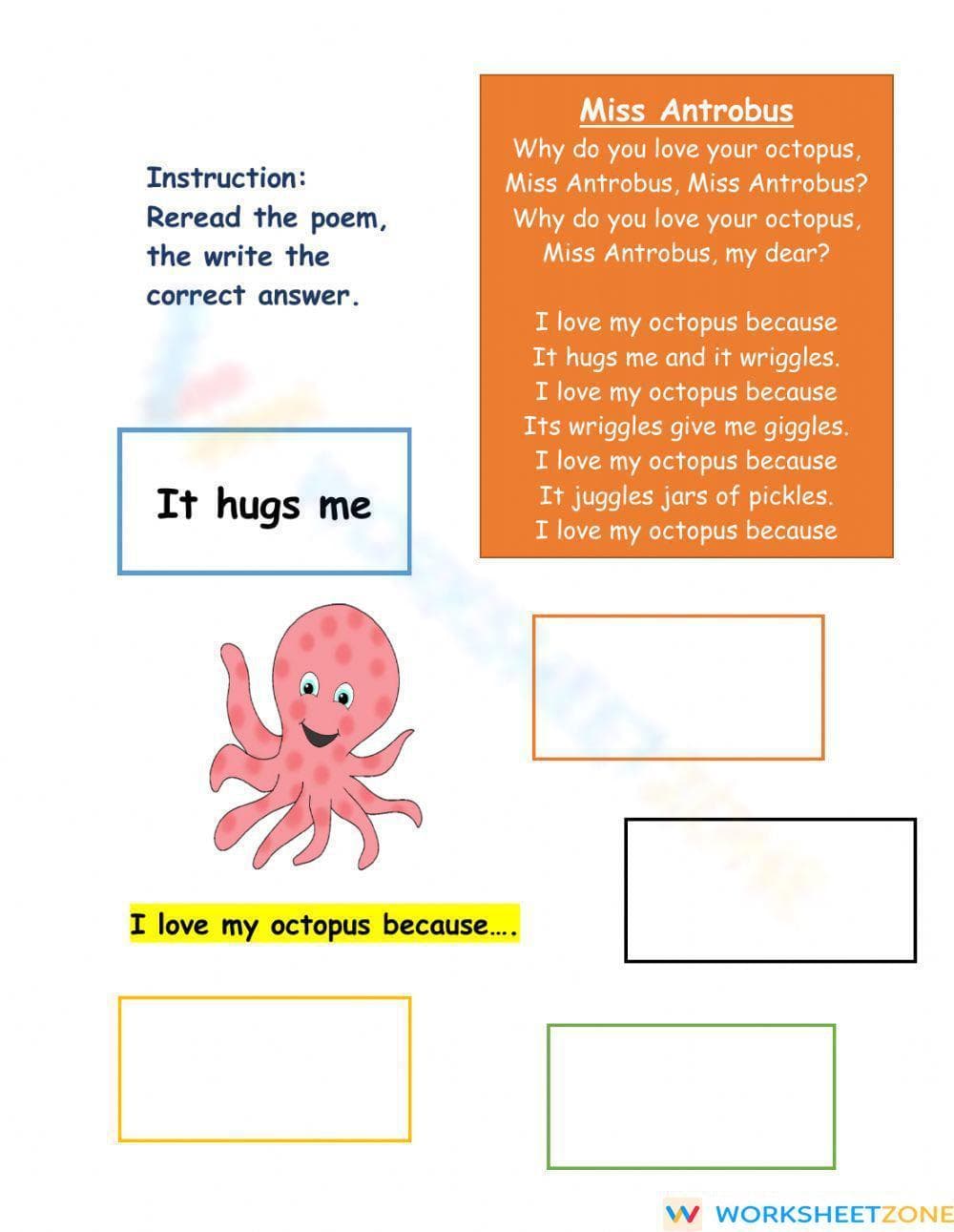
This printable Grade 6-7 ELA worksheet engages students with the whimsical poem "Miss Antrobus" by Richard Edwards. Students read the rhyming verses to identify specific textual evidence explaining why the character loves her octopus. This focused activity improves reading comprehension and ability to extract details from literary texts while exploring poetic rhythm and rhyme.
At a Glance
- Grade: 6-7 · Subject: English Language Arts
- Standard:
CCSS.ELA-LITERACY.RL.6.1— Cite textual evidence to support analysis of what the text says explicitly- Skill Focus: Reading comprehension and extracting textual evidence
- Format: 1 page · 5 problems · Answer key included · PDF
- Best For: Literacy centers, bell-ringers, and sub plans
- Time: 10–15 minutes
What's Inside
This single-page PDF includes the complete text of the "Miss Antrobus" poem presented in a clear, readable orange block. Below the poem, five structured response boxes guide students to transcribe specific reasons for the character's affection for her pet octopus. One box is pre-filled as a worked example ("It hugs me") to model the expected response. A full answer key is provided to ensure accuracy.
Zero-Prep Workflow
This resource allows for immediate classroom implementation with zero teacher setup. Print the single-sheet PDF in under 1 minute. Distribute for a focused 10-15 minute independent activity requiring no extra instructions. Use the included answer key for a 2-minute grading process. It is an ideal "grab-and-go" solution for sub days or transitional literacy blocks.
Standards Alignment
This activity is aligned to CCSS.ELA-LITERACY.RL.6.1, requiring students to cite textual evidence to support analysis of what the text says explicitly. By identifying the specific reasons listed in the poem, students practice grounding their answers in the source material. This standard code can be copied directly into lesson plans, IEP goals, or district curriculum mapping tools.
How to Use It
Use this worksheet as a formative assessment after a lesson on identifying textual details. Teachers can observe students as they work to ensure they correctly identify the "because" clauses. Alternatively, assign it as a bell-ringer to settle the class and activate reading skills. Students should complete the task in approximately 12 minutes.
Who It's For
This worksheet is ideal for middle school students in Grades 6 and 7, particularly those who benefit from scaffolded reading tasks. It provides support for English Language Learners (ELLs) by pairing a rhythmic text with clear writing prompts. Pair this with a short audio reading of the poem or an anchor chart on poetic devices.
The use of rhythmic poetry like "Miss Antrobus" to teach foundational evidence-gathering skills is supported by Fisher & Frey (2014) in their research on the gradual release of responsibility. By providing a clear text-to-task mapping, this worksheet allows students to practice CCSS.ELA-LITERACY.RL.6.1 in a low-anxiety environment. Students must distinguish between explicit details (hugging, wriggling, juggling pickles) and the overall theme of the poem. Research from the NAEP highlights that students who consistently practice identifying explicit details in Grade 6 and 7 texts show significant improvement in more complex inference-based tasks in later grades. This worksheet serves as a crucial bridge between simple decoding and high-level literary analysis, providing the repetition needed for mastery of the plain-English skill: quoting accurately from a text to explain what it says. It is a reliable tool for any ELA curriculum aiming for standards-aligned literacy growth.


