


























Views
Downloads


Metric and Temperature Conversion Worksheet | Grade 6 Ready
Paste this activity's link or code into your existing LMS (Google Classroom, Canvas, Teams, Schoology, Moodle, etc.).
Students can open and work on the activity right away, with no student login required.
You'll still be able to track student progress and results from your teacher account.
This comprehensive Grade 6 math worksheet empowers students to master complex measurement transformations across metric, imperial, and temperature systems. By applying specific formulas and conversion factors, learners bridge the gap between abstract ratios and real-world data application. The structured approach ensures students build calculation fluency while developing a conceptual understanding of unit relationships.
At a Glance
- Grade: 6 · Subject: Math
- Standard:
CCSS.MATH.CONTENT.6.RP.A.3.d— Use ratio reasoning to convert and transform measurement units across different systems- Skill Focus: Multi-System Conversions
- Format: 4 pages · 26 problems · Answer key included · PDF
- Best For: Guided practice and measurement review
- Time: 35–45 minutes
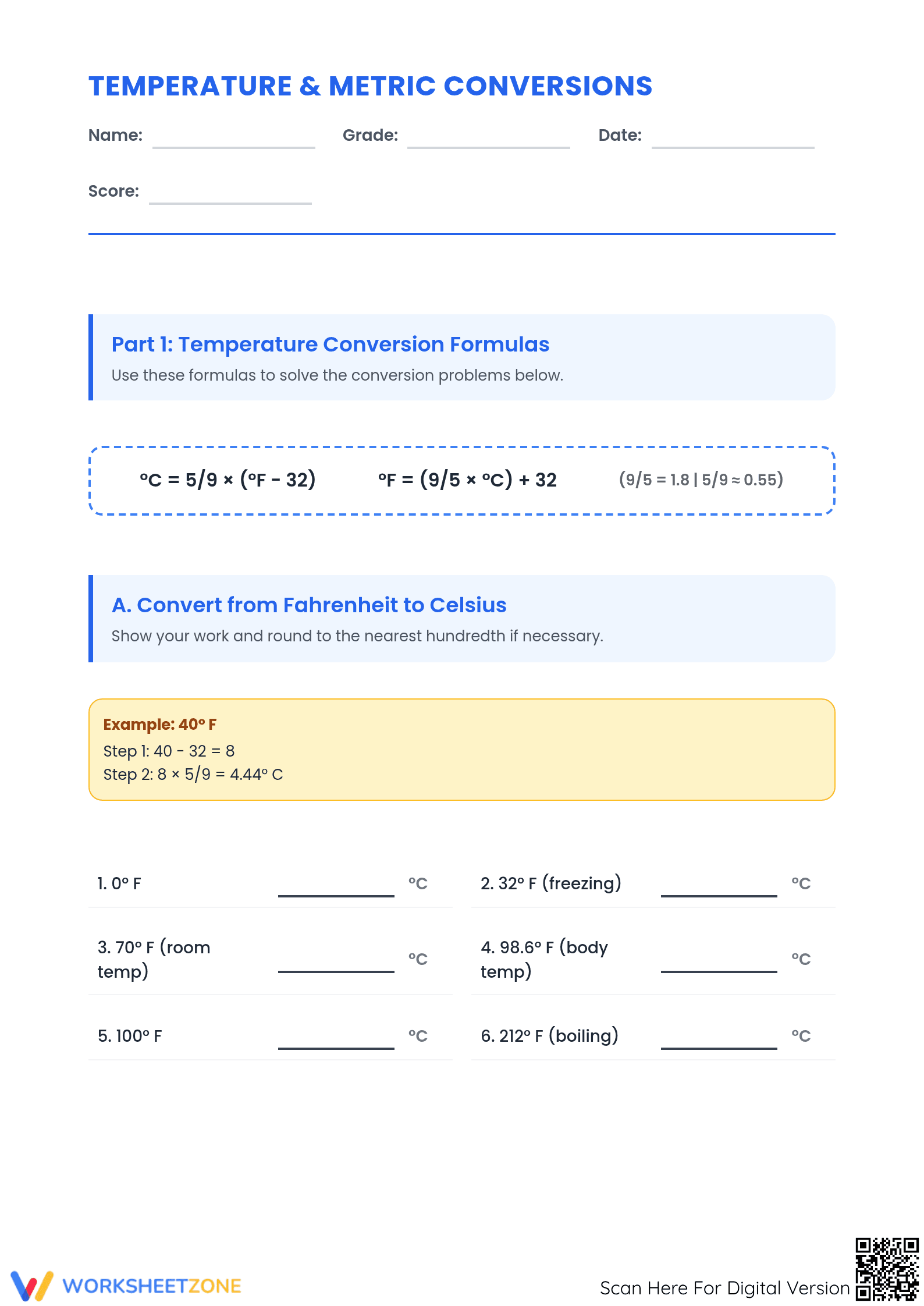
The resource spans four detailed pages, beginning with temperature conversion formulas for Celsius and Fahrenheit. It includes a robust reference table for volume (L, gal, mL), length (in, cm, ft, m), and weight (oz, g, lb, kg). Every section provides clear instructions, worked examples to model correct procedure, and a comprehensive answer key for immediate student feedback or teacher grading.
The instructional design follows a clear skill progression to ensure student success. First, "Guided Practice" uses temperature examples to model formula substitution with 12 initial problems. Next, "Supported Practice" provides a conversion factor table for 9 mixed-unit problems, reducing scaffolding. Finally, students transition to "Independent Practice" through 5 application word problems that require extracting data and selecting appropriate conversion strategies without direct cues.
This resource is strictly aligned to `CCSS.MATH.CONTENT.6.RP.A.3.d`, which requires students to use ratio reasoning to convert measurement units and manipulate units appropriately when multiplying or dividing quantities. The word problems also touch upon `CCSS.MATH.CONTENT.7.RP.A.3` for multi-step real-world ratio applications. Both standard codes can be copied directly into lesson plans, IEP goals, or district curriculum mapping tools.
Use this worksheet during the "You Do" phase of a gradual release lesson on measurement systems. It serves as an excellent formative assessment tool after direct instruction on unit ratios. For effective differentiation, observe students during the word problem section to identify those struggling with multi-step logic versus those with simple calculation errors. Expect a total completion time of 40 minutes.
This material is designed for Grade 6 students but is highly effective for Grade 7 review or Grade 5 enrichment. It provides necessary support for English Language Learners through visual reference tables and clear examples. Pair this resource with a physical thermometer or a metric ruler to provide a concrete anchor for the abstract calculations performed on the page.
The mastery of measurement conversion is a foundational pillar of middle school mathematics, directly impacting student success in subsequent physical science and engineering coursework. According to the RAND AIRS 2024 report on curriculum alignment, structured practice that bridges the gap between procedural fluency and situational word problems significantly improves long-term retention of ratio-based reasoning. This worksheet addresses that need by requiring students to not only apply formulas but also determine which conversion factor is appropriate for a given real-world context, such as determining fluid volume or calculating weight for a recipe. By incorporating temperature conversions alongside standard metric and imperial units, the resource provides a holistic view of the measurement landscape. Aligned to CCSS.MATH.CONTENT.6.RP.A.3.d, this tool ensures students can accurately transform units and explain the underlying relationships between different systems, meeting high-rigor standards for college and career readiness in STEM fields.


