


























Views
Downloads
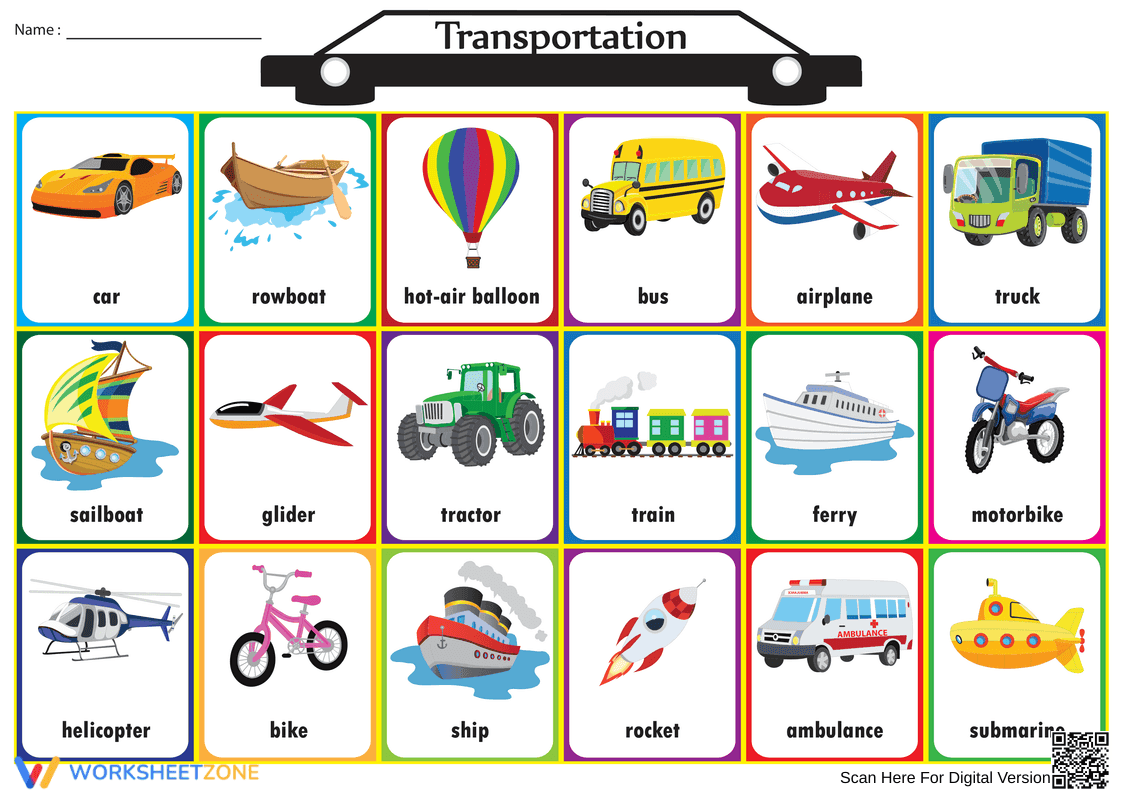

Grade K-1 Transportation — Essential No-Prep Reference Chart
Paste this activity's link or code into your existing LMS (Google Classroom, Canvas, Teams, Schoology, Moodle, etc.).
Students can open and work on the activity right away, with no student login required.
You'll still be able to track student progress and results from your teacher account.
This printable means of transportation chart provides a comprehensive visual reference for early learners to identify and name various vehicles. By connecting vibrant illustrations with clear text labels, students build essential vocabulary and spelling skills across land, air, and sea categories. It is a fundamental tool for enhancing language development and environmental awareness in young children.
At a Glance
- Grade: K–1 · Subject: ELA & Language
- Standard:
CCSS.ELA-LITERACY.L.K.5.A— Sort common objects into categories like transportation to gain a sense of concepts they represent.- Skill Focus: Vocabulary identification and categorization
- Format: 1 page · 18 vehicles · Reference Chart · PDF
- Best For: Primary visual reference for vocabulary development and word recognition.
- Time: 5–10 minutes
This resource features a single-page high-definition chart containing 18 distinct modes of transportation. Each vehicle is paired with its corresponding name in a clean, legible font, making it an ideal reference for spelling and word recognition. The layout is color-coded with vibrant borders to keep students engaged while they explore land, water, and air vehicles from buses and trains to submarines and rockets.
Integrating this chart into your lesson requires zero preparation time. Simply print the PDF in under 30 seconds, distribute copies to your students or display it on a digital whiteboard for about 1 minute, and begin your vocabulary review or sorting activity for 2 minutes. It serves as an excellent reference for writing centers or as a reliable sub-plan resource that requires no prior teacher setup.
The chart is aligned to CCSS.ELA-LITERACY.L.K.5.A, which focuses on sorting common objects into categories to gain a sense of the concepts the categories represent. By identifying vehicles like airplanes, ships, and buses, students practice essential categorization skills. Both standard codes can be copied directly into lesson plans, IEP goals, or district curriculum mapping tools to ensure academic rigor and compliance.
Use this chart during the introductory phase of a transportation unit to gauge prior knowledge or as a permanent reference in a literacy center. For a formative-assessment tip, observe students as they attempt to sort these 18 items into "land," "water," and "air" categories orally or by using counters. Expected completion time for a guided walkthrough or individual reference task is approximately 10 minutes.
This chart is designed for Preschool, Kindergarten, and Grade 1 students, including English Language Learners who benefit from visual scaffolding. It pairs naturally with a transportation-themed reading passage or an anchor chart about "Things That Go." The high-contrast imagery supports learners with varying visual processing needs by clearly defining each object.
According to research highlighted by Fisher & Frey (2014) regarding visual literacy and vocabulary acquisition, the use of labeled graphic organizers and charts significantly enhances the "I Do, We Do, You Do" instructional model. This transportation chart supports CCSS.ELA-LITERACY.L.K.5.A by providing concrete visual anchors for 18 specific vocabulary terms, bridging the gap between pictorial recognition and phonetic spelling. Early exposure to categorized word lists is a proven strategy for building the mental schemata necessary for reading comprehension and expressive language. By using high-contrast imagery and standard fonts, this resource ensures that foundational literacy concepts are accessible to all learners, including those requiring tier-1 instructional supports. Educators can rely on this validated instructional aid to support language acquisition milestones and prepare young learners for complex text interactions in later grades.


