


























Views
Downloads

Transportation Spelling Worksheet | Essential Preschool ELA
Paste this activity's link or code into your existing LMS (Google Classroom, Canvas, Teams, Schoology, Moodle, etc.).
Students can open and work on the activity right away, with no student login required.
You'll still be able to track student progress and results from your teacher account.
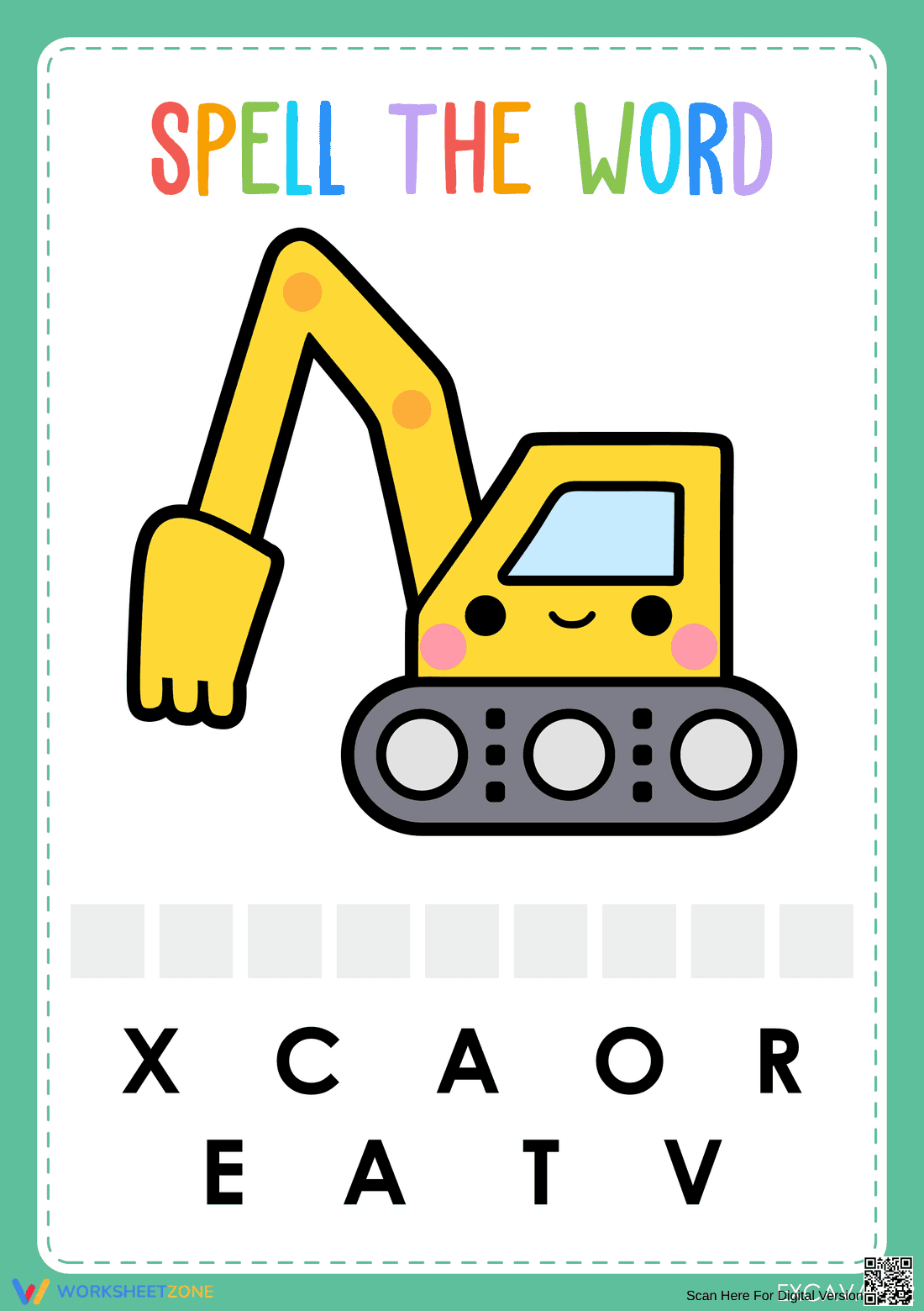
This preschool transportation worksheet helps young learners master the spelling of complex vehicle names through visual association and letter recognition. By focusing on the word "excavator," students engage with multi-syllabic vocabulary while practicing letter-sound correspondence. This activity transforms a high-interest topic into a foundational literacy exercise that builds confidence in early writing skills.
At a Glance
- Grade: Preschool · Subject: English Language Arts
- Standard:
CCSS.ELA-LITERACY.L.PK.2— Demonstrate a beginning understanding of letters and sounds in early writing- Skill Focus: Transportation Vocabulary & Spelling
- Format: 1 page · 1 complex task · Answer key included · PDF
- Best For: Early literacy centers and morning work
- Time: 5–10 minutes
The worksheet features a high-quality, colorful illustration of a friendly excavator to provide immediate context for the learner. Below the image, a series of 9 empty boxes corresponds to the letters in the target word. A scrambled letter bank containing the letters X, C, A, O, R, E, A, T, and V is provided at the bottom, offering a clear visual scaffold for students who are still developing their spelling independence.
Skill Progression
- Guided Practice: Students identify the excavator image, providing a visual cue for the vocabulary word. This initial step ensures the student understands the object before attempting the linguistic task.
- Supported Practice: The 9-letter bank acts as a scaffold, allowing students to match letters to boxes rather than relying on pure recall, reducing cognitive load.
- Independent Practice: Students write or arrange letters in sequence, solidifying the spelling of a complex word through a structured gradual release model.
Standards Alignment
This resource is specifically aligned with `CCSS.ELA-LITERACY.L.PK.2`, which focuses on demonstrating a beginning understanding of letters and sounds. By requiring students to select specific letters to form a word, the worksheet reinforces the concept that letters represent spoken sounds in a fixed order. This standard code can be copied directly into lesson plans, IEP goals, or district curriculum mapping tools.
How to Use It
Use this worksheet during a "Things That Go" or construction-themed unit to integrate literacy with science and social studies. It works exceptionally well as a formative assessment during small-group instruction; teachers can observe whether a student recognizes the initial "E" sound or struggles with the middle consonants. Expect most preschoolers to complete the task in 5 to 10 minutes with minimal guidance.
Who It's For
This activity is designed for preschool students, but it is also highly effective for English Language Learners (ELLs) who need to pair visual images with specific English vocabulary. It pairs naturally with transportation-themed picture books or classroom anchor charts featuring construction equipment.
Research from RAND AIRS 2024 emphasizes that high-interest visual aids, such as construction vehicles, increase engagement in early literacy tasks. By utilizing "excavator" within a structured spelling framework, this worksheet aligns with evidence-based practices for phonological awareness. The letter bank supports the CCSS.ELA-LITERACY.L.PK.2 standard by providing scaffolding for students to bridge the gap between letter recognition and word formation. Studies indicate that students engaging with complex vocabulary in supported environments show significant gains in letter-sound correspondence. This printable resource provides a focused, 1-page intervention that is developmentally appropriate and standards-aligned for the preschool classroom.


