


























Views
Downloads

Transportation Spelling Worksheet | Essential Preschool ELA
Paste this activity's link or code into your existing LMS (Google Classroom, Canvas, Teams, Schoology, Moodle, etc.).
Students can open and work on the activity right away, with no student login required.
You'll still be able to track student progress and results from your teacher account.
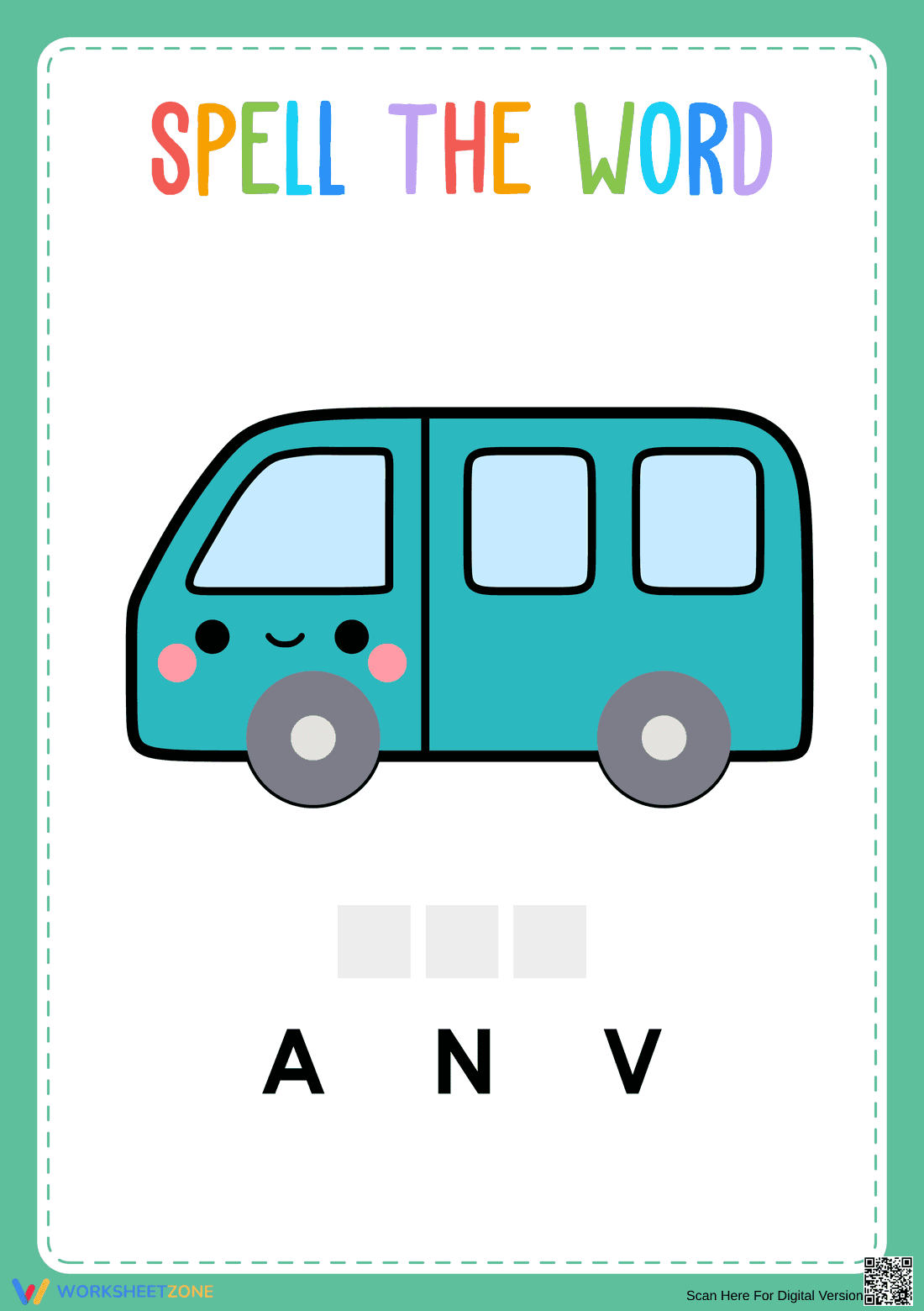
This preschool ELA worksheet focuses on early literacy and letter recognition through a transportation theme. Students identify the vehicle pictured and arrange the provided letters to spell the word correctly. It builds the foundational understanding that specific letter sequences represent spoken words, preparing young learners for kindergarten reading success.
At a Glance
- Grade: Preschool · Subject: ELA
- Standard:
CCSS.ELA-LITERACY.RF.K.1.B— Recognize that spoken words are represented by specific sequences of letters- Skill Focus: Spelling & Letter Sequencing
- Format: 1 page · 1 task · Answer key included · PDF
- Best For: Morning work or literacy centers
- Time: 5–10 minutes
The worksheet features a high-contrast, colorful illustration of a van to engage visual learners. Below the image, three empty boxes provide a clear target for letter placement. Three scrambled letters (A, N, V) are provided at the bottom, serving as a built-in word bank that supports students in identifying the correct components of the word. The layout is intentionally simple to prevent cognitive overload in early learners.
This resource is designed for a zero-prep workflow. 1. Print: Select the page and print in color or grayscale in under 30 seconds. 2. Distribute: Hand out to students with scissors and glue or pencils for writing. 3. Review: Check the 3-letter sequence instantly. Total teacher preparation time is less than 2 minutes, making it an ideal choice for emergency sub plans, transition periods, or as a quick supplemental activity during a transportation unit.
Aligned to CCSS.ELA-LITERACY.RF.K.1.B, this activity requires students to "Recognize that spoken words are represented in written language by specific sequences of letters." While designed for preschool, it bridges the gap to kindergarten expectations by introducing CVC (Consonant-Vowel-Consonant) structures. This standard code can be copied directly into lesson plans, IEP goals, or district curriculum mapping tools to track foundational literacy progress.
Use this as a formative assessment during a "Things That Go" unit. Observe if students can identify the initial "V" sound and match it to the correct letter tile. It also works well as a quiet-time activity after direct instruction on the letter 'V' or transportation vocabulary. Expected completion time is 5 to 10 minutes depending on the student's fine motor skills and phonemic awareness level.
This is for preschool and early kindergarten students who are beginning to explore phonics. It is particularly helpful for English Language Learners (ELLs) who benefit from the direct visual-to-word association. Pair this with a transportation-themed picture book or a set of plastic vehicle toys for a multi-sensory learning experience that reinforces the vocabulary used in the worksheet.
Early literacy development relies heavily on the phonological awareness and letter-sound correspondence practiced in this activity. By focusing on a single, high-frequency word like "van," students build the confidence needed for more complex decoding tasks. According to Fisher & Frey (2014), the use of visual scaffolds and scrambled letter banks provides the necessary support for young learners to transition from oral language to written literacy. This worksheet specifically addresses CCSS.ELA-LITERACY.RF.K.1.B by requiring students to manipulate letter sequences to form a meaningful word. Research indicates that early exposure to these structured spelling tasks significantly correlates with later reading fluency and orthographic mapping skills. This resource provides a targeted, 1-page intervention that fits easily into a balanced literacy framework, ensuring that students master the fundamental concept that letters have a fixed order in written English.


