


























Views
Downloads
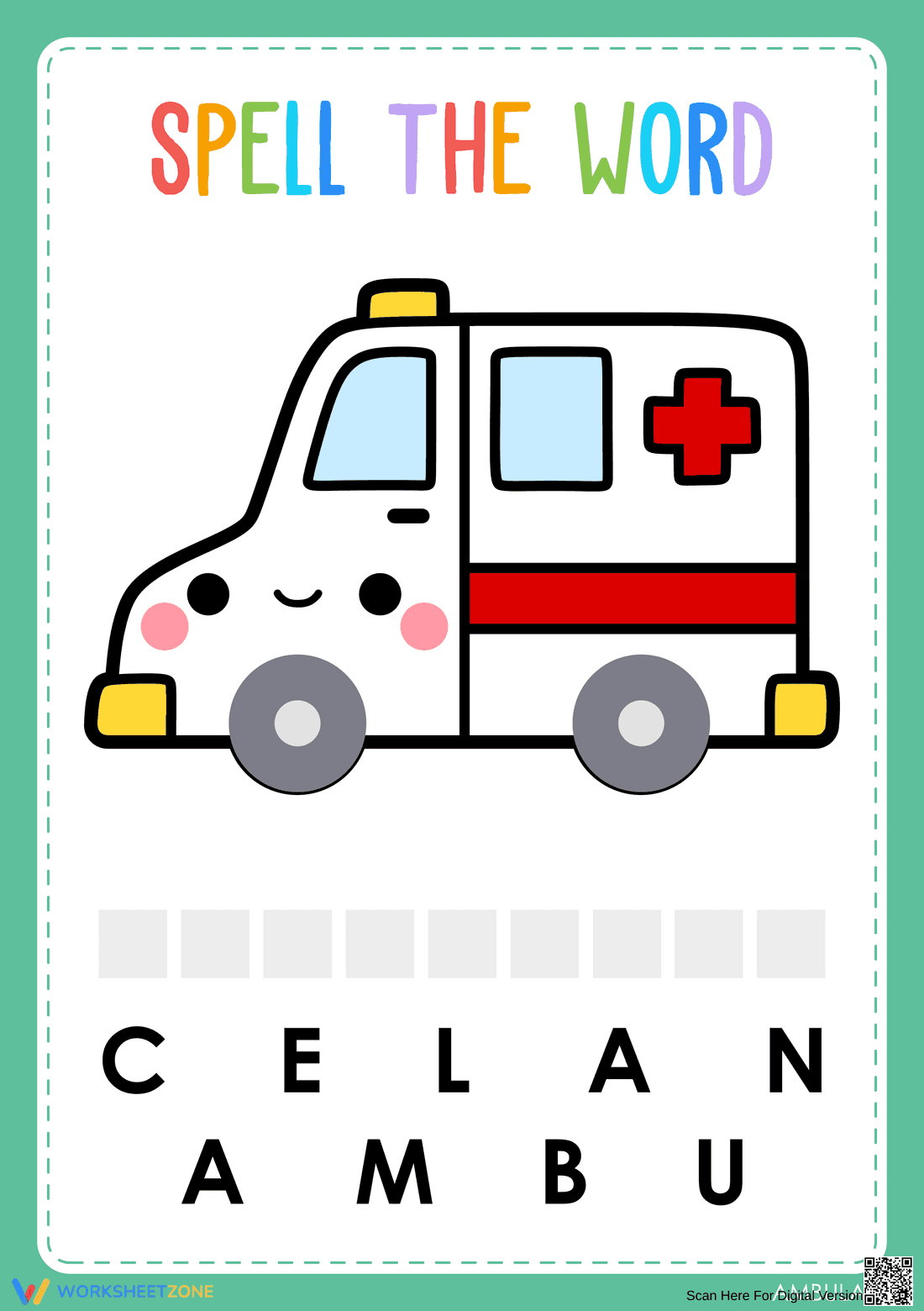

Preschool Spelling — Printable No-Prep Worksheet
Paste this activity's link or code into your existing LMS (Google Classroom, Canvas, Teams, Schoology, Moodle, etc.).
Students can open and work on the activity right away, with no student login required.
You'll still be able to track student progress and results from your teacher account.
This preschool spelling worksheet provides young learners with targeted practice in letter recognition and word formation. By unscrambling letters to spell the word "ambulance," students develop foundational literacy skills and improve their visual-motor coordination. The engaging transportation theme keeps early learners focused while building essential vocabulary.
At a Glance
- Grade: Preschool · Subject: ELA
- Standard:
CCSS.ELA-LITERACY.L.K.2— Spell simple words using letter-sound knowledge- Skill Focus: Spelling and letter recognition
- Format: 1 page · 1 problem · Answer key included · PDF
- Best For: Independent practice centers
- Time: 5–10 minutes
Inside this single-page resource, educators will find a visual spelling task centered around a cartoon ambulance. The worksheet features nine empty boxes corresponding to the target word, providing structural support for early writers. Below the boxes, scrambled letters are presented in a large font. A discreet answer key is located at the bottom right corner, allowing for quick teacher verification.
This resource offers a streamlined workflow:
- Print (1 minute): Generate the PDF and print copies. The bold lines ensure high-quality printing.
- Distribute (1 minute): Hand out the worksheet with pencils. The intuitive design requires minimal instruction.
- Review (3 minutes): Students complete the task independently. Teachers can quickly scan the filled boxes for rapid assessment.
With a total teacher preparation time of under two minutes, this worksheet is an excellent addition to emergency sub plans or spontaneous literacy centers.
This worksheet aligns with CCSS.ELA-LITERACY.L.K.2, which expects students to demonstrate command of the conventions of standard English capitalization, punctuation, and spelling when writing. It specifically supports the foundational skill of recognizing and organizing letters to form meaningful words. Both standard codes can be copied directly into lesson plans, IEP goals, or district curriculum mapping tools.
Teachers can utilize this worksheet during morning work routines to transition students into the academic day. It serves as an excellent independent activity while the teacher conducts small-group sessions. As a formative assessment tip, observe how students approach the scrambled letters: do they search for the initial sound first, or randomly place letters? This observation provides valuable data on phonemic awareness. Expected completion time ranges from five to ten minutes.
This resource is primarily designed for preschool and early kindergarten students developing basic literacy skills. It is particularly beneficial for visual learners who respond well to engaging illustrations and clear spatial boundaries. For students requiring additional support, teachers can provide physical letter tiles to manipulate before writing. This worksheet pairs perfectly with a direct instruction lesson on community helpers or a read-aloud featuring emergency vehicles.
Early exposure to spelling and letter manipulation is a critical component of emergent literacy. Aligning with CCSS.ELA-LITERACY.L.K.2 to spell simple words using letter-sound knowledge, this worksheet provides structured practice in organizing letters to form recognizable vocabulary. According to Fisher & Frey (2014), providing students with targeted, scaffolded tasks that connect visual stimuli to phonetic components significantly enhances long-term word retention and reading fluency. The use of scrambled letters combined with visual cues, such as the ambulance illustration, supports cognitive mapping and reinforces the alphabetic principle. By engaging in this specific spelling task, preschool learners develop the fine motor skills and phonological awareness necessary for future reading success. This foundational practice ensures that young students build the confidence and competence required to tackle more complex literacy challenges as they progress.


