


























Views
Downloads
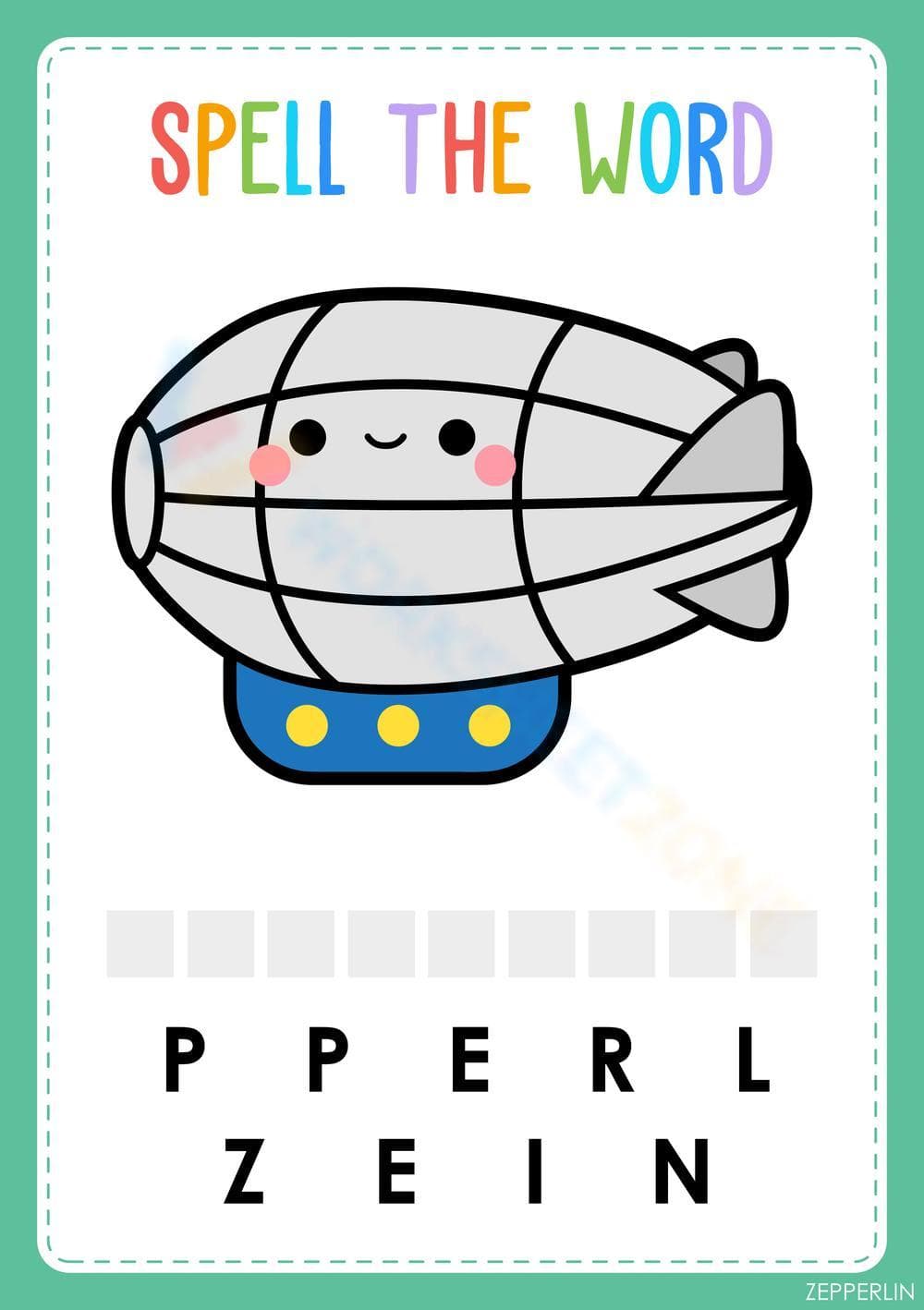

Zeppelin Spelling Worksheet | Essential Preschool ELA
Paste this activity's link or code into your existing LMS (Google Classroom, Canvas, Teams, Schoology, Moodle, etc.).
Students can open and work on the activity right away, with no student login required.
You'll still be able to track student progress and results from your teacher account.
This Preschool ELA worksheet focuses on spelling the word "Zeppelin" through letter recognition and sequencing. Students use a visual prompt and a scrambled letter bank to identify, organize, and write the correct letters in order. It builds foundational literacy skills by connecting phonics to specific transportation vocabulary in an engaging, visual format.
At a Glance
- Grade: Preschool · Subject: ELA
- Standard:
CCSS.ELA-LITERACY.L.PK.2— Begin to associate letters with their names and sounds- Skill Focus: Spelling and letter sequencing
- Format: 1 page · 1 problem · Answer key included · PDF
- Best For: Transportation units and morning work
- Time: 5–10 minutes
This single-page PDF features a high-quality illustration of a zeppelin to provide immediate context. Below the image, students find 8 empty boxes corresponding to the 8 letters in the word. A scrambled letter bank (P, P, E, R, L, Z, E, I, N) is provided at the bottom to support letter identification and spelling accuracy.
The worksheet follows a gradual release model. First, students engage in Guided Practice by identifying the large visual cue of the zeppelin. Next, they move to Supported Practice, using the provided letter bank to narrow down their choices. Finally, they perform Independent Practice by correctly sequencing the letters into the boxes to spell the word. This three-step process ensures students feel successful while mastering complex vocabulary.
This resource aligns with `CCSS.ELA-LITERACY.L.PK.2`, which requires students to begin to associate letters with their names and sounds. By manipulating the letters to form a specific word, students demonstrate an early understanding of print concepts and spelling patterns. This standard code can be copied directly into lesson plans, IEP goals, or district curriculum mapping tools.
Use this worksheet as a focused morning work activity during a "Things That Fly" or "Transportation" unit. It also serves as an excellent formative assessment tool; teachers can observe whether a student recognizes the letter 'Z' or understands the left-to-right progression of spelling. Expect completion within 5 to 10 minutes depending on the student's fine motor skills.
This activity is designed for preschool students and early kindergarteners who are beginning to explore letter-sound relationships. It is also highly effective for English Language Learners (ELLs) who need visual aids to build their English vocabulary. Pair this with a picture book about airships or a classroom anchor chart featuring different modes of transportation.
According to the RAND AIRS 2024 report on early childhood literacy, visual-to-text association is a critical precursor to reading fluency. This worksheet addresses the CCSS.ELA-LITERACY.L.PK.2 standard by requiring students to engage in letter-sound mapping and orthographic processing. By isolating a single, complex word like "Zeppelin," the resource allows for deep focus on letter shapes and sequencing without overwhelming the learner. Research indicates that structured spelling tasks with immediate visual feedback help solidify the alphabetic principle in young children. This printable provides a clear, distraction-free environment for students to practice these essential skills. Educators can utilize this resource to bridge the gap between simple letter recognition and the more advanced phonemic awareness required in later grades. The inclusion of a scrambled letter bank specifically supports cognitive retrieval and pattern recognition, which are foundational components of the NAEP literacy framework for early learners.


