


























Views
Downloads
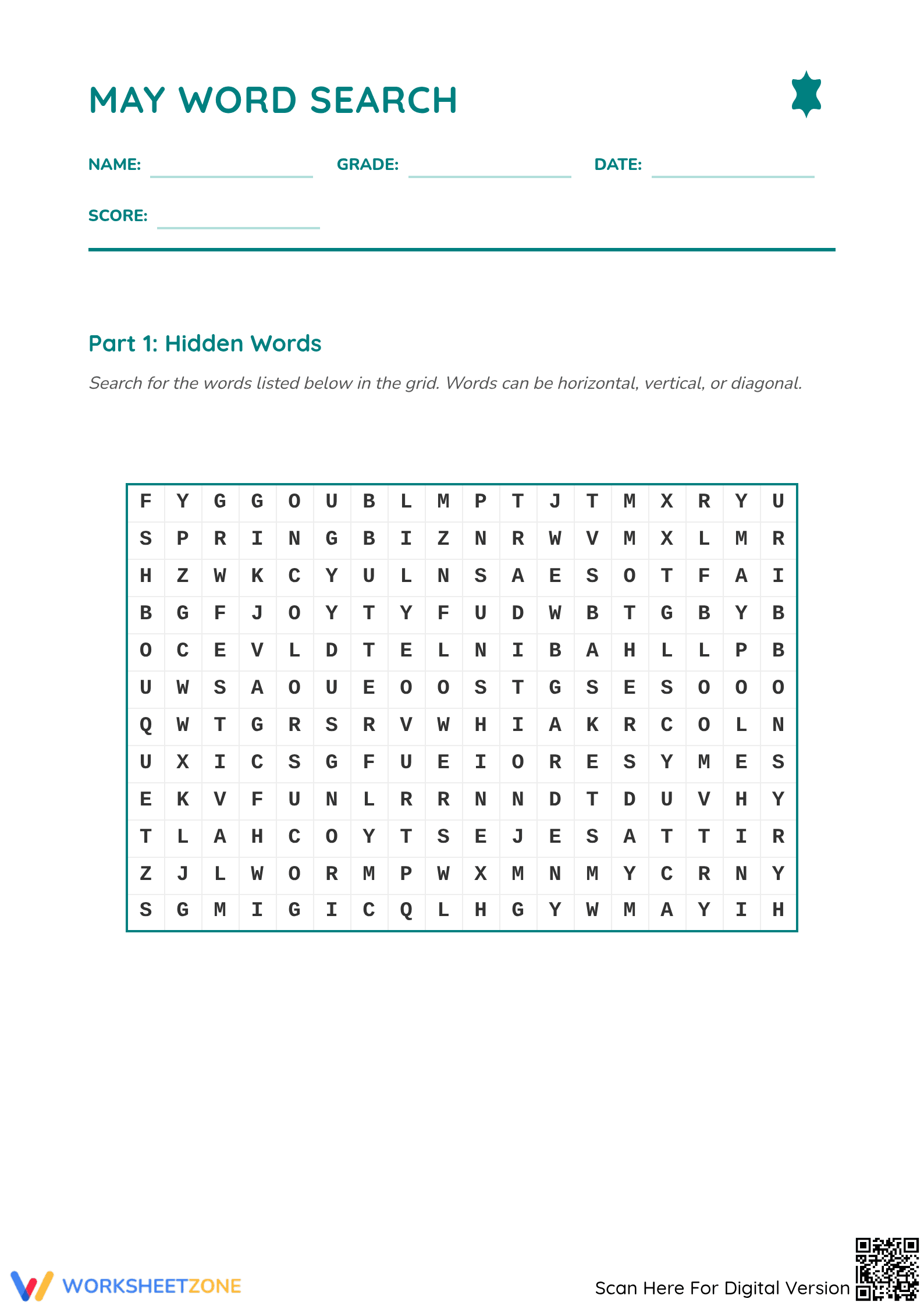


Grade 3 May Vocabulary — Printable No-Prep Worksheet
Paste this activity's link or code into your existing LMS (Google Classroom, Canvas, Teams, Schoology, Moodle, etc.).
Students can open and work on the activity right away, with no student login required.
You'll still be able to track student progress and results from your teacher account.
This engaging Grade 3 vocabulary worksheet helps students recognize seasonal terminology and apply new words in context. By combining a fun May-themed word search with a creative sentence-writing activity, learners build spelling fluency and demonstrate their understanding of standard English grammar in a single, easy-to-use resource.
At a Glance
- Grade: 3 · Subject: ELA
- Standard:
CCSS.ELA-LITERACY.L.3.6— Acquire and use grade-appropriate vocabulary words.- Skill Focus: Vocabulary and Sentence Writing
- Format: 2 pages · 4 tasks · Answer key included · PDF
- Best For: Morning work or sub plans
- Time: 15–20 minutes
This two-page printable includes an 18-word seasonal word search puzzle and a structured creative writing section. Students first locate spring-themed words like "bouquet," "tradition," and "sunshine" within the grid. Then, they select three words from the provided word bank to draft original, complete sentences. The clear layout features dedicated writing lines to support neat handwriting, and a complete answer key is provided for quick grading.
Designed for busy educators, this resource requires absolutely zero prep.
- Print (1 minute): Simply download the PDF and print the two-page student packet.
- Distribute (1 minute): Hand out the worksheets as students enter the room for immediate engagement.
- Review (3 minutes): Use the included answer key to quickly check the word search and evaluate sentence structure.
With a total teacher prep time of under two minutes, this activity is an ideal addition to any emergency sub plan or morning routine.
This activity is aligned to primary standard CCSS.ELA-LITERACY.L.3.6, requiring students to acquire and use accurately grade-appropriate conversational, general academic, and domain-specific words and phrases. It also supports foundational writing skills by prompting students to construct complete sentences using their newly reviewed vocabulary. Both standard codes can be copied directly into lesson plans, IEP goals, or district curriculum mapping tools.
This versatile worksheet is perfect for morning work during the month of May, giving students a focused, independent task while you take attendance. It also serves as an excellent early-finisher activity after a main ELA lesson. As a formative assessment tip, review the three creative sentences to quickly gauge whether students are using correct capitalization, punctuation, and context clues. Expected completion time is 15 to 20 minutes.
This resource is designed for third-grade general education students, though it can easily be adapted for second-grade enrichment or fourth-grade review. The built-in word bank provides excellent scaffolding for English Language Learners (ELLs) and students needing spelling support. Pair this worksheet with a spring-themed read-aloud or a seasonal anchor chart to further reinforce the vocabulary words in context.
Integrating thematic vocabulary practice into daily routines significantly enhances student retention and language acquisition. According to a recent ScienceDirect TpT Analysis, resources that combine visual recognition tasks, such as word searches, with immediate application exercises yield higher engagement and better long-term memory of new terms. This worksheet directly supports CCSS.ELA-LITERACY.L.3.6 by challenging students to acquire and use grade-appropriate vocabulary words in their own writing. By transitioning learners from passive word identification in the puzzle to active sentence construction, educators can effectively bridge the gap between spelling and reading comprehension. Regular exposure to seasonal and domain-specific vocabulary ensures that students build a robust lexicon, which is a critical component of overall literacy development and academic success across all subject areas.


