


























Views
Downloads
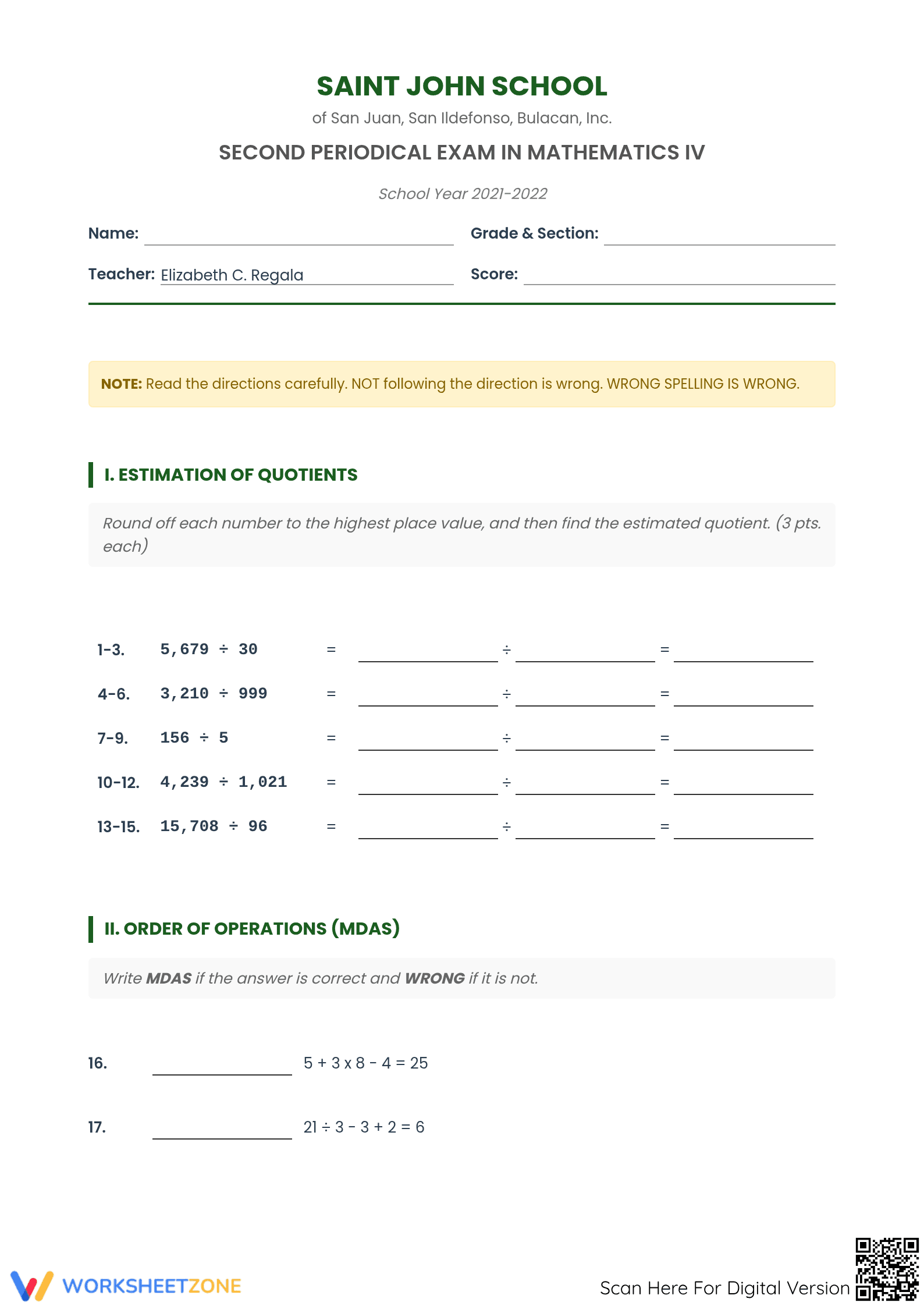
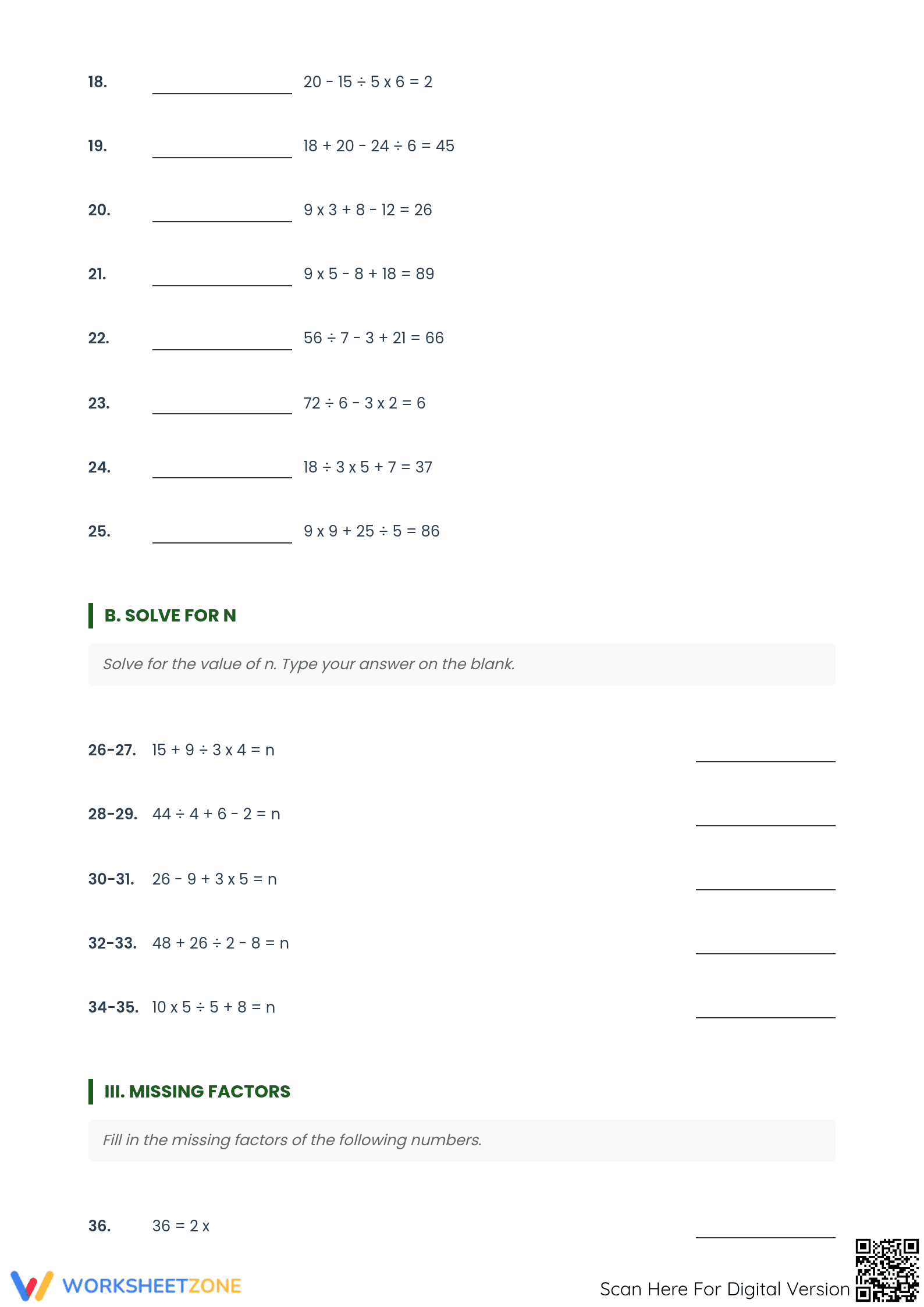
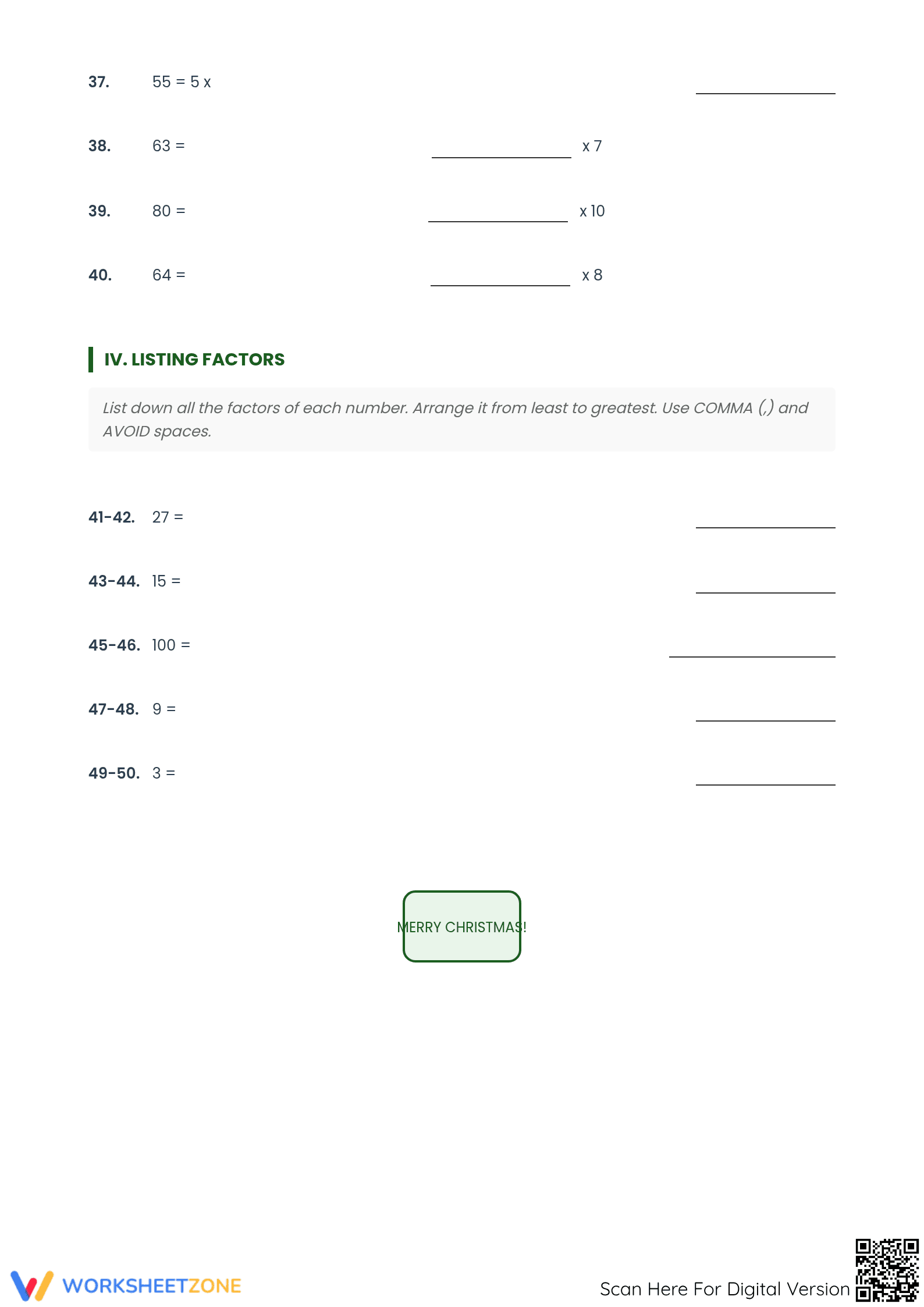

Grade 4 Math 2nd Periodical Exam | Essential Aligned Test
Paste this activity's link or code into your existing LMS (Google Classroom, Canvas, Teams, Schoology, Moodle, etc.).
Students can open and work on the activity right away, with no student login required.
You'll still be able to track student progress and results from your teacher account.
This Grade 4 Mathematics 2nd Periodical Exam provides a comprehensive assessment of core numerical skills. Students will demonstrate their understanding of number theory and fraction operations through 40 carefully sequenced problems. This printable resource ensures that learners have mastered the essential building blocks of intermediate math, including factors, multiples, and fractional equivalence.
At a Glance
- Grade: Grade 4 · Subject: Math
- Standard:
CCSS.MATH.CONTENT.4.NF.B.3— Add and subtract fractions with like denominators by joining parts of a whole- Skill Focus: Multi-domain Mastery (Fractions, Factors, Multiples)
- Format: 3 pages · 40 problems · Answer key included · PDF
- Best For: Cumulative quarterly assessment and test prep
- Time: 45–60 minutes
What's Inside
The three-page examination contains a balanced mix of 40 tasks designed to measure different levels of understanding. The first half focuses on number theory, featuring questions on prime and composite numbers, divisibility, and calculating the Greatest Common Factor (GCF). The second half transitions into fractions, covering types of fractions, simplification, and operations with like denominators. A full answer key is included.
Mastery Evidence
This assessment provides clear evidence of student mastery across three critical tiers. The multiple-choice section targets the "Meeting" level by testing recall of prime properties and basic GCF calculations. The problem-solving components move into the "Exceeding" tier, requiring students to synthesize their understanding of factors to simplify complex fractions. Teachers can use the task groupings to map performance directly to IEP progress notes.
Standards Alignment
The primary alignment is CCSS.MATH.CONTENT.4.NF.B.3, which requires students to understand addition and subtraction of fractions as joining parts of a whole. The worksheet also supports CCSS.MATH.CONTENT.4.OA.B.4 by assessing the ability to find factor pairs for whole numbers. Both standard codes can be copied directly into lesson plans, IEP goals, or district curriculum mapping tools.
How to Use It
Deploy this worksheet as a formal summative assessment at the end of the grading period to measure cumulative growth. It also serves as an effective test prep tool during review week. Teachers should observe students during the GCF section to identify their procedural efficiency. Expect a completion time of 45 to 60 minutes for most Grade 4 students.
Who It's For
This resource is designed for Grade 4 students but is effective for Grade 5 learners requiring a review of foundational concepts. It pairs naturally with anchor charts focused on fraction models and divisibility rules. Differentiation is built into the task variety, supporting students who excel at multiple-choice recognition while challenging those ready for independent problem-solving applications.
This Grade 4 Mathematics assessment aligns with evidence-based recommendations for cumulative review in elementary education. According to the RAND AIRS 2024 report on mathematics instructional materials, structured assessments that bridge multiple domains—such as number theory and fraction operations—provide critical data for instructional pivot points. By evaluating a student's ability to transition from identifying prime numbers to applying those concepts in fraction simplification, teachers gain a holistic view of numerical literacy. This 40-item examination utilizes a mix of formats to ensure students can demonstrate both procedural fluency and conceptual understanding of standard CCSS.MATH.CONTENT.4.NF.B.3. Such comprehensive evaluations are essential for identifying specific gaps in fractional reasoning before moving into advanced units, ensuring that every learner achieves the necessary prerequisites for middle-school mathematics success.


