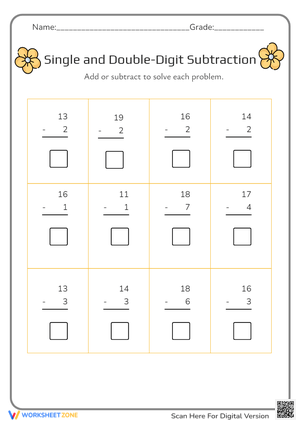
Why Single Digit Subtraction Worksheets Belong in Daily K-1 Practice
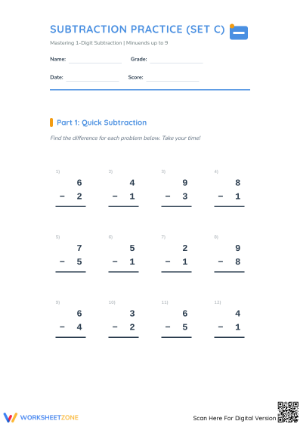
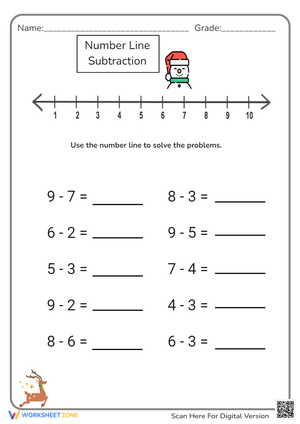
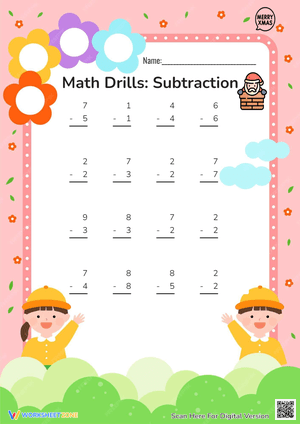
For K-1 teachers, single digit subtraction worksheets are one of the most practical tools for building fact fluency during short, repeatable blocks of instruction. Whether you use them for a five-minute warm-up, a small-group station, or homework, they give students the repetition that automatic recall requires. The goal isn't just correct answers—it's answers that come quickly enough to free up working memory for harder math later.
This page focuses on how to sequence, assign, and assess single digit subtraction worksheets so they move students from kindergarten expectations toward the Grade 1 fluency bar. Instead of handing out random pages, you'll get a routine that ties each worksheet to a specific skill and a specific standard.
Below, each recommendation ties back to the Common Core progression from kindergarten through Grade 1, so the practice you assign matches what students are actually accountable for. Nothing here asks you to invent new materials—just to use single-digit subtraction pages with a bit more intention than the typical grab-and-go worksheet.
Start With Subtraction Within 5, Then Build to 10
Kindergarten sets the foundation. Under K.OA.A.5, students are expected to fluently add and subtract within 5. That's the floor you build on. If a first grader still hesitates on 5 - 2 or 4 - 3, timed work within 10 will only frustrate them, so start your worksheet sequence at the level they can already handle.
From there, the progression is straightforward:
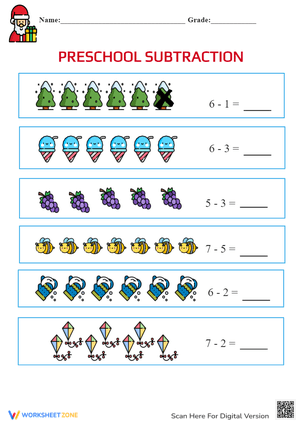
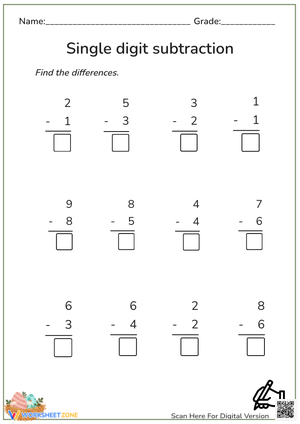
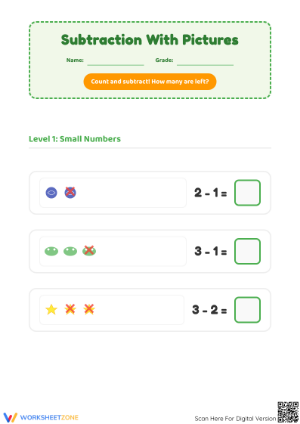
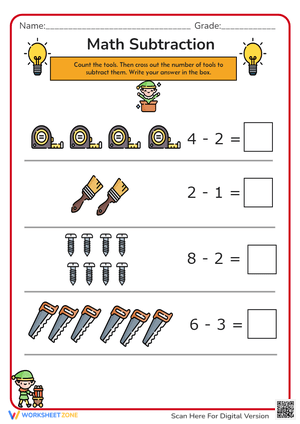
- Within 5: facts like 5 - 1, 4 - 2, and 3 - 3 that reinforce the kindergarten floor.
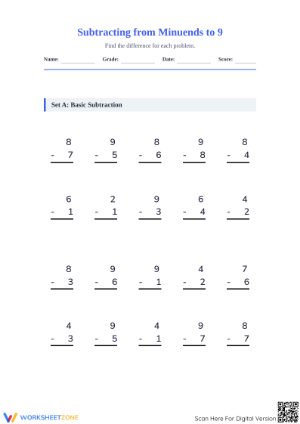
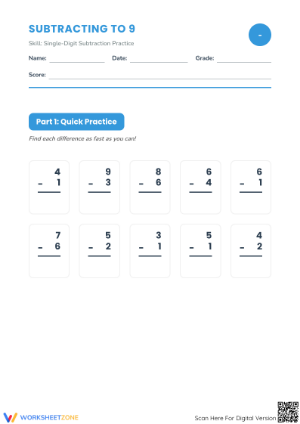
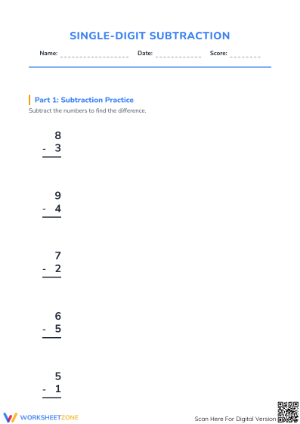
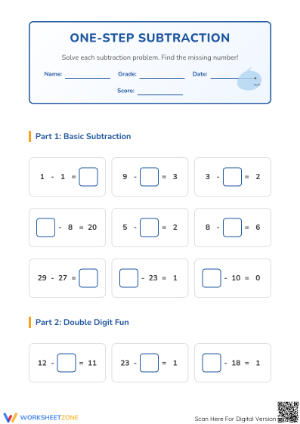
- Within 10: facts like 9 - 4, 8 - 6, and 10 - 7 that push toward the Grade 1 fluency expectation.
- Mixed fact families: pages that interleave related facts so students stop relying on a single pattern.
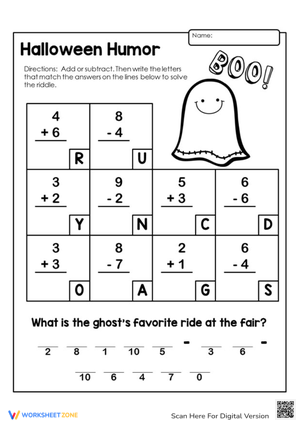
Interleaving matters. When a worksheet groups every 8 - problem together, students can coast on momentum. Mixing 8 - 3 with 7 - 5 and 6 - 2 forces genuine retrieval, which is what fluency actually measures. That's why mixing operations and fact families on a single page is worth the small extra prep.
How These Worksheets Align With Common Core 1.OA.C.6
The clearest reason to use structured subtraction practice in Grade 1 is the standard itself.
The Common Core standard 1.OA.C.6 asks first graders to add and subtract within 20 while demonstrating fluency for addition and subtraction within 10. Classroom research often defines that fluency as accurate recall within about 2-3 seconds, so single digit subtraction worksheets should target automatic answers, not merely correct ones eventually.
1.OA.C.6 also names specific strategies: counting on, making ten, decomposing a number leading to a ten, and using the relationship between addition and subtraction. Worksheets that surface these strategies—rather than isolated drill—help students build the mental tools the standard expects.
The K-2 domain progressions published by the Connecticut State Department of Education lay out how these skills build across grades, and they reinforce the same sequence: students consolidate small-number fluency before extending strategies to larger sums and differences. Worksheets that respect that order tend to produce steadier progress than pages that jump straight to the hardest facts.
Connect Subtraction to the Addition Fact Family
One of the strategies written directly into 1.OA.C.6 is using the relationship between addition and subtraction. Knowing that 8 + 4 = 12 gives a student a fast route to 12 - 8 = 4. For single-digit work, the same logic applies within 10: if a student knows 6 + 3 = 9, then 9 - 3 and 9 - 6 should follow quickly.
You can make the connection explicit on the page. Ask students to write both the addition and the subtraction facts for a set of three numbers, such as 3, 6, and 9. Seeing 3 + 6, 6 + 3, 9 - 3, and 9 - 6 together helps the inverse relationship click, and it doubles the practice value of every fact they already know.
Classroom Implementation
A worksheet only works as well as the routine around it. Here's a repeatable cycle that fits a typical K-1 schedule:
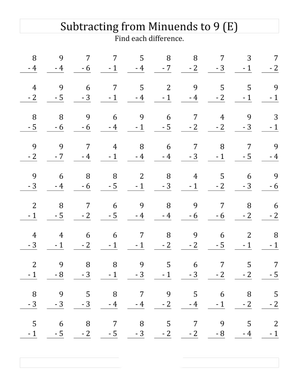
- Short set: Assign 15-20 problems, not a full page of 60. A shorter set keeps focus high and makes daily use sustainable.
- Quick check: Review answers as a group or with a key so students get feedback the same day.
- Error analysis: Note which facts miss most often. Patterns—like every minus-7 fact—tell you what to reteach.
- Small-group reteach: Pull the three or four students who struggled with the same fact family for a focused five-minute review.
Run this cycle a few times a week and worksheets stop being busywork. Each page becomes both practice and a data point about who needs more support.
Balance Timed Practice With Low-Stress Fluency Building
Timed drills build speed, but they aren't risk-free. Research summarized by the Centre for Independent Studies argues that fluency and quick recall genuinely matter for later math learning, yet other classroom research shows timed drills can raise math anxiety in some young students. Both things are true, so how you frame the timer matters as much as the timer itself.
Practical ways to keep timed subtraction low-stress:
- Frame timing as a personal best, not a class race.
- Let students chart their own growth over a week instead of comparing scores.
- Alternate timed pages with untimed practice so speed never becomes the only goal.
It also helps to separate the goal of the day. On some days the target is accuracy, so students work untimed and check carefully. On other days the target is speed, so the timer runs but errors matter less. Naming the goal out loud keeps students from feeling they must be both fast and perfect at once.
Frequently Asked Questions
1. What grade level are single digit subtraction worksheets appropriate for?
They fit late kindergarten through Grade 1 best. Kindergarten targets fluency within 5 (K.OA.A.5), while Grade 1 pushes toward fluency within 10 under 1.OA.C.6. Grade 2 students who need review or intervention also benefit.
2. How many single digit subtraction problems should a first grader practice per session?
A focused set of 15-20 problems usually works better than a full page of 60. Short sets keep attention high and make daily practice realistic without overwhelming students.
3. How do these worksheets align with Common Core 1.OA.C.6?
1.OA.C.6 asks first graders to add and subtract within 20 and demonstrate fluency within 10. Single-digit subtraction pages give the repeated, strategy-based practice that fluency expectation requires.
4. Should single digit subtraction practice be timed?
Timing can build speed toward the roughly 2-3 second recall that defines fluency, but keep it low-stress. Frame timed sets as personal bests and alternate them with untimed practice to avoid math anxiety.
5. How can teachers use these worksheets for intervention or small-group instruction?
Use a completed page to spot which fact families miss most, then pull small groups by shared error pattern. A five-minute reteach on those specific facts is more efficient than reassigning a whole page.