What angle pair relationships worksheets actually teach
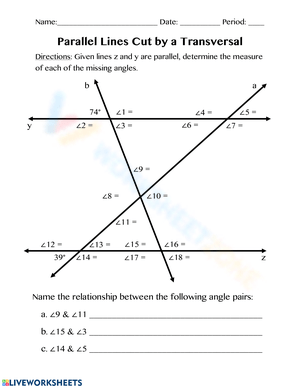
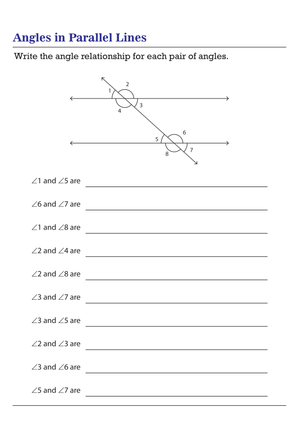
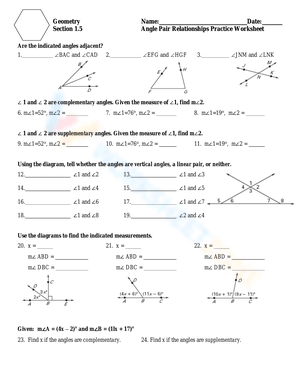
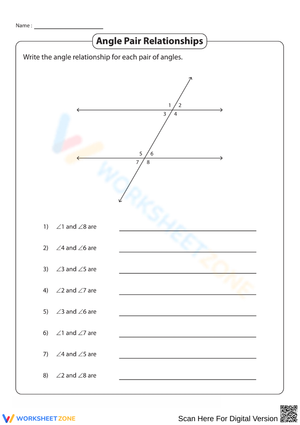
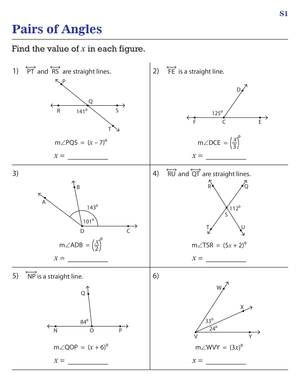
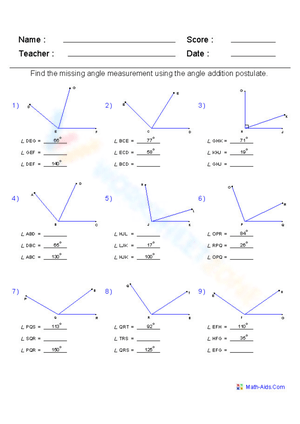
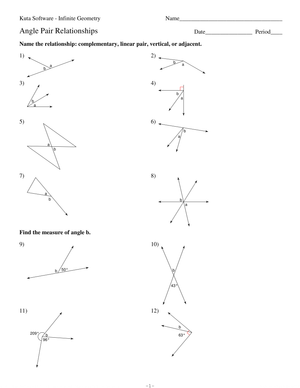
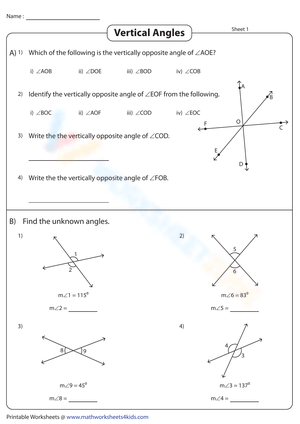
Angle pair relationships worksheets give seventh graders repeated, structured practice with the four angle pairs that anchor middle school geometry: complementary, supplementary, vertical, and adjacent. Instead of memorizing definitions in isolation, students look at labeled figures, decide which relationship applies, and then use that fact to find an unknown angle. For a 7th grade math teacher, the value is practical. You get material that works as a bell-ringer, a small-group task, an independent practice set, or a homework check, all pointed at the same skill your unit is built around.
The four angle pairs students need to know
Most of this unit comes down to four relationships. Good worksheets keep circling back to them until students can name each one on sight.
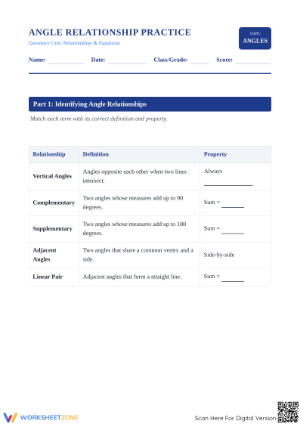
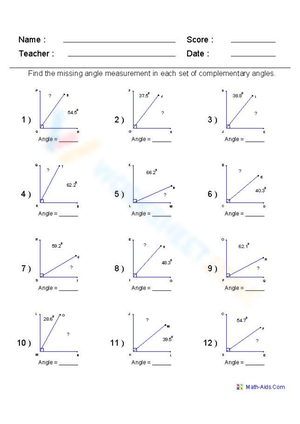
- Complementary angles are two angles whose measures add to 90 degrees.
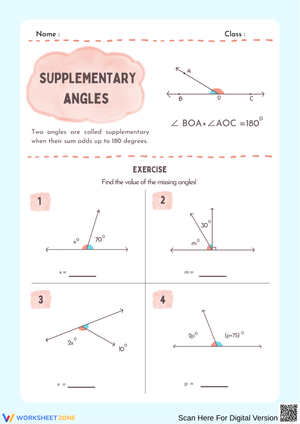
- Supplementary angles are two angles whose measures add to 180 degrees.
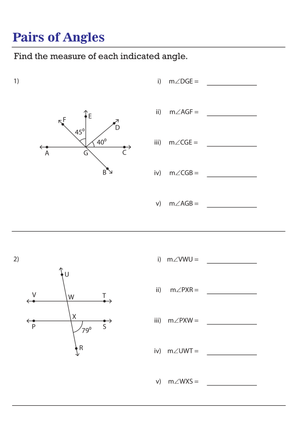
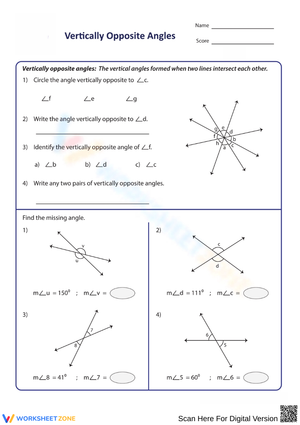
- Vertical angles are formed by two intersecting lines and are always congruent.
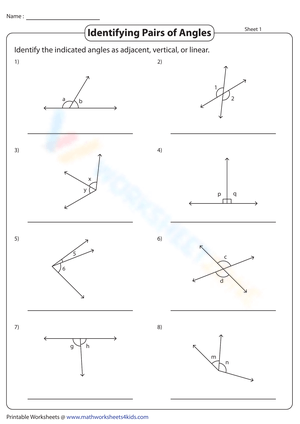
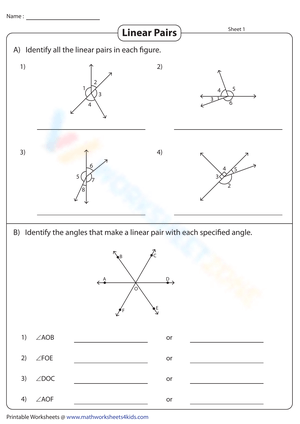
- Adjacent angles share a common vertex and a common side and do not overlap.
The step that separates strong students from struggling ones is not the definitions. It is knowing that a relationship gives you an equation. Once a student sees two angles marked as supplementary, they should reach for x + 47 = 180 without prompting. Worksheets that pair a diagram with a fill-in equation build that reflex faster than pure fact recall.
How these worksheets align with CCSS 7.G.B.5
This topic sits inside one specific standard, which makes alignment easy to defend in a lesson plan or to a curriculum lead.
According to the Common Core State Standards, Grade 7 standard 7.G.B.5 expects students to use facts about supplementary, complementary, vertical, and adjacent angles in a multi-step problem to write and solve simple equations for an unknown angle in a figure. That one standard shapes nearly all seventh-grade angle instruction and the practice sets built for it.
The standard lives in the Geometry domain and builds directly on Grade 4 work with angle measurement in 4.MD.C.7. So students arrive already able to measure and add angles; the new demand is turning a relationship into an equation and solving it. Worksheets aligned to 7.G.B.5 should push past identification into multi-step problems where an unknown angle is the goal.
Common misconceptions these worksheets expose
The most common error is swapping complementary and supplementary. Students who anchor to a memory trick, such as C for corner or 90-degree corner and S for straight line or 180 degrees, recover faster than students relying on rote order. A worksheet that mixes both types on the same page forces the choice instead of letting students coast on a repeated pattern.
A subtler misconception is that adjacent means congruent. Because vertical angles are congruent and often sit next to the angles students are studying, learners overgeneralize and assume any two touching angles must be equal. In practice, adjacent angles are usually unequal, and only their sum is constrained when they form a straight line or right angle. Worksheets that show adjacent angles of clearly different sizes, then ask for the missing measure, break this false rule quickly and prevent it from resurfacing on the unit test.
Scaffolding from diagrams to equations
Seventh graders rarely stumble on the geometry; they stumble on the algebra step. A useful worksheet progression moves in three stages, and you can assign the stages to different students on the same day.
- Stage one: both angles are given numerically, and students confirm the relationship by checking the sum.
- Stage two: one angle is a number and one is a variable, so students write and solve a one-step equation.
- Stage three: angles are written as algebraic expressions, such as 2x + 10 and 3x, requiring a two-step equation.
This staging lets you keep the whole class on angle pair relationships while differentiating the algebra load. Students who need visual support stay in stages one and two with labeled diagrams, while students ready for more work move to stage three expressions.
Classroom Implementation
Angle pair worksheets flex across a full instructional cycle, so you rarely need separate resources for each phase. Early in the unit, use a diagram-heavy sheet as a warm-up where students only label each pair by name. This surfaces who already confuses complementary and supplementary before you invest a full lesson.
Mid-unit, shift to mixed practice that blends identification with equation writing, and use it for small-group intervention. Pull the four or five students who missed the warm-up and work stage-two problems together while the rest of the class runs stage-three sheets independently. Because every version targets the same standard, groups stay on the same topic even at different depths.
Before the test, a single mixed worksheet works as a formative checkpoint. Score it quickly for two things only: did the student pick the right relationship, and did they set up a correct equation. Those two error types tell you whether to reteach geometry or reteach solving. For students who want extra reps, Khan Academy's practice on identifying supplementary, complementary, and vertical angles pairs well with printed sheets for at-home review.
Frequently Asked Questions
1. What grade level covers angle pair relationships?
Complementary, supplementary, vertical, and adjacent angle relationships are formally taught in Grade 7 under CCSS 7.G.B.5. Students arrive prepared by earlier angle measurement work in Grade 4 (4.MD.C.7), so seventh grade is where the four pairs and the related equation solving come together.
2. What is the difference between complementary and supplementary angles?
Complementary angles have measures that add to 90 degrees, forming a right angle. Supplementary angles have measures that add to 180 degrees, forming a straight line. The relationship, not the position of the angles, tells you which sum to use when solving for an unknown.
3. How do these worksheets align with Common Core standard 7.G.B.5?
7.G.B.5 asks students to use facts about supplementary, complementary, vertical, and adjacent angles in multi-step problems to write and solve simple equations for an unknown angle. Worksheets that move from identifying pairs to setting up and solving equations cover the standard directly.
4. How can teachers use angle pair worksheets for intervention or review?
Use a short diagram-based sheet to diagnose who confuses the pairs, then pull those students for small-group work on one-step equations while other students practice two-step expressions. The same worksheet format also serves as a pre-test formative check, since it shows whether errors come from geometry or from algebra.












 Interactive Worksheet Maker
 Quiz Maker
 Word Search Maker
 Crossword Puzzle Maker
 Word Scramble Generator
 Sentence Scramble Generator
 Handwriting Worksheet Generator
 Name Tracing Generator
 Fill In The Blank Generator