


























Views
Downloads
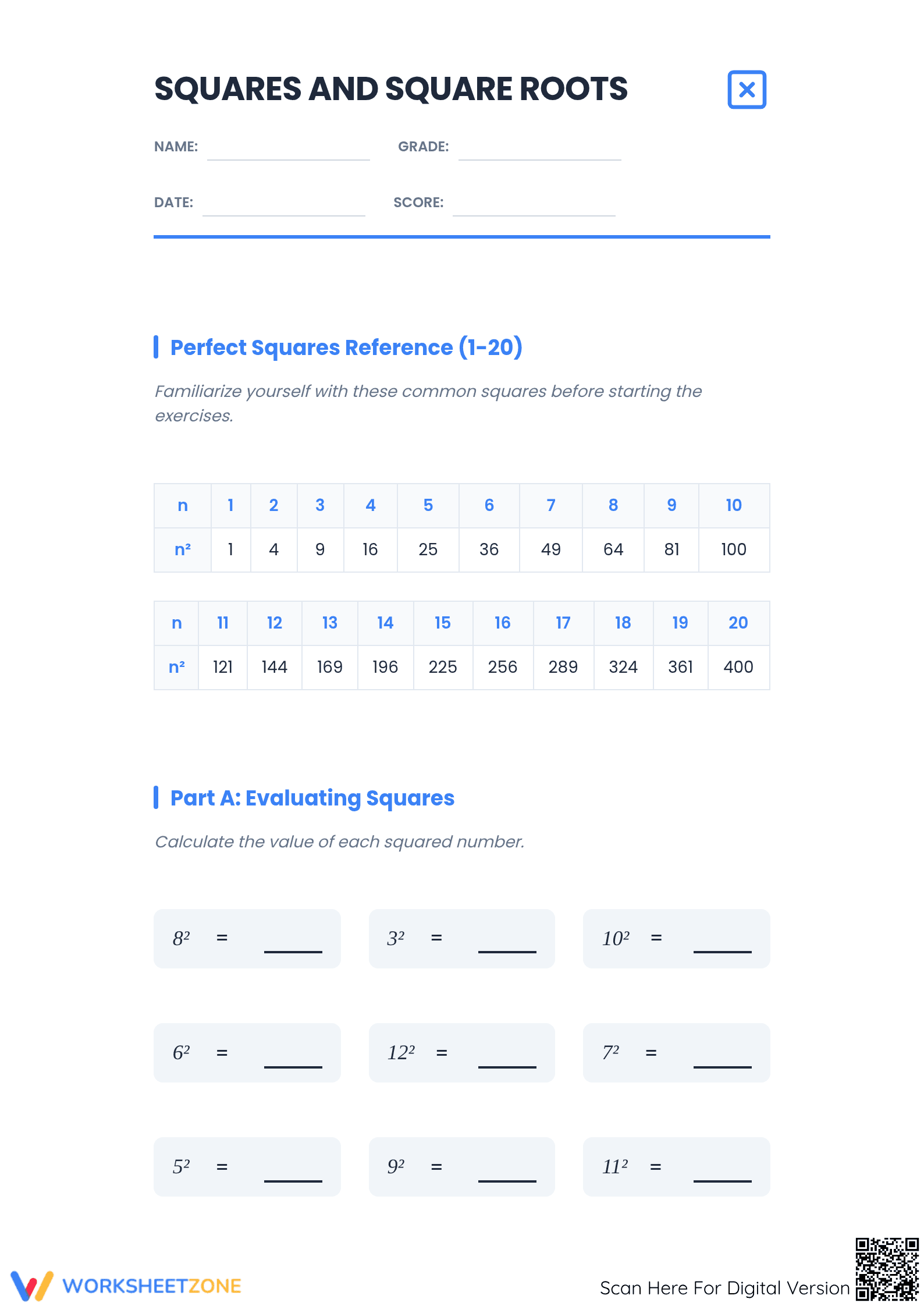


Essential Squares and Square Roots Worksheet | Grade 7
Paste this activity's link or code into your existing LMS (Google Classroom, Canvas, Teams, Schoology, Moodle, etc.).
Students can open and work on the activity right away, with no student login required.
You'll still be able to track student progress and results from your teacher account.
Mastering the relationship between squares and square roots is a fundamental milestone in middle school mathematics. This comprehensive worksheet provides students with a structured path to fluency, moving from simple calculation to complex multi-step problems. By engaging with these exercises, learners solidify their understanding of inverse operations and prepare for higher-level algebra and geometry concepts.
At a Glance
- Grade: 7 · Subject: Math
- Standard:
8.EE.A.2— Evaluate square roots of small perfect squares and solve simple quadratic equations- Skill Focus: Squares and Square Roots Evaluation
- Format: 3 pages · 33 problems · Answer key included · PDF
- Best For: Pre-Algebra practice and formative assessment
- Time: 30–45 minutes
What's Inside
This three-page resource is thoughtfully organized to build student confidence. It begins with a "Perfect Squares Reference (1-20)" table, serving as an immediate scaffold for learners. The exercises are divided into five distinct sections: simple squares, basic square roots, mixed operations combining both skills, real-world application word problems involving area and perimeter, and a final "Challenge" section featuring nested radicals and squared roots.
Skill Progression
The worksheet follows a proven gradual release model. First, Guided Practice in Parts A and B utilizes the provided reference table to build calculation fluency with 21 straightforward evaluation tasks. Next, Supported Practice in Part C introduces mixed operations, requiring students to apply multiple steps to solve six expressions. Finally, Independent Practice in Parts D and E challenges students to apply their knowledge to geometry-based word problems and abstract mathematical puzzles without direct scaffolding.
Standards Alignment
The primary focus of this worksheet is standard `CCSS.MATH.CONTENT.8.EE.A.2`, which requires students to evaluate square roots of small perfect squares. It also supports `CCSS.MATH.CONTENT.7.EE.B.3` by asking students to solve multi-step real-life and mathematical problems posed with positive and negative rational numbers. Both standard codes can be copied directly into lesson plans, IEP goals, or district curriculum mapping tools.
How to Use It
This resource is ideal for use immediately after direct instruction on exponents and radicals. Teachers can assign Part A and B as a quick exit ticket to observe which students are still relying heavily on the reference table versus those who have internalized the facts. For more advanced learners, the mixed operations and challenge sections provide an excellent extension activity while the rest of the class works on foundational fluency. A completion time of 35 minutes is expected.
Who It's For
This worksheet is designed for 7th and 8th-grade math students, particularly those in Pre-Algebra tracks. It is also an effective remediation tool for high school students who need to strengthen their mental math skills before moving into quadratic functions. The clear layout and reference table make it highly accessible for students with IEPs or those requiring visual scaffolds. It pairs naturally with a lesson on the Pythagorean Theorem.
According to a ScienceDirect TpT Analysis, effective math instruction requires a balance of procedural fluency and conceptual application. This worksheet aligns with 8.EE.A.2 through a progression of 33 tasks that move from evaluating perfect squares to solving real-world area problems. By explicitly linking the inverse relationship between squaring a number and finding its root, the resource helps students build a durable mental model of non-linear operations. Research from Fisher & Frey (2014) highlights that gradual release structures—moving from scaffolded reference tables to independent challenge problems—significantly improve long-term retention. This resource ensures that Grade 7 students do not just memorize values but understand how to manipulate them in varied contexts, from calculating fencing to solving nested radical expressions.


