


























Views
Downloads

Essential Algebraic Expressions Vocabulary Cards | Grade 6-7
Paste this activity's link or code into your existing LMS (Google Classroom, Canvas, Teams, Schoology, Moodle, etc.).
Students can open and work on the activity right away, with no student login required.
You'll still be able to track student progress and results from your teacher account.
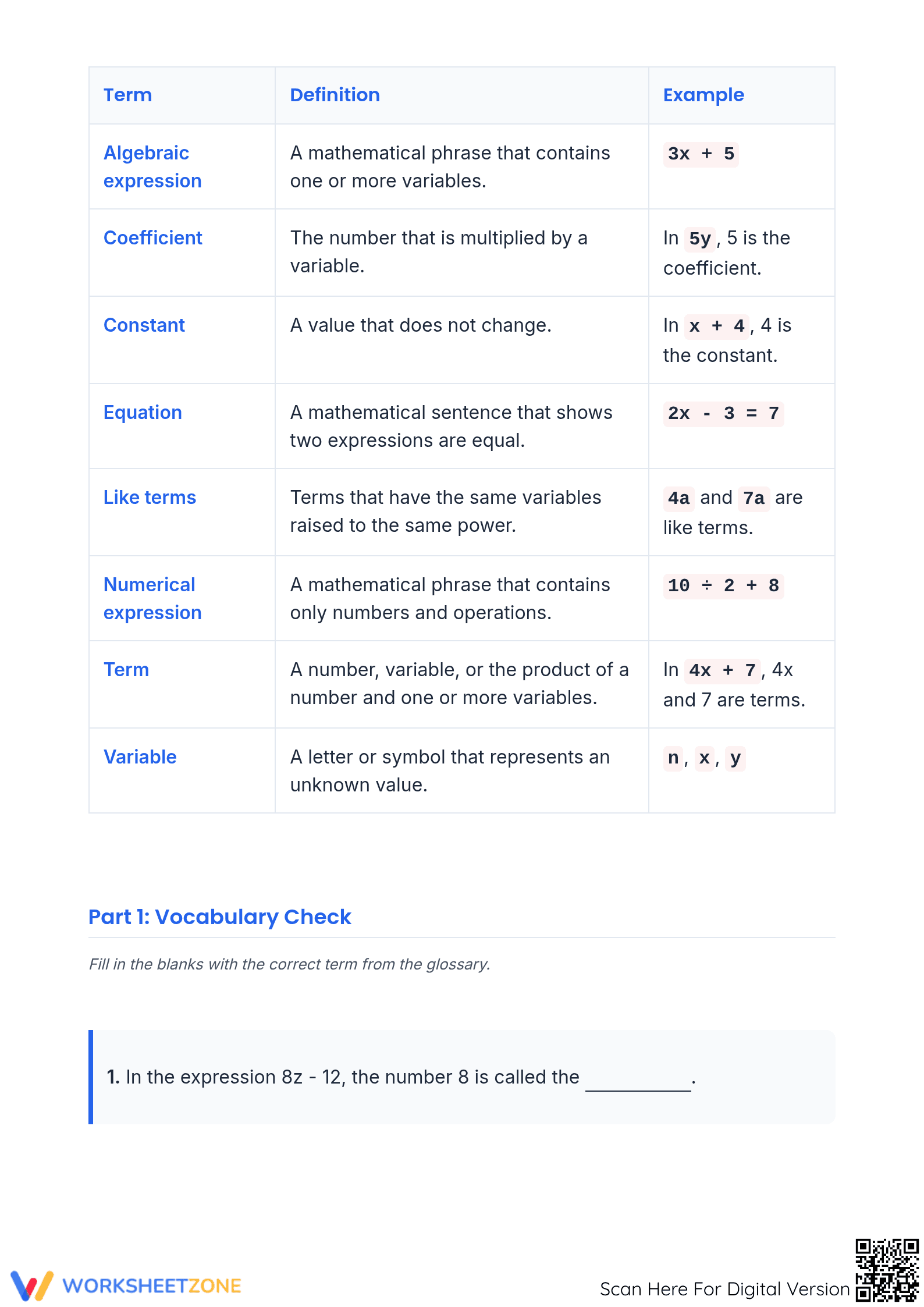
This Grade 6-7 math worksheet provides a comprehensive glossary and interactive study cards to help students master algebraic terminology. By defining and identifying parts of expressions, learners build the linguistic foundation necessary for solving complex equations. It transforms abstract concepts like coefficients and constants into concrete, manageable knowledge.
At a Glance
- Grade: 6-7 · Subject: Math & Algebra
- Standard:
CCSS.MATH.CONTENT.6.EE.A.2.B— Identify parts of an expression using mathematical terms like coefficient and term- Skill Focus: Algebraic Vocabulary Mastery
- Format: 5 pages · 8 problems · Answer key included · PDF
- Best For: Introduction to Algebra and Vocabulary Review
- Time: 20–30 minutes
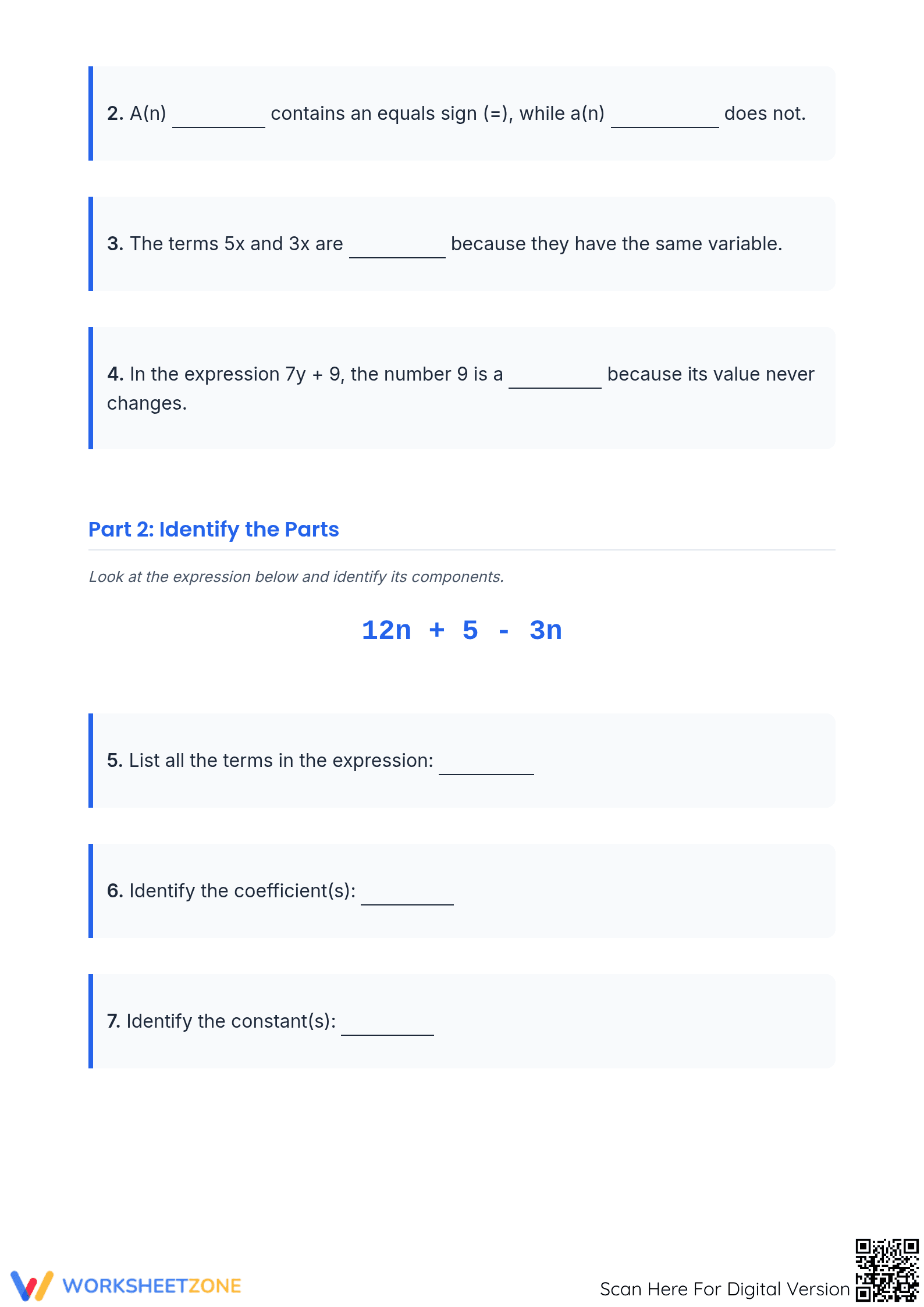
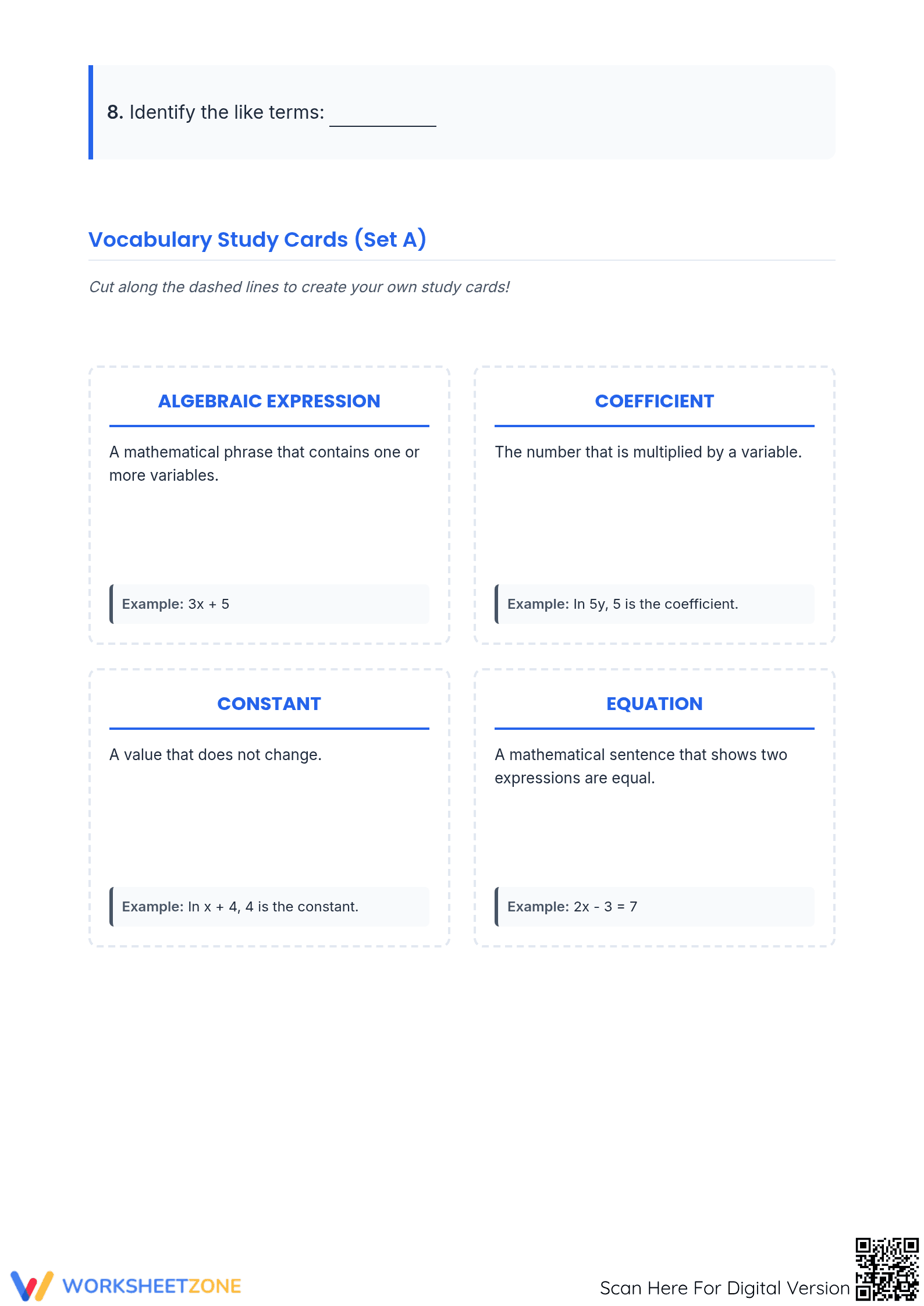
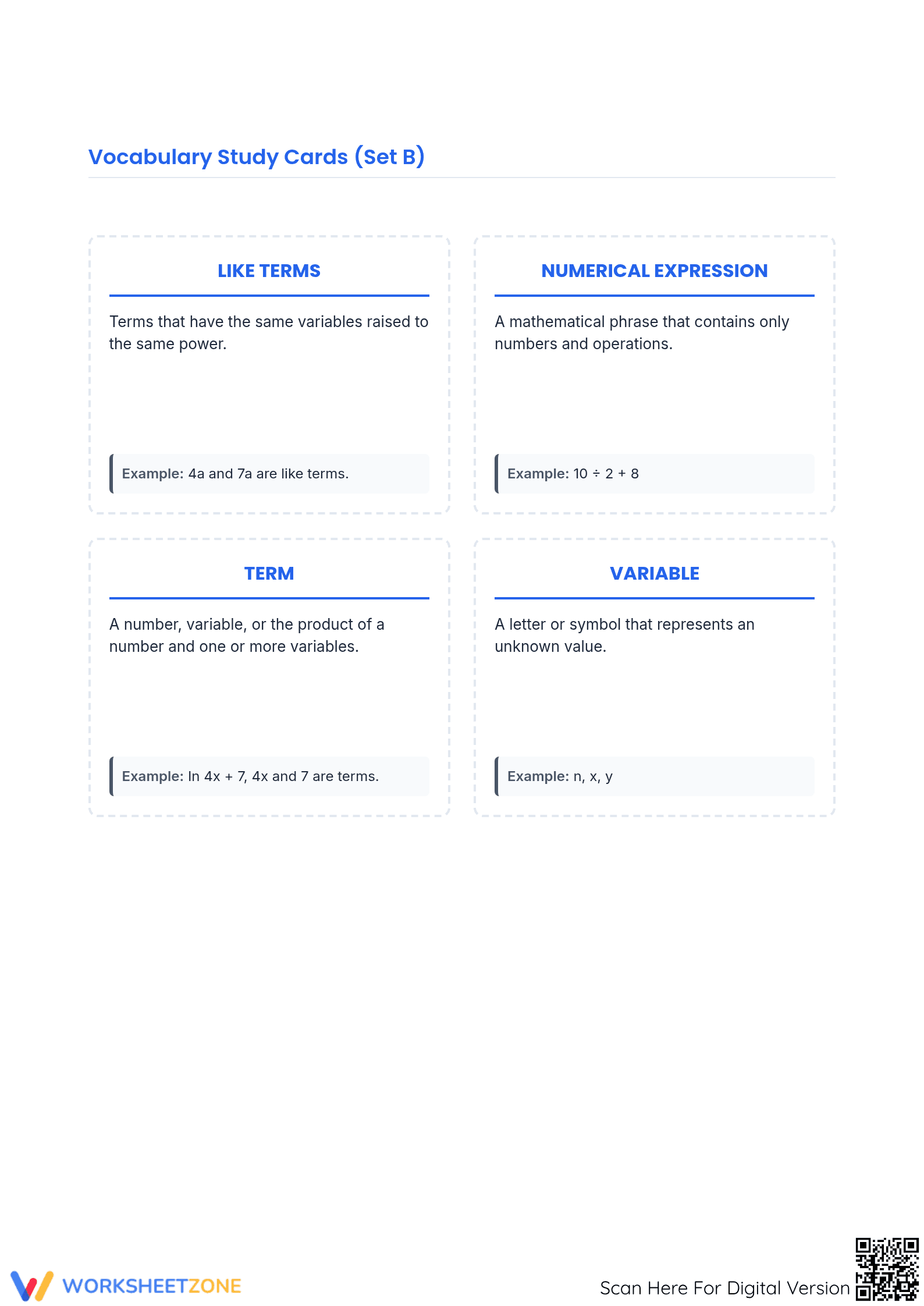
The resource includes a detailed glossary table featuring terms, definitions, and clear examples. Following the reference sheet, students complete a two-part assessment: a vocabulary check and a component identification exercise. Finally, two pages of printable study cards are provided, designed with dashed lines for easy cutting and long-term retention.
The zero-prep workflow is designed for maximum efficiency. First, print the 5-page PDF in less than 30 seconds. Second, distribute the glossary and practice sheets to students for immediate engagement. Third, review the answers using the included key or have students cut out their study cards for independent practice. Total teacher setup time is under 2 minutes, making this an ideal sub plan.
This worksheet aligns with `CCSS.MATH.CONTENT.6.EE.A.2.B`, which requires students to identify parts of an expression using mathematical terms (sum, term, product, factor, quotient, coefficient). It also supports ELA literacy standards for technical vocabulary. Both standard codes can be copied directly into lesson plans, IEP goals, or district curriculum mapping tools.
Use this as a "front-loading" activity before starting a unit on solving equations. It serves as an excellent formative assessment; observe if students can distinguish between a "term" and a "coefficient" during the identification phase. Expected completion time is 25 minutes, including the card-cutting activity for the 8 included terms.
This is ideal for general education middle schoolers, English Language Learners (ELLs) who need visual math support, and students with IEPs focusing on mathematical communication. It pairs perfectly with an anchor chart on the "anatomy of an expression" or a direct instruction lesson on variable substitution.
According to the RAND AIRS 2024 report, explicit vocabulary instruction in mathematics is a critical predictor of long-term success in high school algebra. This resource addresses that need by isolating technical terms like "constant" and "like terms" within a structured, multi-modal framework. By combining a visual glossary with active identification tasks and tactile study cards, the worksheet adheres to the gradual release of responsibility model. Research from Fisher & Frey (2014) suggests that providing students with portable reference tools, such as the included study cards, significantly reduces cognitive load during multi-step problem solving. This 5-page packet ensures that Grade 6 and 7 students move beyond rote memorization toward a functional understanding of mathematical language. The inclusion of CCSS.MATH.CONTENT.6.EE.A.2.B alignment makes it a reliable asset for data-driven classrooms seeking to close the achievement gap in algebraic literacy.


