


























Views
Downloads

Complete 3-Digit Operations Test | Grade 3 Aligned Math
Paste this activity's link or code into your existing LMS (Google Classroom, Canvas, Teams, Schoology, Moodle, etc.).
Students can open and work on the activity right away, with no student login required.
You'll still be able to track student progress and results from your teacher account.
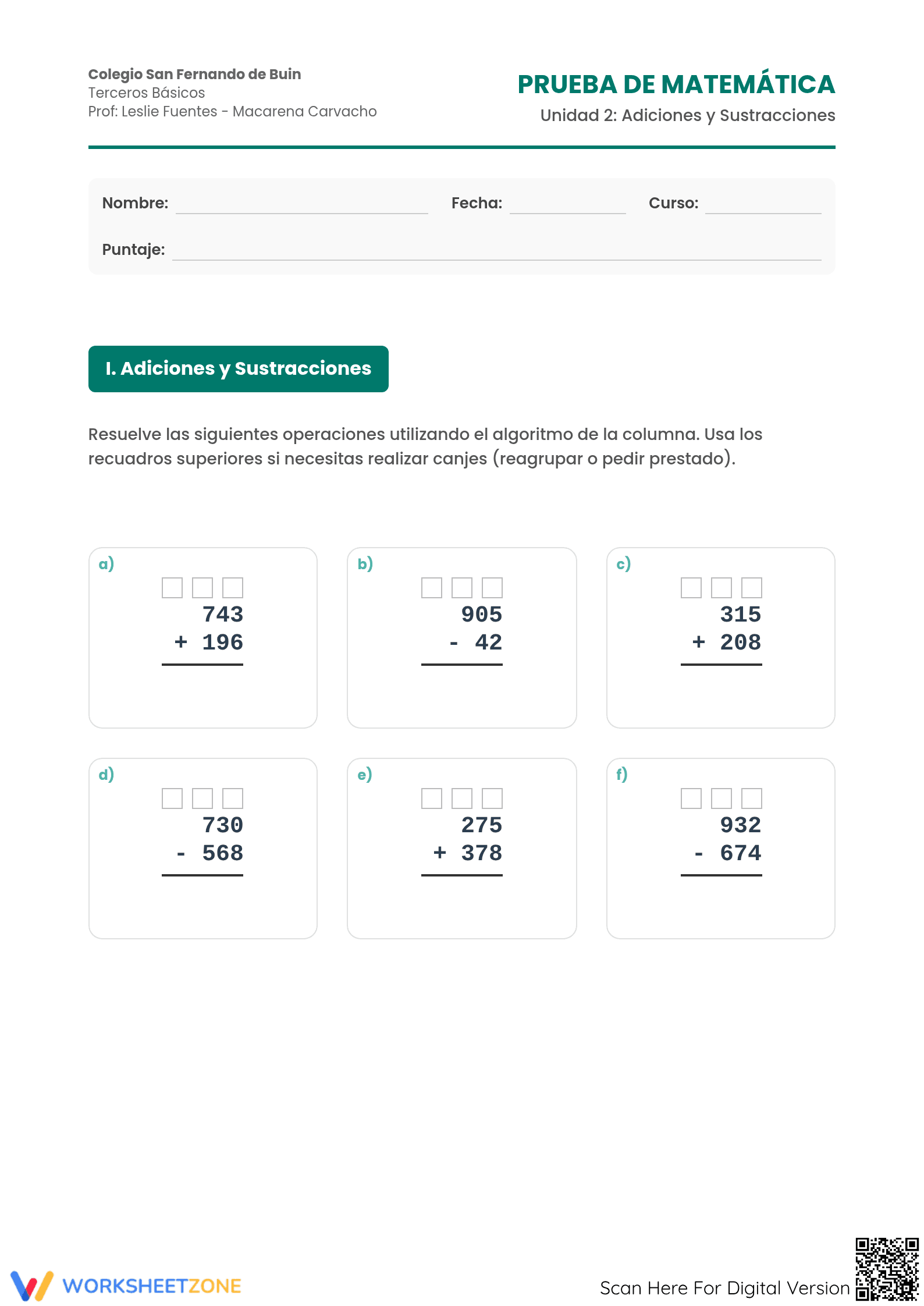
This comprehensive Grade 3 assessment evaluates student proficiency in 3-digit addition and subtraction, including regrouping and multi-step problem solving. Students demonstrate mastery of the column algorithm while establishing critical connections between operations. This printable test provides clear evidence of student progress toward fluency with numbers up to 1,000.
At a Glance
- Grade: 3 · Subject: Math
- Standard:
CCSS.MATH.CONTENT.3.NBT.A.2— Add and subtract within 1000 using place value strategies- Skill Focus: 3-Digit Addition & Subtraction
- Format: 3 pages · 19 problems · Answer key included · PDF
- Best For: End-of-unit summative assessment
- Time: 40–50 minutes
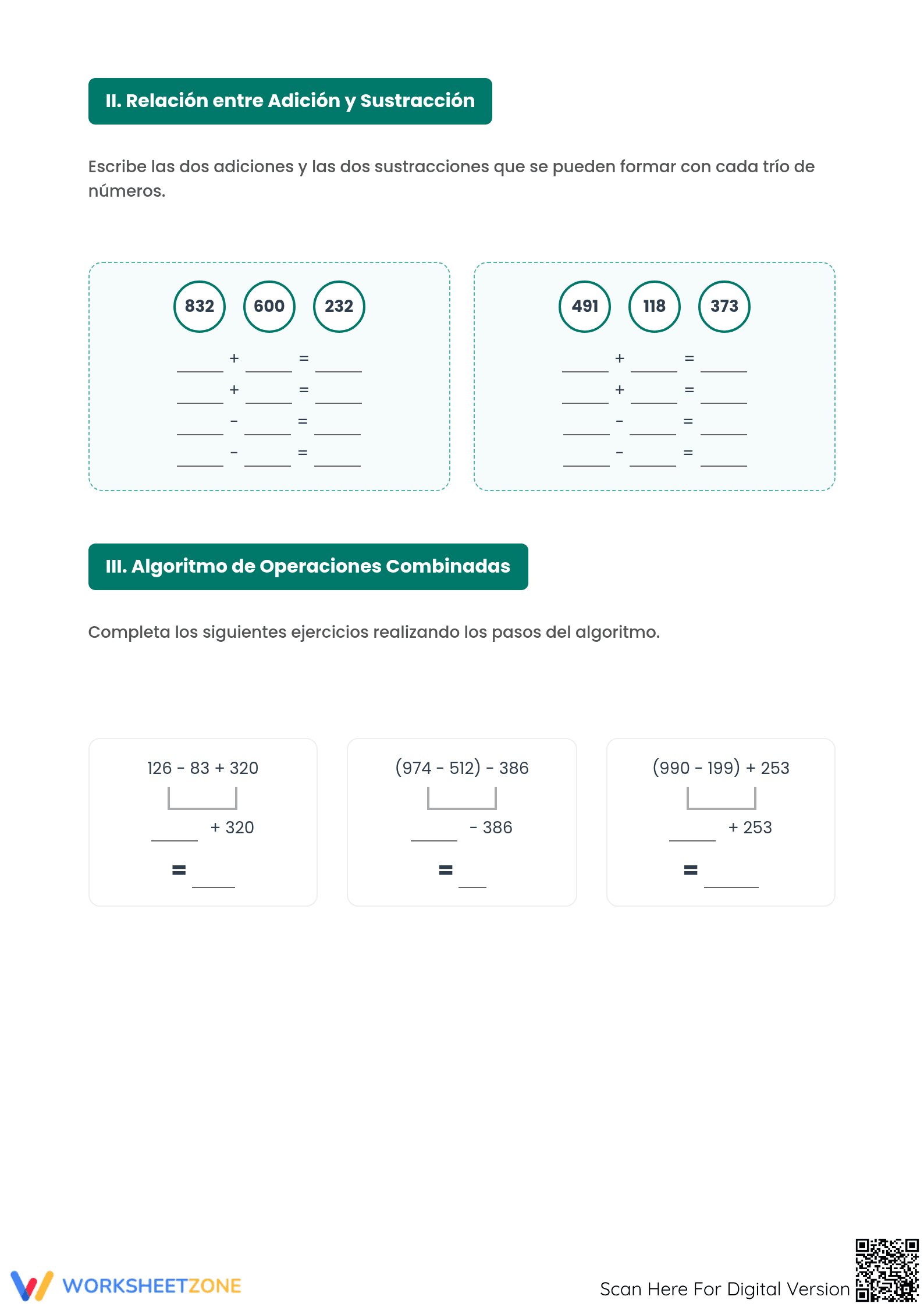
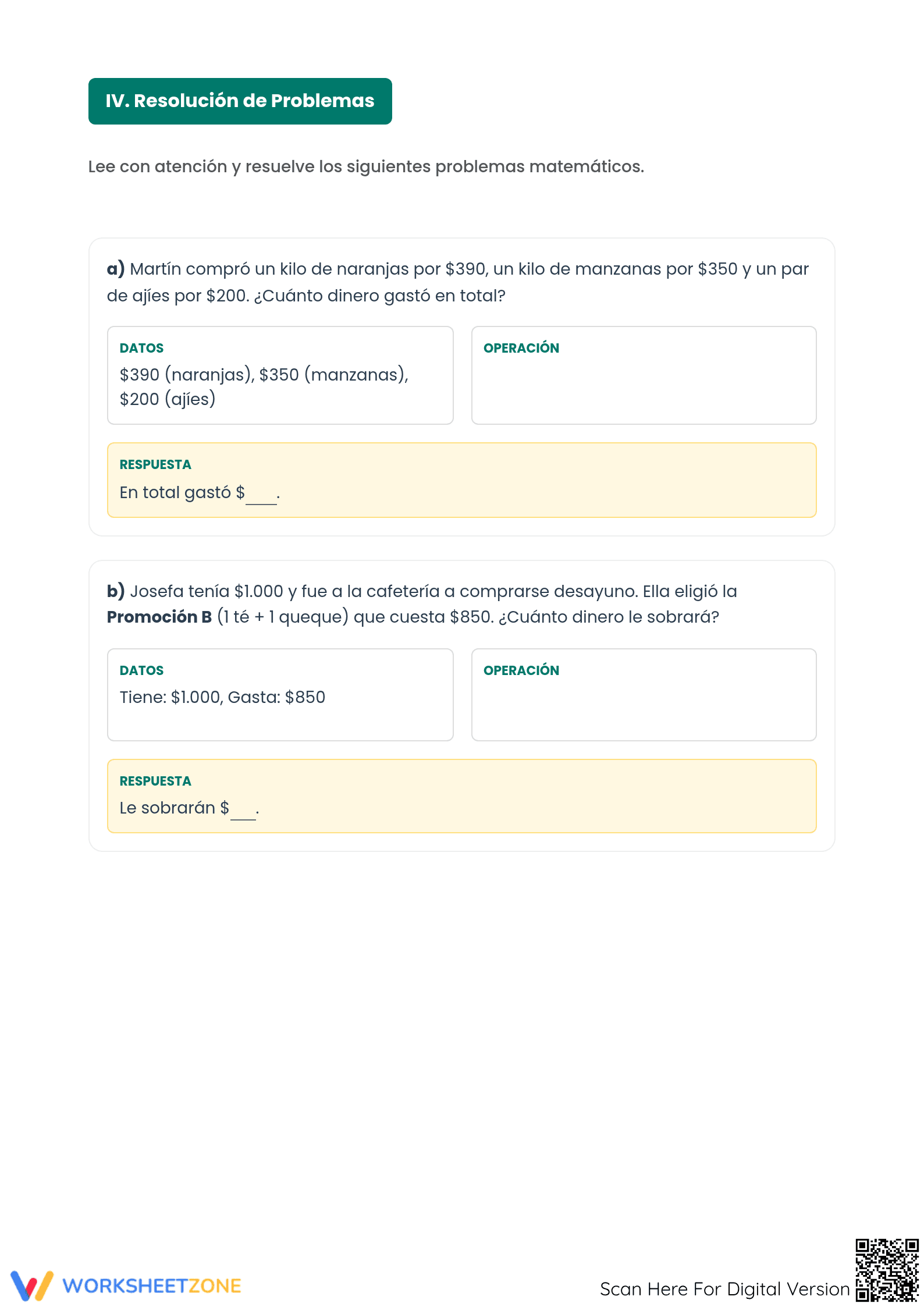
This 3-page assessment features four distinct sections designed to measure procedural and conceptual understanding. Section I includes six computation problems with regrouping boxes to support the column algorithm. Section II explores fact families to verify the relationship between addition and subtraction. Section III focuses on combined operations, while Section IV presents two real-world word problems requiring data extraction and operational execution. A complete answer key is provided for efficient grading.
The assessment is structured to provide clear evidence of student performance across cognitive tiers:
- Approaching Mastery: Performing basic 3-digit addition and subtraction with limited scaffolding.
- Meeting Standard: Applying the column algorithm with regrouping and identifying fact family relationships.
- Exceeding Standard: Solving combined operations and interpreting complex word problems with accurate setup.
Scores can be recorded directly on the score line for entry into gradebooks or IEP progress monitoring systems.
Standards Alignment
The primary focus of this worksheet is CCSS.MATH.CONTENT.3.NBT.A.2: "Fluently add and subtract within 1000 using strategies and algorithms based on place value, properties of operations, and/or the relationship between addition and subtraction." Additionally, Section IV supports CCSS.MATH.CONTENT.3.OA.D.8 through two-step word problems. Both standard codes can be copied directly into lesson plans, IEP goals, or district curriculum mapping tools.
How to Use It
Use this as a formal summative assessment for 3-digit operations. For a formative approach, assign Section IV during small-group instruction to observe translation of narrative scenarios into operations. Watch for consistent use of regrouping boxes as a key indicator of algorithmic understanding. Completion usually takes 40 to 50 minutes.
Who It's For
Optimized for Grade 3, this also serves as a Grade 4 review or Grade 5 intervention. It pairs naturally with base-ten blocks for students needing concrete modeling before transitioning to the abstract algorithm provided in the worksheet.
Research from EdReports 2024 emphasizes that high-quality assessments must balance procedural fluency with conceptual understanding and real-world application. This assessment aligns with that finding by moving from isolated computation (Standard CCSS.MATH.CONTENT.3.NBT.A.2) to the application of fact families and complex word problems. By requiring students to "show their work" through the column algorithm and data extraction boxes, the resource provides educators with a window into the student's mathematical reasoning process. According to the NAEP, proficiency in multi-digit operations is a critical predictor of success in middle-school algebraic thinking. Utilizing standardized assessment tools like this ensures that instruction remains targeted and that learning gaps are identified early. This worksheet provides the structure necessary to confirm that students are not merely memorizing steps but are internalizing the properties of operations and place value logic required for long-term mathematical success.


