


























Views
Downloads

Essential Large Number Addition and Subtraction Worksheet
Paste this activity's link or code into your existing LMS (Google Classroom, Canvas, Teams, Schoology, Moodle, etc.).
Students can open and work on the activity right away, with no student login required.
You'll still be able to track student progress and results from your teacher account.
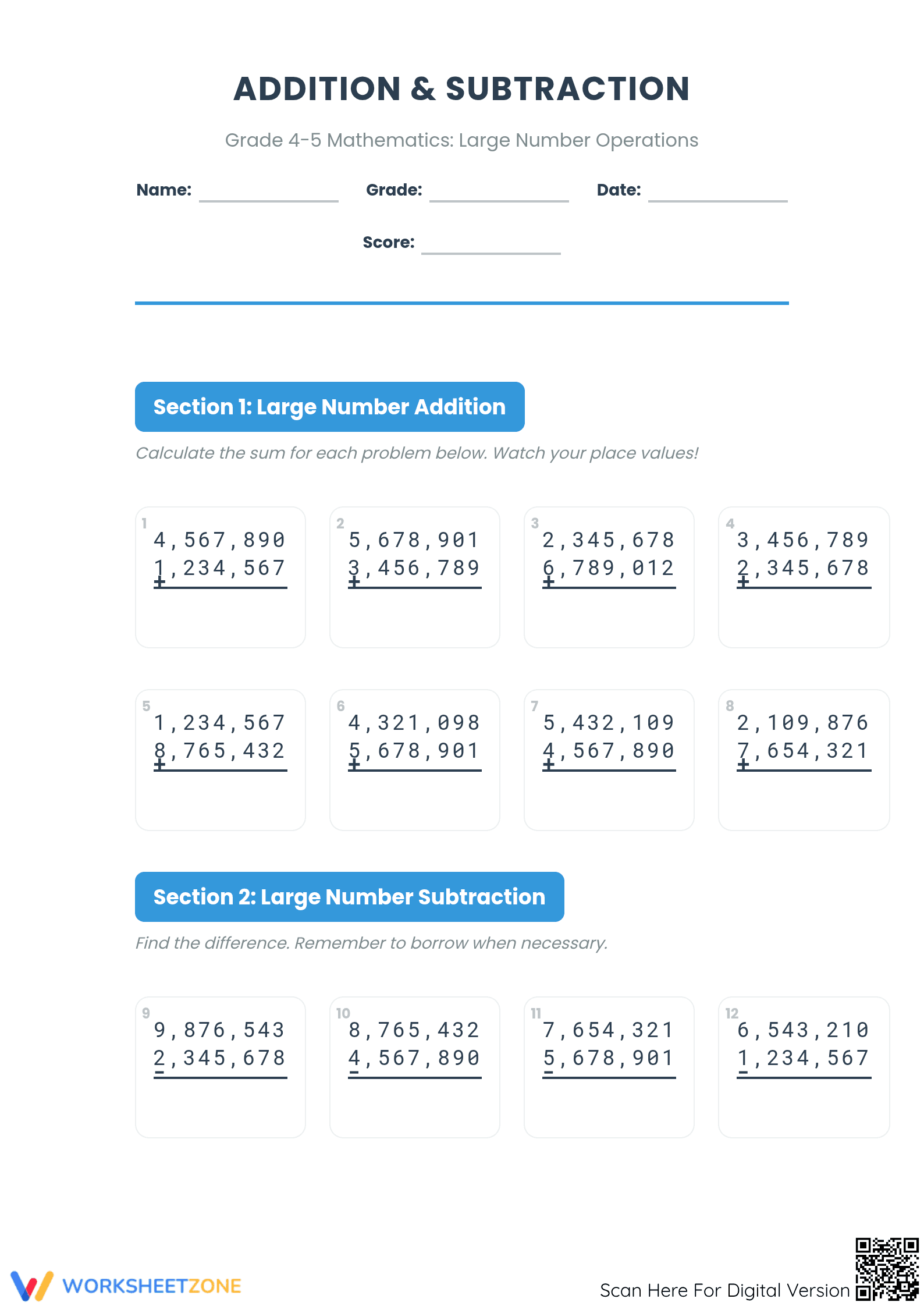
This comprehensive mathematics worksheet provides intensive practice for Grade 4 and Grade 5 students mastering multi-digit addition and subtraction. By working with numbers into the millions and hundred-millions, learners develop computational fluency and place value awareness. This resource ensures students can accurately execute the standard algorithm for large-scale whole number operations.
At a Glance
- Grade: 4–5 · Subject: Math
- Standard:
CCSS.MATH.CONTENT.4.NBT.B.4— Fluently add and subtract multi-digit whole numbers using the standard algorithm- Skill Focus: Large Number Operations
- Format: 3 pages · 32 problems · Answer key included · PDF
- Best For: Computational fluency practice and homework
- Time: 25–40 minutes
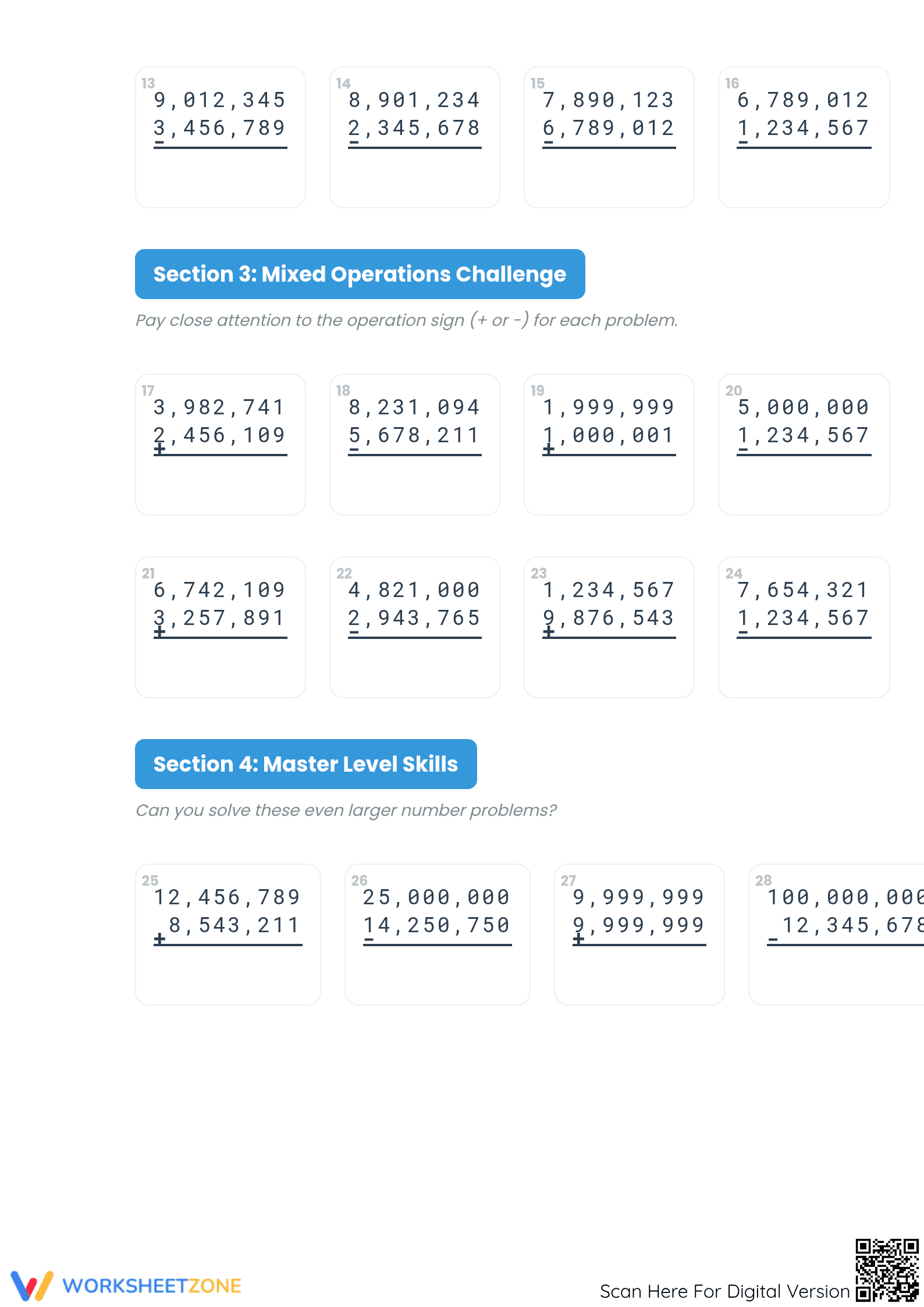
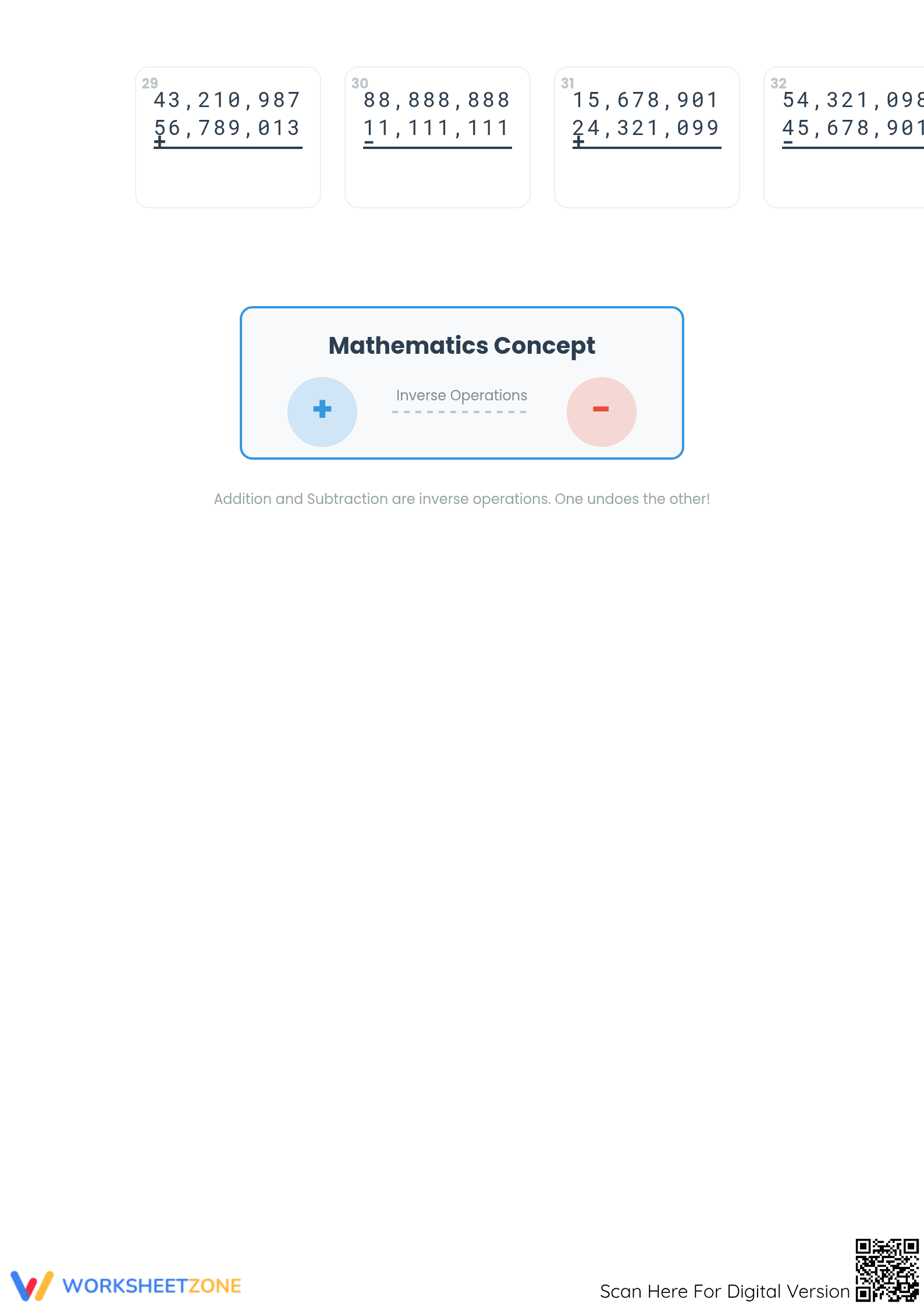
This three-page PDF packet features 32 structured problems divided into four targeted sections. Section 1 focuses on large number addition, while Section 2 shifts to large number subtraction. Section 3 introduces a Mixed Operations Challenge to test operational sign recognition, and Section 4 provides Master Level Skills with numbers exceeding one hundred million. The layout includes clear workspace for vertical calculations and an integrated answer key for rapid grading.
The workflow for this resource is designed for immediate classroom implementation. First, print the three-page PDF (approx. 10 seconds per student set). Second, distribute the materials for independent or guided practice (1 minute). Third, review the completed tasks using the provided answer key (under 1 minute per page). This zero-prep structure makes it an ideal candidate for emergency substitute plans or sudden instructional shifts.
Aligned primarily with CCSS.MATH.CONTENT.4.NBT.B.4, students must fluently add and subtract multi-digit whole numbers using the standard algorithm. The inclusion of numbers beyond one million also supports Grade 5 place value standards. Both standard codes can be copied directly into lesson plans, IEP goals, or district curriculum mapping tools.
Use this worksheet during the "Independent Practice" phase of a lesson after direct instruction on regrouping and borrowing. It serves as a strong formative-assessment tool; observe students on Section 3 to see if they correctly switch between addition and subtraction strategies. Completion typically takes 30 minutes, fitting a standard class period activity block perfectly.
This resource is tailored for students who are moving beyond basic arithmetic into complex multi-digit calculations. It is particularly effective for learners requiring extra repetition to solidify the standard algorithm. Pair this worksheet with a place value anchor chart or a digital number line for students needing additional visual scaffolds.
The development of computational fluency in multi-digit operations is a cornerstone of the upper elementary mathematics curriculum. According to EdReports 2024, high-quality instructional materials must provide sufficient practice with the standard algorithm to ensure students reach the fluency benchmarks required for middle school algebraic success. This worksheet addresses the CCSS.MATH.CONTENT.4.NBT.B.4 standard, requiring students to execute addition and subtraction with precision across multiple place values. Research from Fisher & Frey (2014) emphasizes that gradual release models, supported by structured practice sets like this 32-problem packet, significantly improve long-term retention of procedural knowledge. By isolating the mechanics of large number arithmetic, teachers can identify specific misconceptions in regrouping or borrowing before they impede more complex mathematical reasoning. This resource provides a reliable, evidence-based pathway for students to demonstrate mastery of whole number operations through repetitive, high-success practice opportunities.


