


























Views
Downloads
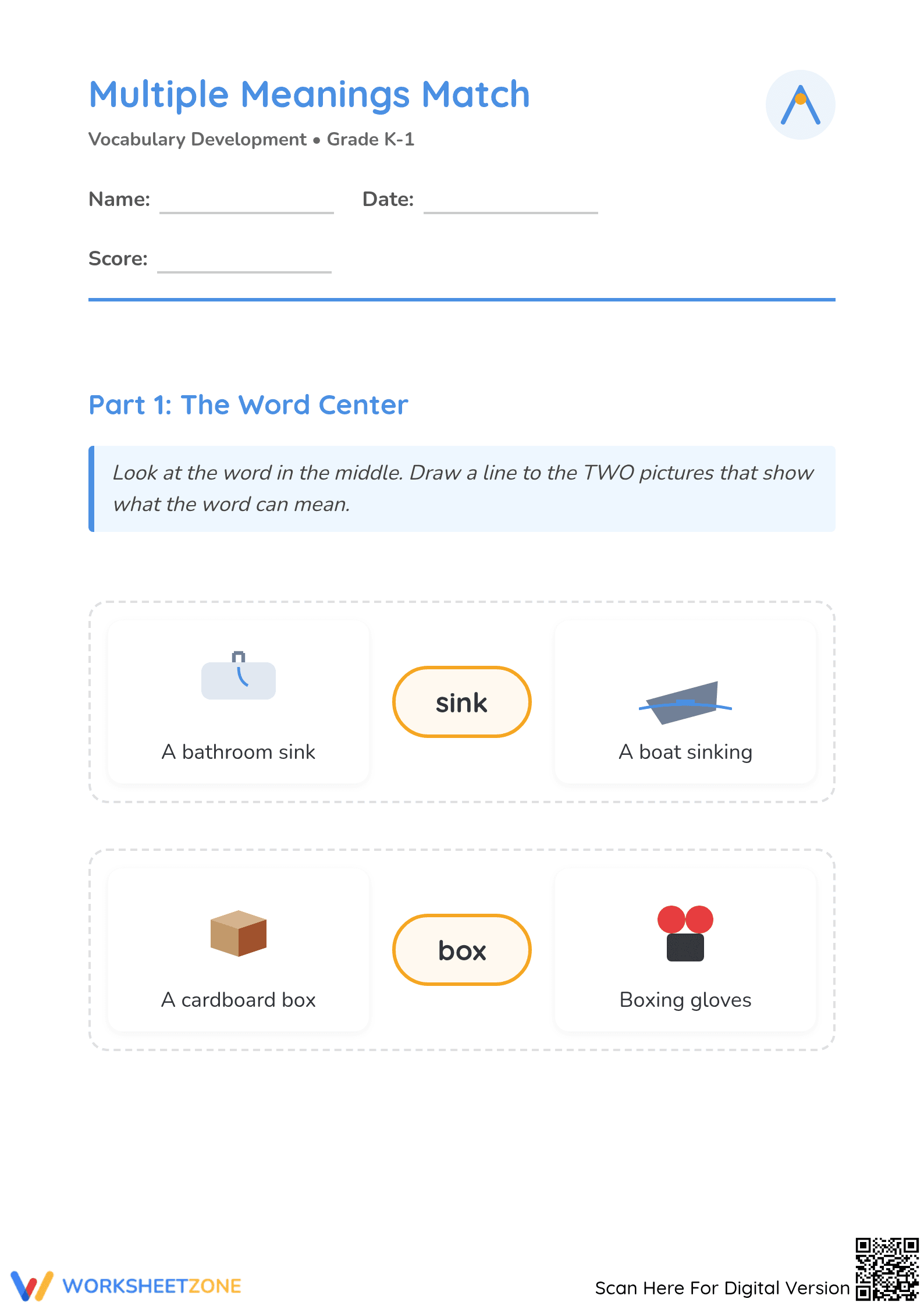


Printable Multiple Meaning Words Worksheet | Grade K-1 ELA
Paste this activity's link or code into your existing LMS (Google Classroom, Canvas, Teams, Schoology, Moodle, etc.).
Students can open and work on the activity right away, with no student login required.
You'll still be able to track student progress and results from your teacher account.
This Grade K-1 ELA worksheet provides a comprehensive introduction to multiple-meaning words. Students learn to distinguish between different definitions of the same word through visual matching and contextual application. Young learners build the foundation for reading comprehension and linguistic flexibility in early elementary grades.
At a Glance
- Grade: K-1 · Subject: ELA
- Standard:
L.K.4.A— Identify new meanings for familiar words and apply them accurately in context- Skill Focus: Multiple Meaning Words (Homonyms)
- Format: 3 pages · 8 problems · Answer key included · PDF
- Best For: Independent practice and vocabulary centers
- Time: 15–25 minutes
What's Inside
The three-page resource is divided into learning phases. Page one features "The Word Center," where students match words like "sink" and "box" to pairs of pictures. Page two transitions to "Which One Fits?", requiring students to use context clues within simple sentences to select the correct definition. The final page includes "Word Play," a creative extension where students generate and illustrate their own homonym.
Skill Progression
- Guided practice: The initial matching tasks use illustrations to anchor two meanings for common nouns and verbs, providing 4 pairs.
- Supported practice: Three multiple-choice sentence tasks shift the focus from visual recognition to semantic analysis using familiar classroom vocabulary.
- Independent practice: The final creative task removes scaffolds, challenging students to synthesize their understanding by identifying and illustrating a new word-meaning pair.
This follows the gradual-release I Do, We Do, You Do framework.
Standards Alignment
The alignment is CCSS.ELA-LITERACY.L.K.4.A: "Identify new meanings for familiar words and apply them accurately (e.g., knowing duck is a bird and learning the verb to duck)." The resource also supports L.1.4.A by requiring students to use sentence-level context as a clue to the meaning of a word. Both standard codes can be copied directly into lesson plans, IEP goals, or district curriculum mapping tools.
How to Use It
Use this worksheet during the "You Do" phase of a vocabulary lesson. After introducing the concept of homonyms with an anchor chart, distribute page one to check for initial understanding. Use the "Which One Fits?" section as a formative assessment to see if students can apply the concept without direct visual aids. Expect students to spend 20 minutes for completion and review.
Who It's For
This resource is for Kindergarten and Grade 1 students, including English Language Learners who benefit from visual-word associations. It is an ideal pairing for a direct instruction lesson on "Words with Many Jobs" or as a supplement to a reading passage that features multiple-meaning vocabulary.
Alignment to standard CCSS.ELA-LITERACY.L.K.4.A is critical for early literacy development, as multiple-meaning words comprise a significant portion of high-frequency vocabulary. According to Fisher & Frey (2014), visual scaffolding in vocabulary acquisition allows students to create mental models that bridge the gap between phonological recognition and semantic depth. This worksheet facilitates that process by requiring students to navigate 8 distinct tasks that move from concrete visual matching to abstract contextual application. Research from EdReports 2024 emphasizes that systematic exposure to homonyms in the primary grades reduces cognitive load during future reading tasks, as students become adept at switching between word meanings based on syntax. By completing the creative "Word Play" extension, students demonstrate mastery by generating their own linguistic examples, a high-order thinking skill that reinforces long-term retention of complex vocabulary concepts.


