


























Views
Downloads

Essential Pizza Ingredient Matching | Grade 1 Ready Worksheet
Paste this activity's link or code into your existing LMS (Google Classroom, Canvas, Teams, Schoology, Moodle, etc.).
Students can open and work on the activity right away, with no student login required.
You'll still be able to track student progress and results from your teacher account.
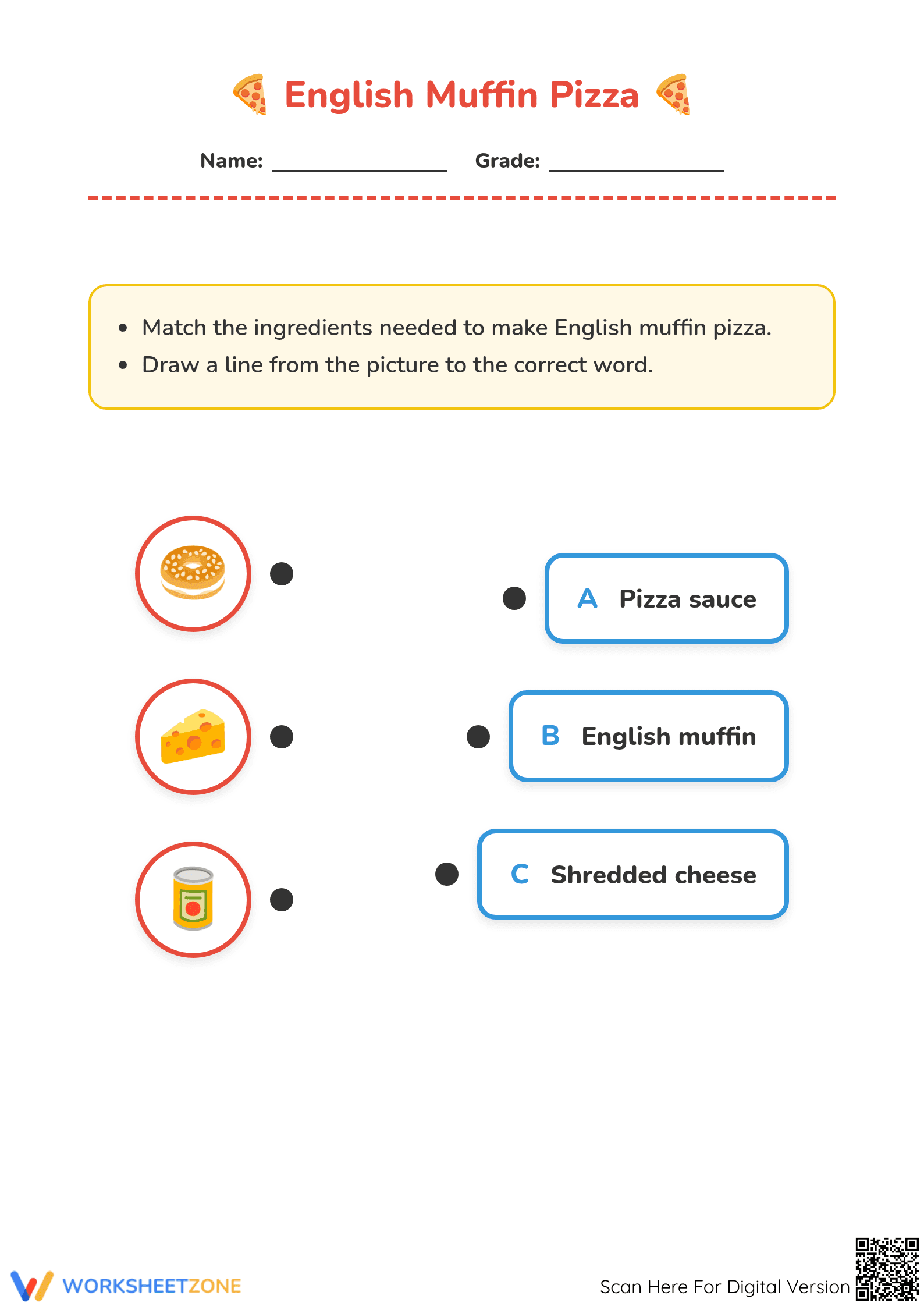
This printable English Muffin Pizza matching worksheet helps early learners bridge the gap between visual recognition and written vocabulary. Students identify three essential ingredients—muffin, cheese, and sauce—to build foundational reading skills. By connecting real-world items to their printed names, children develop the literal associations necessary for functional literacy and life skills.
At a Glance
- Grade: 1 · Subject: English Language Arts (ELA)
- Standard:
CCSS.ELA-LITERACY.L.1.5.C— Identify real-life connections between words and their use- Skill Focus: Picture-to-word matching and functional vocabulary
- Format: 1 page · 3 problems · Answer key included · PDF
- Best For: Independent centers and functional life skills
- Time: 5–10 minutes
What's Inside
The worksheet features a clean, high-contrast layout designed for young learners. It contains three vivid photographs of common kitchen items alongside clear, sans-serif labels. The simple structure provides a distraction-free environment for students to practice drawing lines from images to text, facilitating a 1-page, self-contained activity that includes an psychosocial key for quick teacher verification or student self-correction.
Zero-Prep Workflow
- Print: Generate the single-page PDF in under 30 seconds.
- Distribute: Hand out to students as a morning warm-up or transition activity.
- Review: Quickly check for visual-linguistic alignment in approximately 1 minute.
Total teacher preparation time is well under two minutes, making it ideal for emergency sub plans or fast-finisher packets.
Standards Alignment
This resource is specifically aligned with `CCSS.ELA-LITERACY.L.1.5.C`, which requires students to identify real-life connections between words and their use. By matching the tangible ingredients of a pizza to their written identifiers, students practice word-object permanence in a relatable context. This standard code can be copied directly into lesson plans, IEP goals, or district curriculum mapping tools.
How to Use It
Use this worksheet during a functional life-skills lesson or as a pre-activity before a classroom cooking demonstration. For a formative assessment, observe if students can read the labels aloud before matching, or if they rely solely on initial letter sounds to identify the words. The task typically takes 5–10 minutes and serves as an excellent check for reading readiness.
Who It's For
Designed for Preschool through Grade 1 students, this activity is also highly effective for English Language Learners (ELLs) and students with developmental delays requiring concrete vocabulary support. It pairs naturally with a cooking-themed picture book or a sensory-based lesson on food preparation and sequencing.
According to the NAEP framework, early exposure to functional vocabulary is a critical predictor of later reading comprehension success. This worksheet targets the primary standard `CCSS.ELA-LITERACY.L.1.5.C` by focusing on the plain-English skill of identifying real-life connections between words and their use. Research from Fisher & Frey (2014) emphasizes that a gradual release of responsibility starts with high-interest, low-stakes activities that bridge oral and written language. By providing students with clear photographic cues, this resource reduces cognitive load and allows for successful independent practice. The inclusion of three distinct matching tasks provides enough repetition to solidify the concept of word-object permanence without overwhelming young learners. This data-driven approach ensures that students are not just memorizing words but are building a robust internal lexicon grounded in physical reality, which is essential for transitioning from learning to read to reading to learn in subsequent grades.


