




























Views
Downloads
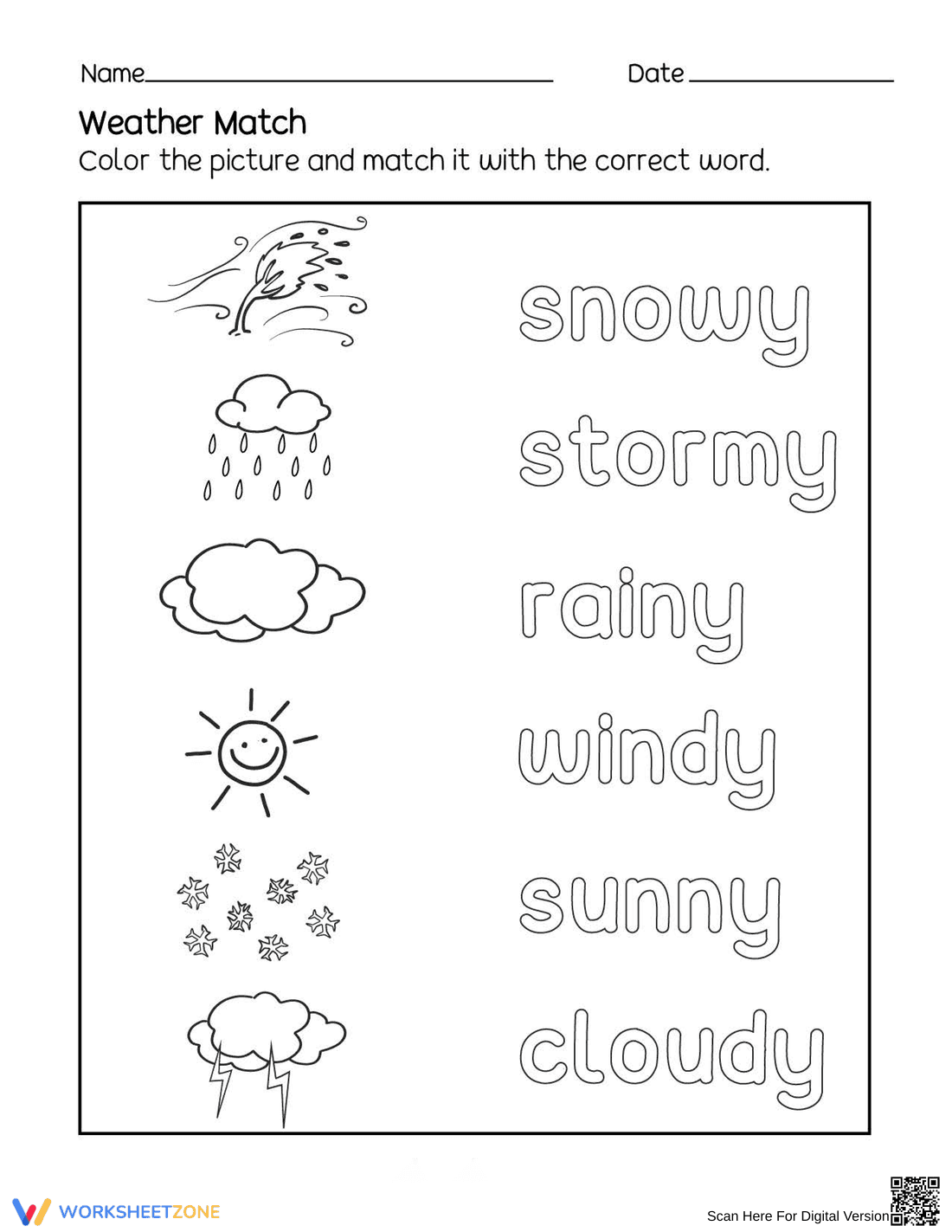

Essential Weather Match Worksheet | Kindergarten Science

Paste this activity's link or code into your existing LMS (Google Classroom, Canvas, Teams, Schoology, Moodle, etc.).
Students can open and work on the activity right away, with no student login required.
You'll still be able to track student progress and results from your teacher account.
This Kindergarten and Grade 1 Science worksheet helps young learners identify weather conditions through matching and coloring. Students strengthen their observational skills and vocabulary by connecting visual cues like rain and snow to their written names. This activity builds a strong foundation for future earth science mastery and environmental awareness.
At a Glance
- Grade: K–1 · Subject: Science
- Standard:
K-ESS2-1— Use observations of local weather conditions to describe patterns over time.- Skill Focus: Weather vocabulary and identification
- Format: 1 page · 6 problems · Answer key included · PDF
- Best For: Early finishers and morning work
- Time: 10–15 minutes
What's Inside
This printable resource features a single-page activity with six weather illustrations: windy, rainy, cloudy, sunny, snowy, and stormy. Each image is paired with a corresponding word in a clear font. The worksheet includes a coloring component to keep students engaged during the matching tasks. A full answer key is included for quick grading.
Zero-Prep Workflow
The zero-prep design allows teachers to integrate this into their day effortlessly. First, print the single PDF page (30 seconds). Second, distribute copies to students with crayons (1 minute). Third, review the completed matches as a class (1 minute). Total preparation time is under two minutes, perfect for emergency sub plans or transition periods.
Standards Alignment
This resource is primary aligned to K-ESS2-1: "Use and share observations of local weather conditions to describe patterns over time." By identifying different weather types, students develop the knowledge needed to track environmental changes. Both standard codes can be copied directly into lesson plans, IEP goals, or district curriculum mapping tools.
How to Use It
Use this worksheet during a unit on Earth Science after a lesson on weather. It serves as an excellent formative-assessment tool; observe if students correctly identify the "windy" tree or "stormy" bolt. It is also perfect for independent morning work or as a quiet activity for early finishers who need a creative yet educational task.
Who It's For
This printable is designed for Kindergarten and First Grade students beginning to explore science. It is beneficial for visual learners and students requiring fine motor practice. It pairs naturally with a daily weather calendar or a classroom weather chart to reinforce real-world observations through structured pencil-and-paper practice during science centers.
The K-ESS2-1 standard focuses on using observations to describe weather patterns, a critical cognitive milestone for early learners. According to the RAND AIRS 2024 report on elementary science instruction, providing students with structured visual aids and vocabulary matching tasks significantly increases retention of categorical scientific data in the K-2 band. This worksheet implements these findings by requiring students to synthesize visual cues with written weather terms. By engaging both the creative coloring process and the logical matching task, the resource supports dual-coding theory, which suggests that verbal and non-verbal processing working together leads to stronger memory formation. Educators can rely on this standard-aligned tool to verify that students can distinguish between complex weather states like cloudy versus stormy. This resource provides a quantifiable measure of student progress toward meeting state and national science benchmarks through six specific, observable data points in a single-page format.


