


























Views
Plays

7.G.B.6 Worksheet: ASVAB Geometry — Grade 7 Aligned
Paste this activity's link or code into your existing LMS (Google Classroom, Canvas, Teams, Schoology, Moodle, etc.).
Students can open and work on the activity right away, with no student login required.
You'll still be able to track student progress and results from your teacher account.
This geometry worksheet helps students master essential spatial reasoning and measurement skills required for the ASVAB exam. By solving practical problems involving angles, circles, and polygons, learners build the mathematical proficiency needed to score higher on military entrance tests. This resource provides targeted practice to reinforce core geometric concepts.
At a Glance
- Grade: Grade 7 · Subject: Math and Geometry
- Standard:
CCSS.MATH.CONTENT.7.G.B.6— Solve mathematical problems involving area, surface area, perimeter, and angles- Skill Focus: Geometric calculations and spatial relationships
- Format: 2 pages · 10 problems · Answer key included · PDF
- Best For: Standardized test preparation and geometry review
- Time: 20 to 30 minutes
What's Inside
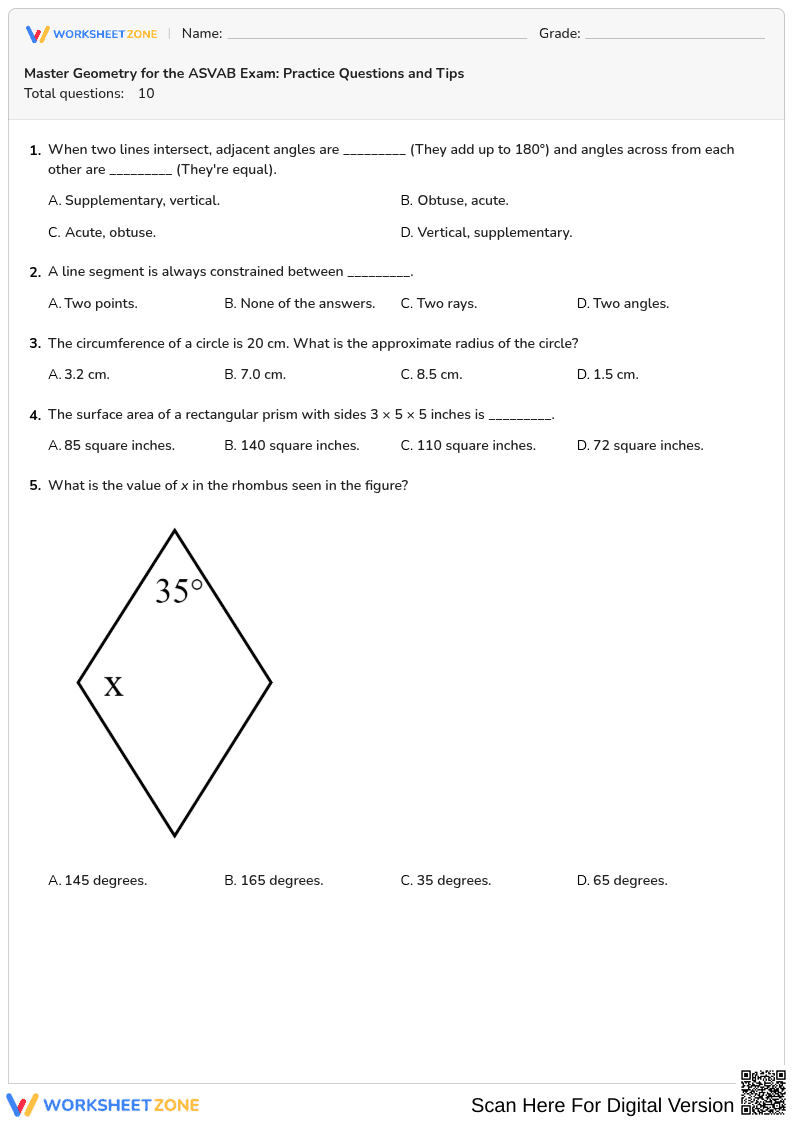
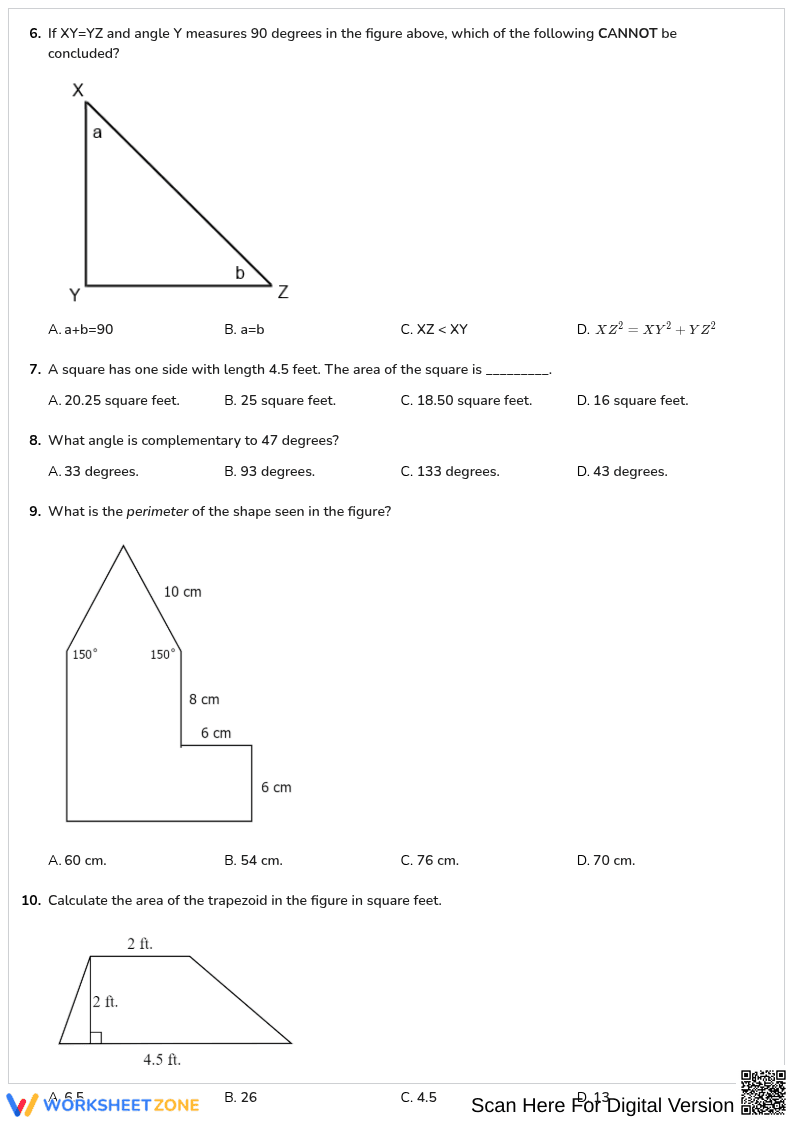
This two-page practice assessment features 10 multiple-choice questions designed to mirror the ASVAB exam format. The problems cover geometric concepts including angle relationships, circle circumference, surface area of rectangular prisms, and properties of polygons like rhombuses, triangles, and trapezoids. Visual diagrams support spatial reasoning, and a complete answer key is provided to facilitate quick grading.
Mastery Evidence
The assessment evaluates student proficiency across three performance tiers. Questions targeting basic angle identification and perimeter represent the Approaching level. Intermediate problems involving circle circumference and area of basic quadrilaterals align with the Meeting tier. Advanced questions requiring multi-step calculations, such as surface area of rectangular prisms, represent the Exceeding tier. Teachers can record scores directly into gradebooks or IEP progress logs.
Standards Alignment
This worksheet aligns directly with Common Core Standard CCSS.MATH.CONTENT.7.G.B.6, which requires students to solve mathematical problems involving area, volume, and surface area of two- and three-dimensional objects. It also supports standard 7.G.B.5 by incorporating problems requiring students to use facts about supplementary, complementary, vertical, and adjacent angles to solve for unknown angles. Both standard codes can be copied directly into lesson plans or IEP goals.
How to Use It
Use this resource as a post-instruction assessment to gauge student understanding after completing a geometry unit. Alternatively, assign it as a timed practice test during test preparation sessions to build student stamina. While students work, observe their strategies for calculating the area of composite shapes to identify common misconceptions. The expected completion time is 20 to 30 minutes.
Who It's For
This worksheet is designed for seventh-grade students mastering geometry standards, as well as older learners preparing for standardized exams like the ASVAB. It accommodates diverse learners through clear visual aids and structured multiple-choice options. Pair this worksheet with a comprehensive geometry formula sheet to support students who require additional scaffolding.
This geometry practice worksheet aligns with standard CCSS.MATH.CONTENT.7.G.B.6, focusing on the plain-English skill of solving mathematical problems involving area, perimeter, and surface area of geometric shapes. According to research from the Fisher & Frey (2014) framework on gradual release of responsibility, structured multiple-choice assessments with visual scaffolds help students transition from guided practice to independent mastery. By presenting geometric problems in a standardized format, this resource reinforces spatial reasoning and formula application, which are critical for success on high-stakes exams like the ASVAB. The inclusion of diverse polygon types ensures that students develop a flexible understanding of geometric properties rather than relying on rote memorization. Educators can utilize this tool to gather reliable diagnostic data, helping to identify specific areas where students require targeted intervention before taking formal assessments. Ultimately, this targeted practice builds the confidence and competence necessary for academic and career advancement.


