




























Views
Downloads

Essential Manned vs Unmanned Space Missions Worksheet

Paste this activity's link or code into your existing LMS (Google Classroom, Canvas, Teams, Schoology, Moodle, etc.).
Students can open and work on the activity right away, with no student login required.
You'll still be able to track student progress and results from your teacher account.
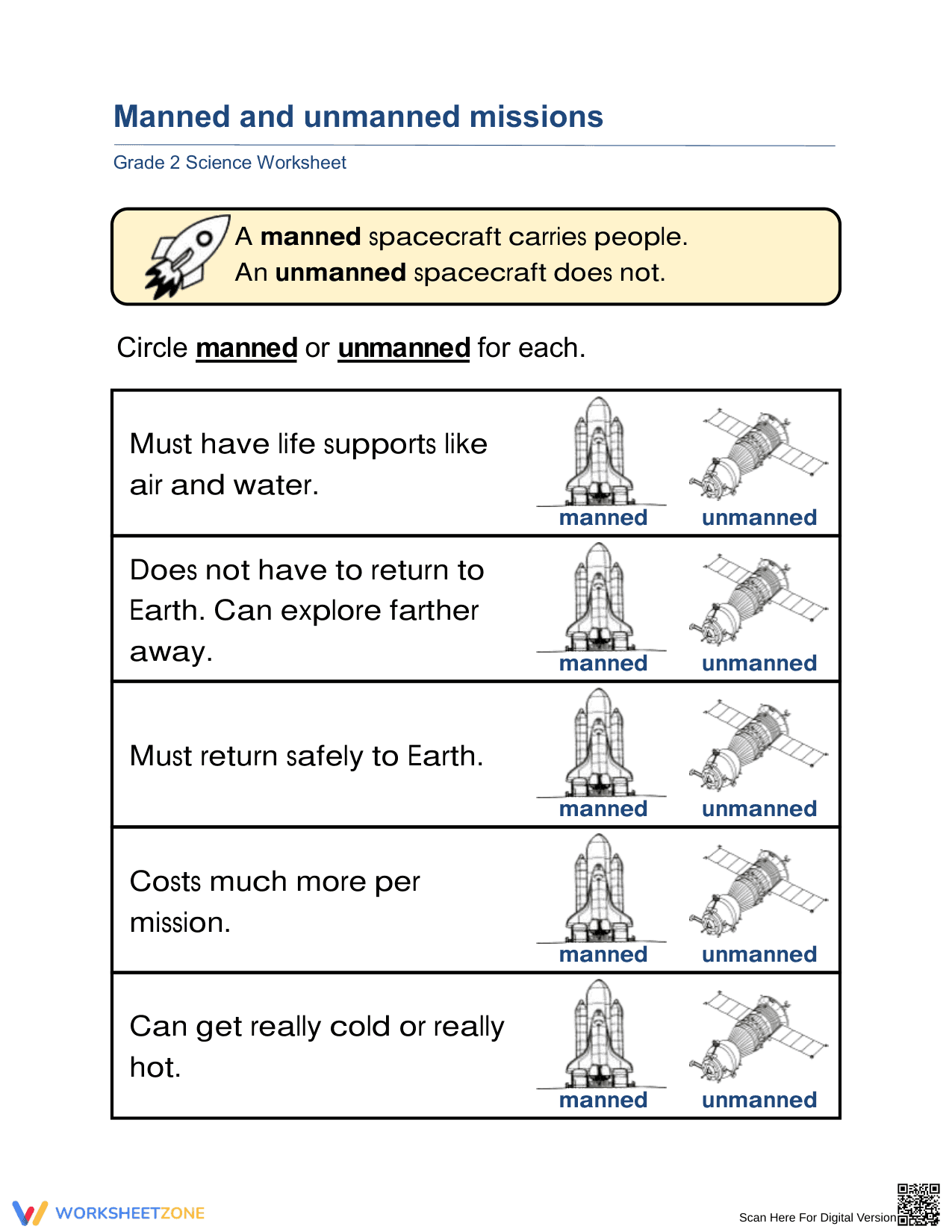
This Grade 2 science worksheet helps students distinguish between manned and unmanned space missions through clear definitions and logical comparisons. Students identify critical differences in life support requirements, cost, and mission distance before applying their knowledge to a creative writing prompt. This resource ensures young learners understand the fundamental logistics of modern space exploration.
At a Glance
- Grade: 2 · Subject: Science
- Standard:
CCSS.ELA-LITERACY.RI.2.3— Describe the connection between scientific ideas or concepts in a text- Skill Focus: Manned vs Unmanned Missions
- Format: 2 pages · 6 problems · Answer key included · PDF
- Best For: Introduction to space exploration logistics
- Time: 20–30 minutes
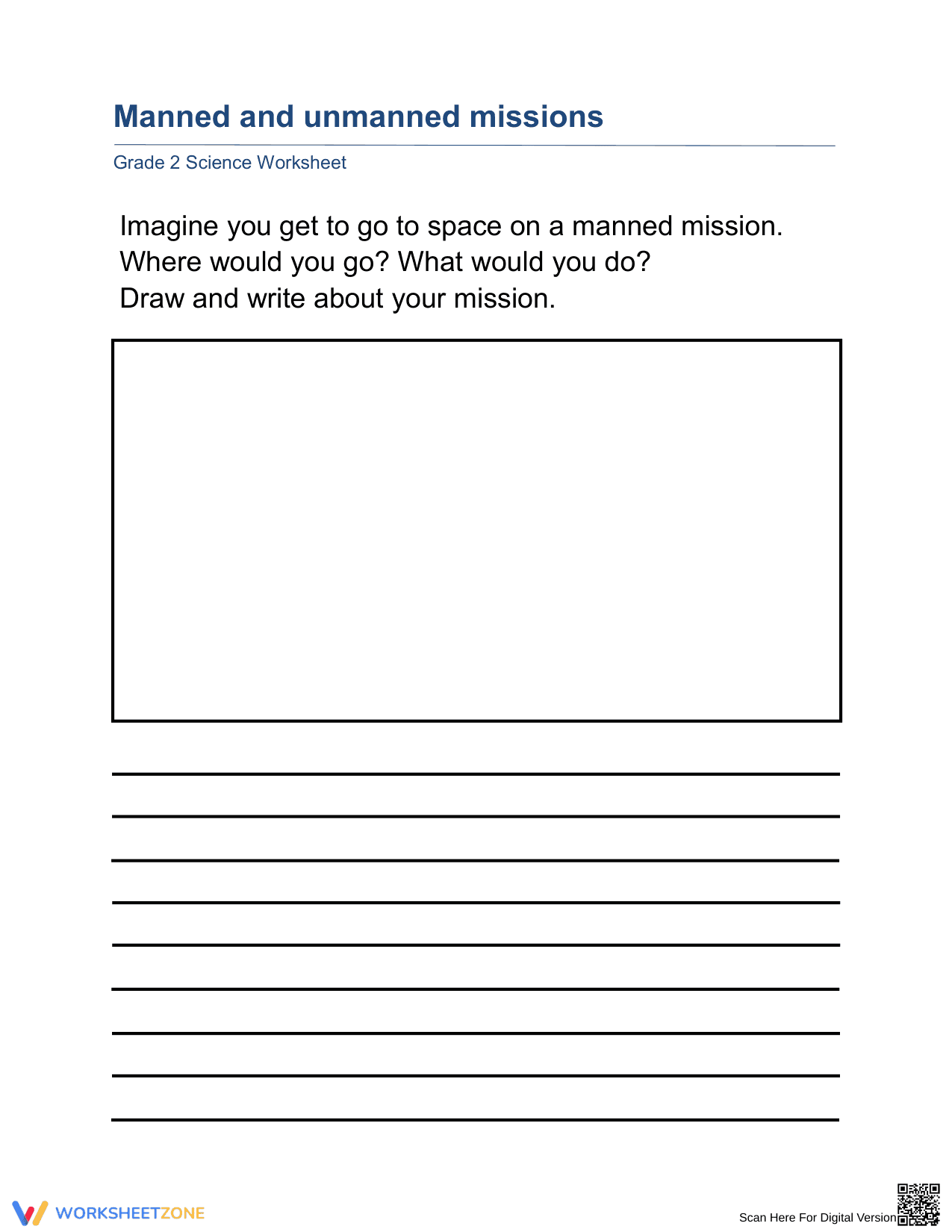
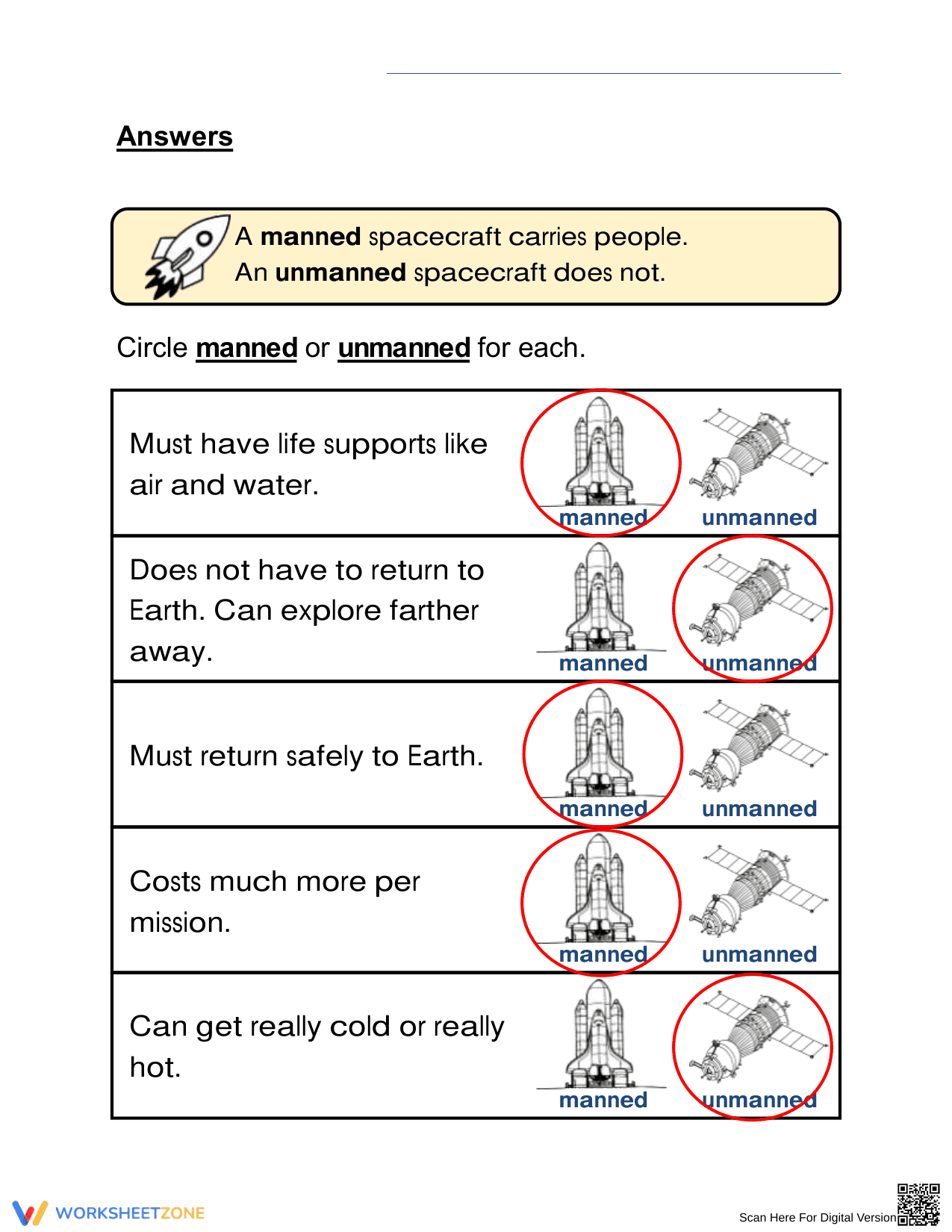
The worksheet features a two-page structure designed for independent or guided study. The first page contains a clear definition box followed by five comparative scenarios where students circle the correct mission type based on logic cues. The second page transitions to higher-order thinking with a manned mission creative prompt, providing a drawing box and primary-ruled lines for descriptive writing about a personal space journey.
Zero-Prep Workflow
The zero-prep workflow for this resource is designed for maximum teacher efficiency. First, print the two-page PDF in under thirty seconds. Second, distribute the copies to students and read the definition box aloud to ensure foundational understanding for all learners. Third, review the completed categorization and creative writing samples as a whole class or through individual check-ins. Total teacher preparation time remains under two minutes, making it an ideal choice for last-minute science blocks or emergency sub plans.
Standards Alignment
This activity aligns primarily with CCSS.ELA-LITERACY.RI.2.3, requiring students to describe the connection between scientific concepts. It also supports CCSS.ELA-LITERACY.W.2.3 by asking students to write a narrative about a specific event. Both standard codes can be copied directly into lesson plans, IEP goals, or district curriculum mapping tools to ensure instructional accountability and rigorous content delivery.
How to Use It
Use this worksheet as a formative assessment during a unit on the solar system or engineering. It is best placed after a brief direct instruction session about NASA or private space agencies. Teachers should observe whether students can explain why life support is only needed for manned missions, as this indicates a deeper grasp of the scientific concept. Expect students to complete both pages within a 25-minute window.
Who It's For
This resource is perfect for second-grade students and can be adapted for first-grade enrichment or third-grade review. The inclusion of visual icons next to text descriptions provides excellent support for English Language Learners and students with reading scaffolds. Pair this worksheet with a short non-fiction passage about the International Space Station or the Mars Rover to provide concrete examples of both mission types.
According to Fisher & Frey (2014), the use of scaffolding in science literacy is essential for Grade 2 learners to transition from concrete facts to abstract application. This worksheet utilizes that research-backed progression by providing a clear definition before moving to guided categorization and independent creative application. By distinguishing between manned and unmanned missions, students develop the foundational vocabulary needed for later complex engineering and physics concepts. The integration of writing and drawing tasks ensures that multiple learning modalities are engaged, which NAEP data suggests improves long-term retention of scientific terminology. Aligned with CCSS.ELA-LITERACY.RI.2.3, this tool provides the necessary structure for students to compare scientific ideas accurately. The standard code and plain-English skill of identifying mission types provide a measurable outcome for classroom teachers and curriculum specialists seeking to meet rigorous state and national benchmarks in early elementary science education.


