




























Views
Downloads

Essential Law of Poles Magnetism Worksheet | Grade 5 Science

Paste this activity's link or code into your existing LMS (Google Classroom, Canvas, Teams, Schoology, Moodle, etc.).
Students can open and work on the activity right away, with no student login required.
You'll still be able to track student progress and results from your teacher account.
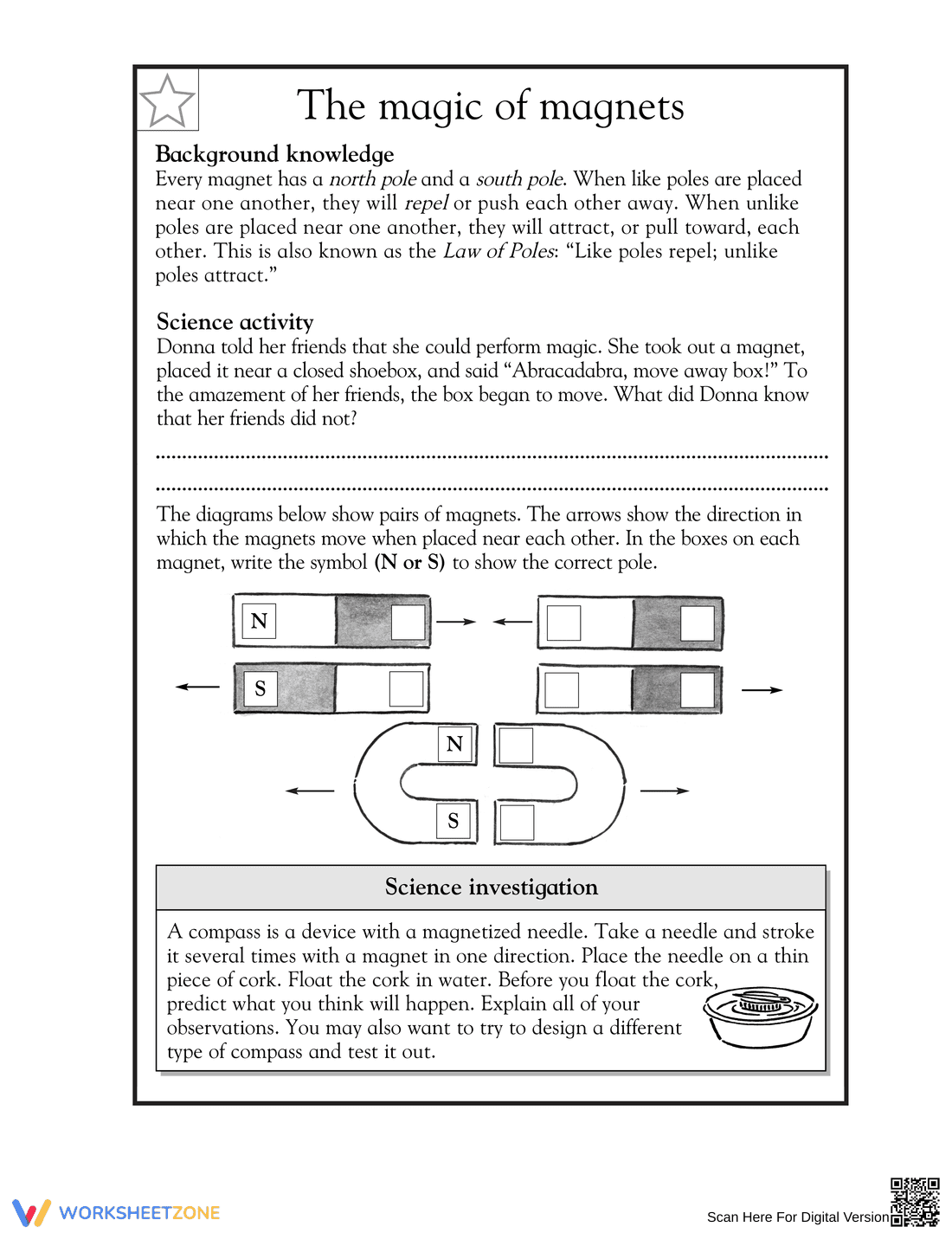
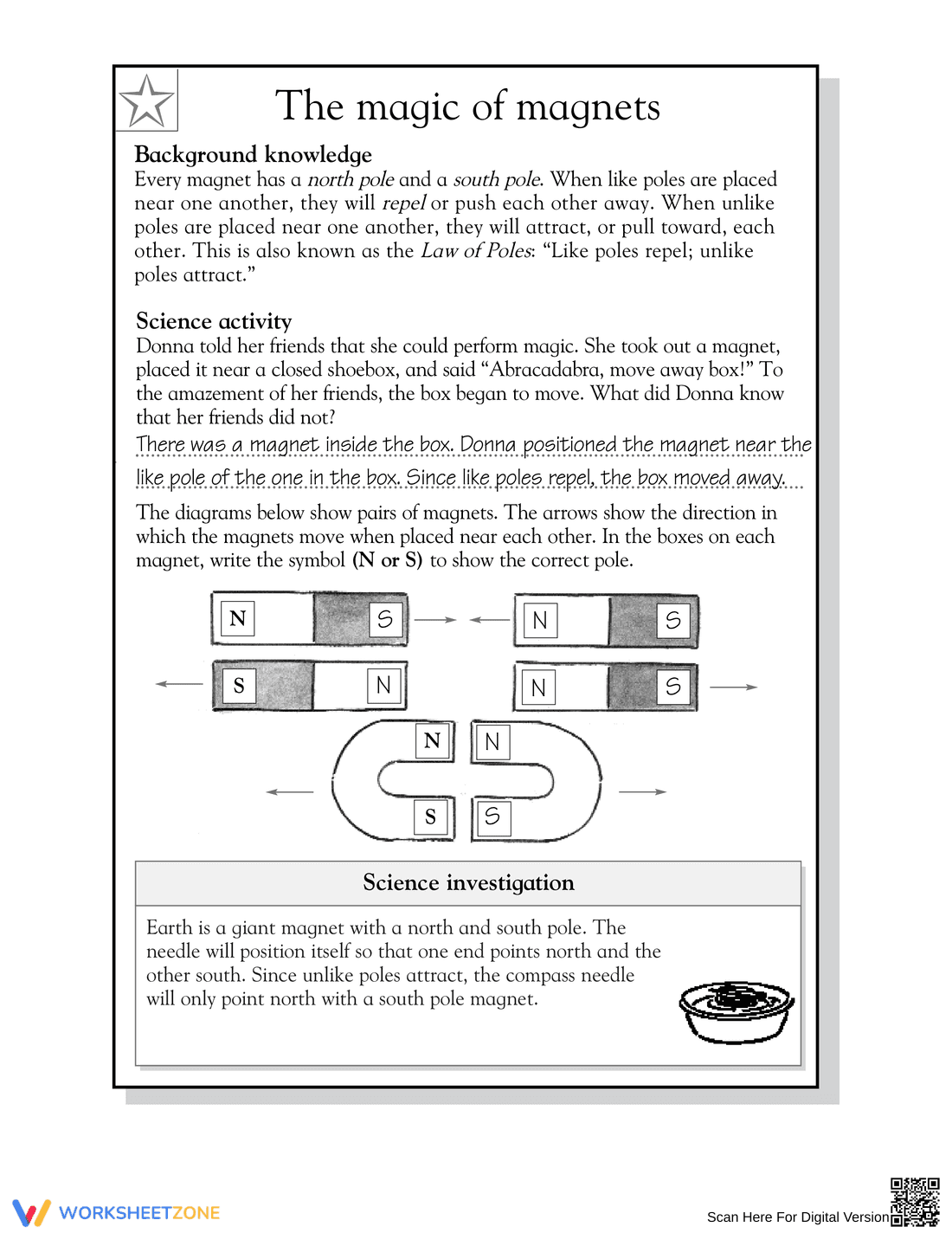
This Grade 5 science worksheet introduces students to the fundamental Law of Poles through engaging diagrams. Students observe how magnets interact, predicting movement based on whether poles are like or unlike. By applying background knowledge to real-world scenarios, learners build a strong conceptual foundation in physical science and magnetic interactions.
At a Glance
- Grade: 5 · Subject: Physical Science
- Standard:
3-PS2-3— Ask questions to determine cause and effect relationships of magnetic interactions- Skill Focus: Magnetic Attraction and Repulsion
- Format: 1 page · 5 tasks · Answer key included · PDF
- Best For: Independent practice or science centers
- Time: 15–20 minutes
What's Inside
The worksheet features a comprehensive layout designed for student autonomy. It begins with a concise background knowledge section defining the North and South poles and the Law of Poles. The "Science Activity" provides a narrative prompt to stimulate critical thinking. Three detailed diagrams require students to identify magnetic poles based on directional arrows, followed by a hands-on "Science Investigation" prompt for creating a DIY compass.
Zero-Prep Workflow
Teachers can implement this resource in under two minutes with a simple three-step workflow. First, print the single-page PDF for your class (30 seconds). Second, distribute the sheets and allow students to read the background knowledge independently (5 minutes). Third, review the answers using the included key or through a quick whole-class discussion (5 minutes). This streamlined process makes the worksheet an ideal solution for emergency sub plans or low-prep science rotations.
Standards Alignment
The content is primarily aligned with 3-PS2-3, which focuses on determining cause-and-effect relationships in magnetic interactions. While targeted at Grade 5 for reinforcement, it mirrors the NGSS requirement for students to understand how magnets exert forces on each other without direct contact. This standard code can be copied directly into lesson plans, IEP goals, or district curriculum mapping tools.
How to Use It
Utilize this worksheet during the "Explain" or "Elaborate" phase of a 5E science lesson. It serves as an excellent formative assessment tool; observe students as they complete the diagrams to identify those struggling with the concept that like poles repel. Expected completion time is 15 to 20 minutes, making it a perfect fit for a focused science block or a homework assignment that reinforces classroom laboratory work.
Who It's For
This resource is designed for Grade 5 students but is adaptable for Grade 4 review or Grade 6 introductory units. For students requiring extra support, provide a physical bar magnet to manipulate alongside the diagrams. It pairs naturally with a hands-on lab using iron filings or a digital simulation of magnetic fields to provide a multi-sensory learning experience.
Educational research, such as the ScienceDirect TpT Analysis (2024), emphasizes visual scaffolding in elementary physics. By using directional arrows, this worksheet reduces cognitive load, allowing students to focus on the Law of Poles. The progression from definitions to diagram analysis mirrors the gradual release of responsibility model advocated by Fisher & Frey (2014). Students who master these magnetic cause-and-effect relationships demonstrate the higher-order thinking skills necessary for success in middle school physical science. This Grade 5 resource provides the essential structured practice required to cement these concepts, ensuring learners can accurately predict magnetic behavior in diverse contexts. By integrating literacy with technical diagram analysis, the worksheet supports a comprehensive approach to science education that meets modern academic rigors.


