


























Views
Downloads

Essential Grade 7 Math Midterm: Inequalities & 3D Geometry
Paste this activity's link or code into your existing LMS (Google Classroom, Canvas, Teams, Schoology, Moodle, etc.).
Students can open and work on the activity right away, with no student login required.
You'll still be able to track student progress and results from your teacher account.
This comprehensive Grade 7 math midterm assessment evaluates student proficiency in two critical domains: three-dimensional geometry and linear inequalities. Students demonstrate their ability to identify geometric solids, calculate surface area, and represent inequality solutions on number lines. This resource provides a rigorous diagnostic tool to measure first-term mathematical progress and readiness for advanced algebraic concepts.
At a Glance
- Grade: 7 · Subject: Mathematics
- Standard:
CCSS.MATH.CONTENT.7.EE.B.4.B— Solve word problems leading to inequalities and graph the solution set.- Skill Focus: Linear Inequalities & 3D Geometry
- Format: 4 pages · 40 problems · Answer key included · PDF
- Best For: Midterm assessment and cumulative review
- Time: 45–60 minutes
What's Inside
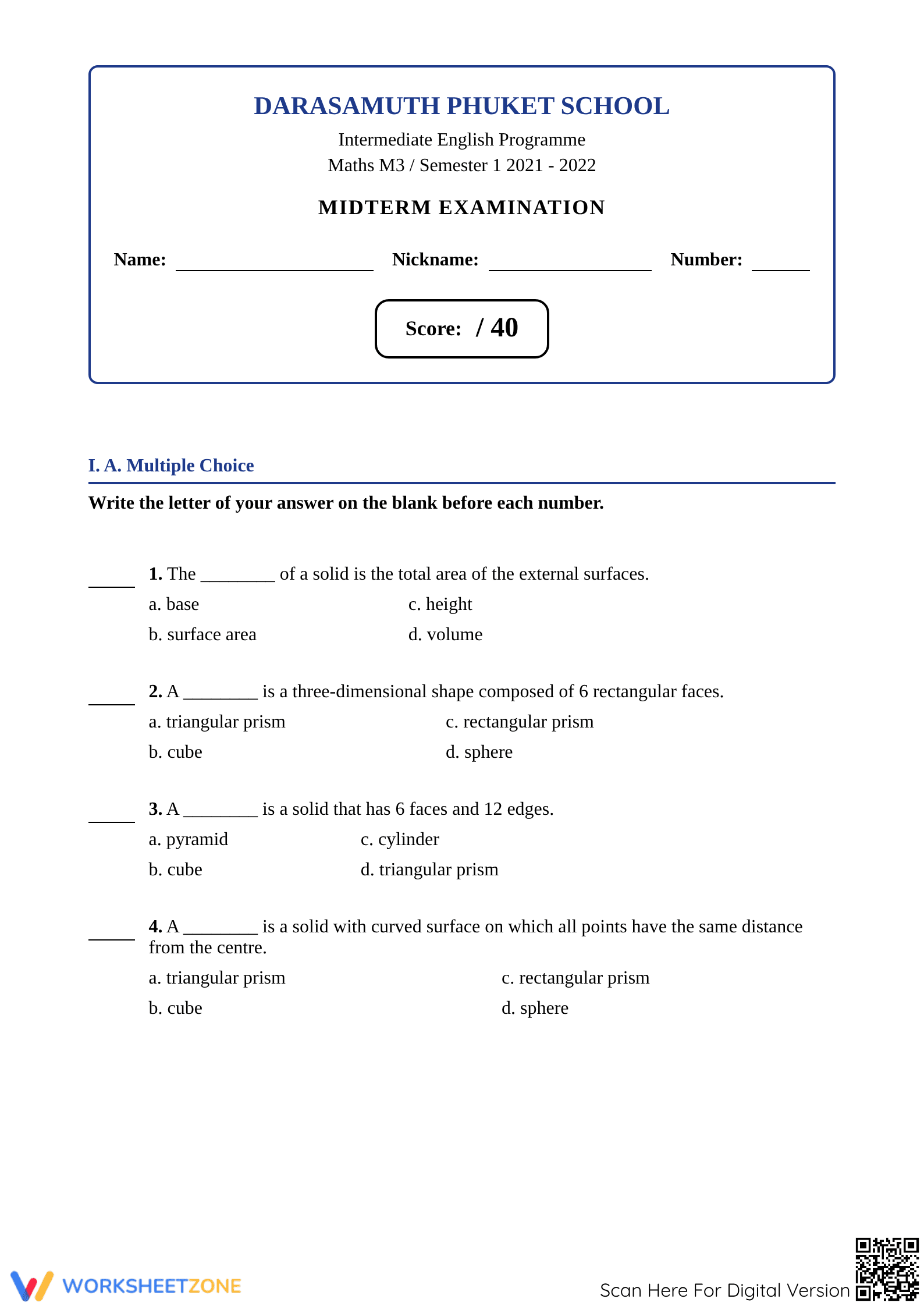
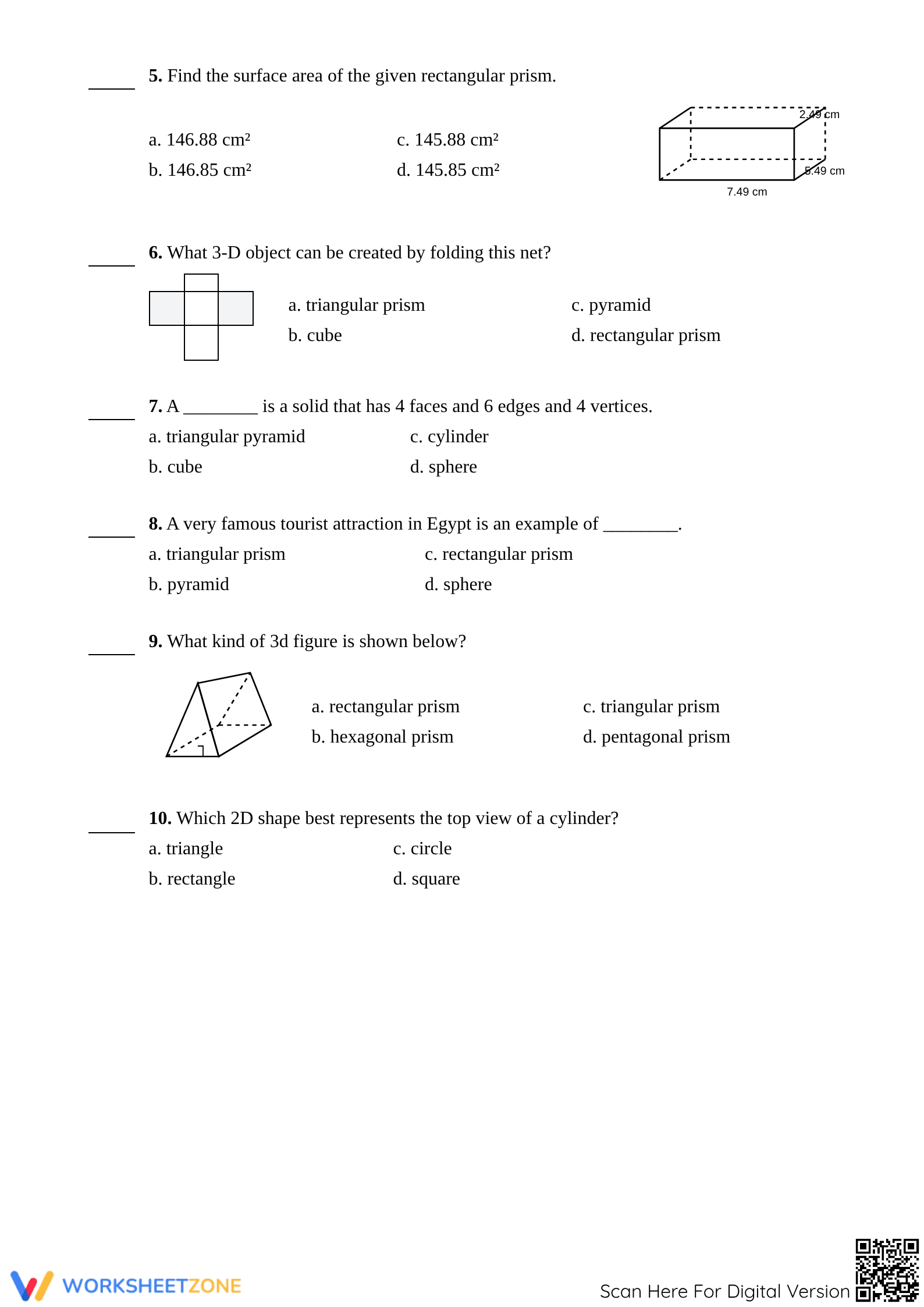
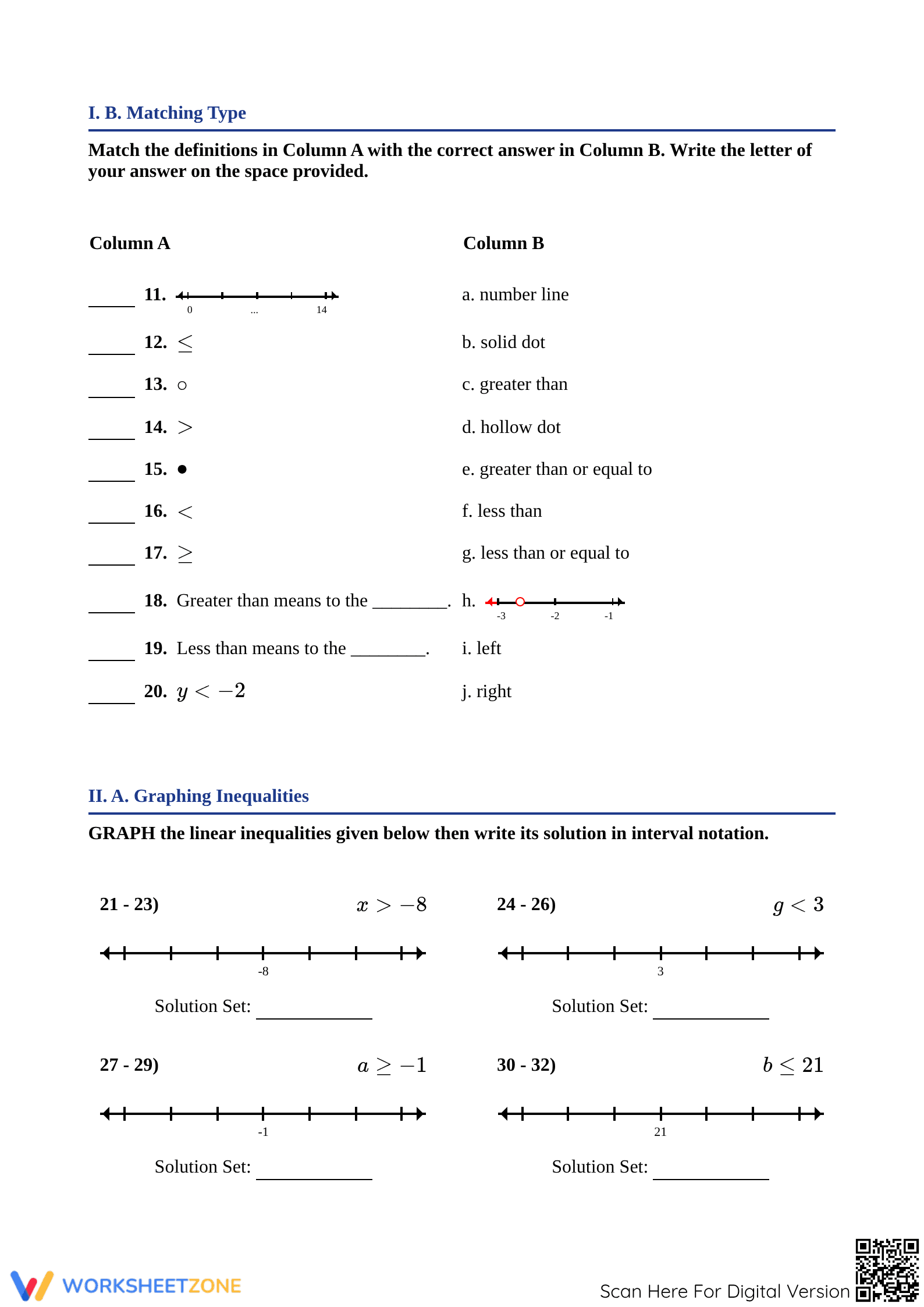
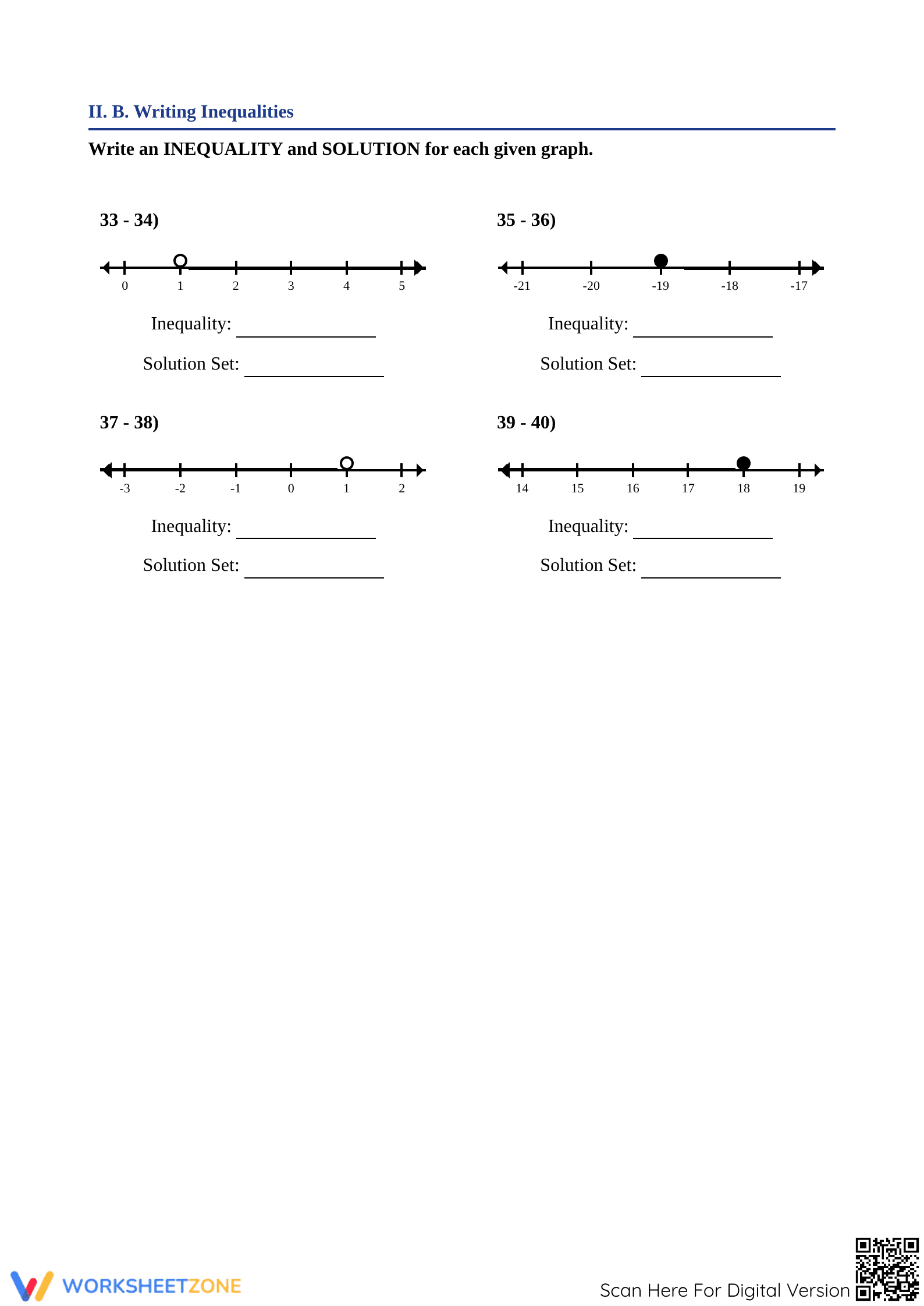
The 4-page PDF contains 40 distinct problems organized into logical sections. The first half features 10 multiple-choice questions focusing on 3D shape properties, nets, and surface area calculations. The second half transitions to algebra, utilizing matching exercises for inequality symbols, graphing tasks on pre-labeled number lines, and "writing inequalities" prompts where students derive algebraic expressions from visual graphs. A full answer key is provided for efficient grading.
Mastery Evidence
- Foundational Recognition: Multiple-choice items (1-10) assess basic identification of geometric properties and surface area formulas.
- Symbolic Literacy: The matching section (11-20) verifies that students can correctly associate mathematical symbols with their verbal and visual definitions.
- Application & Synthesis: The graphing and writing sections (21-40) require higher-order application of algebraic rules to represent solution sets accurately.
Teachers can map these 40 points to standard mastery levels: 36-40 (Exceeding), 28-35 (Meeting), and below 28 (Approaching). Scores can be entered directly into gradebooks or used to document IEP progress toward algebraic goals.
Standards Alignment
The primary focus is `CCSS.MATH.CONTENT.7.EE.B.4.B`, which requires students to solve real-world problems leading to inequalities of the form px + q > r or px + q < r and graph the solution set. Additionally, the geometry section aligns with `CCSS.MATH.CONTENT.7.G.B.6`, focusing on the surface area of three-dimensional objects composed of triangles and quadrilaterals. Both standard codes can be copied directly into lesson plans, IEP goals, or district curriculum mapping tools.
How to Use It
Use this worksheet as a formal summative assessment at the end of a first-term unit on equations and geometry. It is best administered during a single 60-minute testing block. For formative use, teachers can observe students during the graphing section to identify common misconceptions regarding "open" versus "closed" circles on the number line. This data allows for targeted small-group intervention before moving into multi-step inequality solving.
Who It's For
This resource is designed for Grade 7 students in general education or Pre-Algebra tracks. It is also highly effective for Grade 8 students requiring a cumulative review of foundational inequality concepts. The clear visual aids and structured layout support English Language Learners and students with executive functioning needs. Pair this assessment with a reference anchor chart for 3D shape formulas for students requiring accommodations.
According to the RAND AIRS 2024 report, high-quality math assessments that integrate visual representations with symbolic logic significantly improve student retention of algebraic concepts. This worksheet adheres to these findings by requiring students to translate between verbal definitions, algebraic symbols, and number line graphs. By covering both geometry and algebra, the assessment mirrors the balanced rigor found in modern state testing frameworks. Research from Fisher & Frey (2014) emphasizes that cumulative assessments like this midterm provide essential feedback loops for the gradual release of responsibility model, ensuring students can independently apply skills across different mathematical domains. The inclusion of 40 varied tasks ensures a statistically significant sample of student performance, allowing educators to make data-driven decisions for subsequent instructional cycles or remediation strategies.


