


























Views
Downloads

Geometry Transformations Worksheet | Grade 9-10 Printable
Paste this activity's link or code into your existing LMS (Google Classroom, Canvas, Teams, Schoology, Moodle, etc.).
Students can open and work on the activity right away, with no student login required.
You'll still be able to track student progress and results from your teacher account.
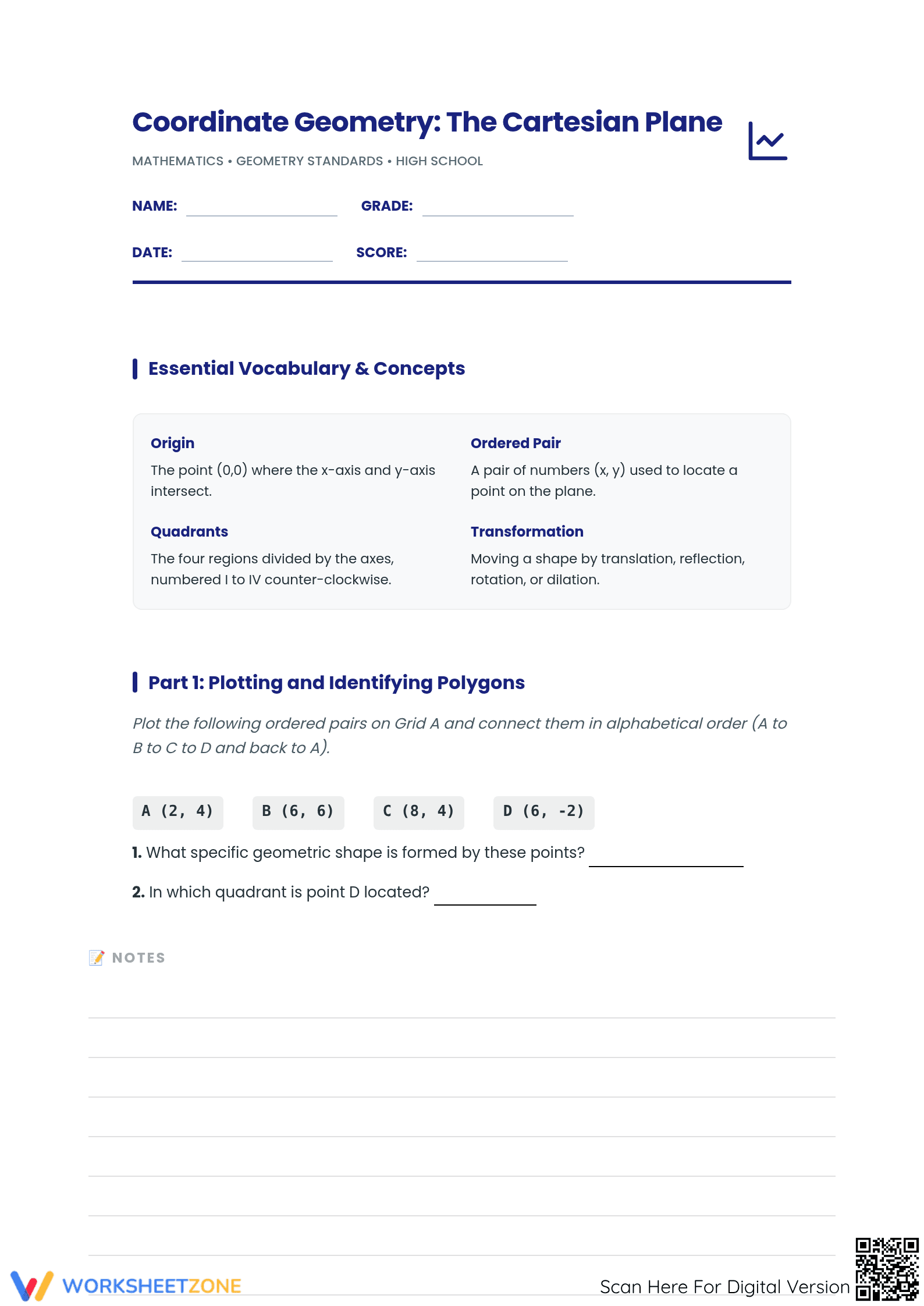
This geometry worksheet provides structured practice with coordinate planes, rigid transformations, and the distance formula. Students plot ordered pairs to form polygons, execute reflections across the y-axis, and calculate segment lengths. Connecting visual graphing with algebraic rules helps learners build a strong foundation for spatial reasoning.
At a Glance
- Grade: 9-10 · Subject: Geometry
- Standard:
HSG-CO.A.5— Draw transformed figures using reflections and describe the algebraic rules.- Skill Focus: Coordinate Geometry and Transformations
- Format: 3 pages · 6 problems · Answer key included · PDF
- Best For: Independent practice and review
- Time: 25–35 minutes
What's Inside
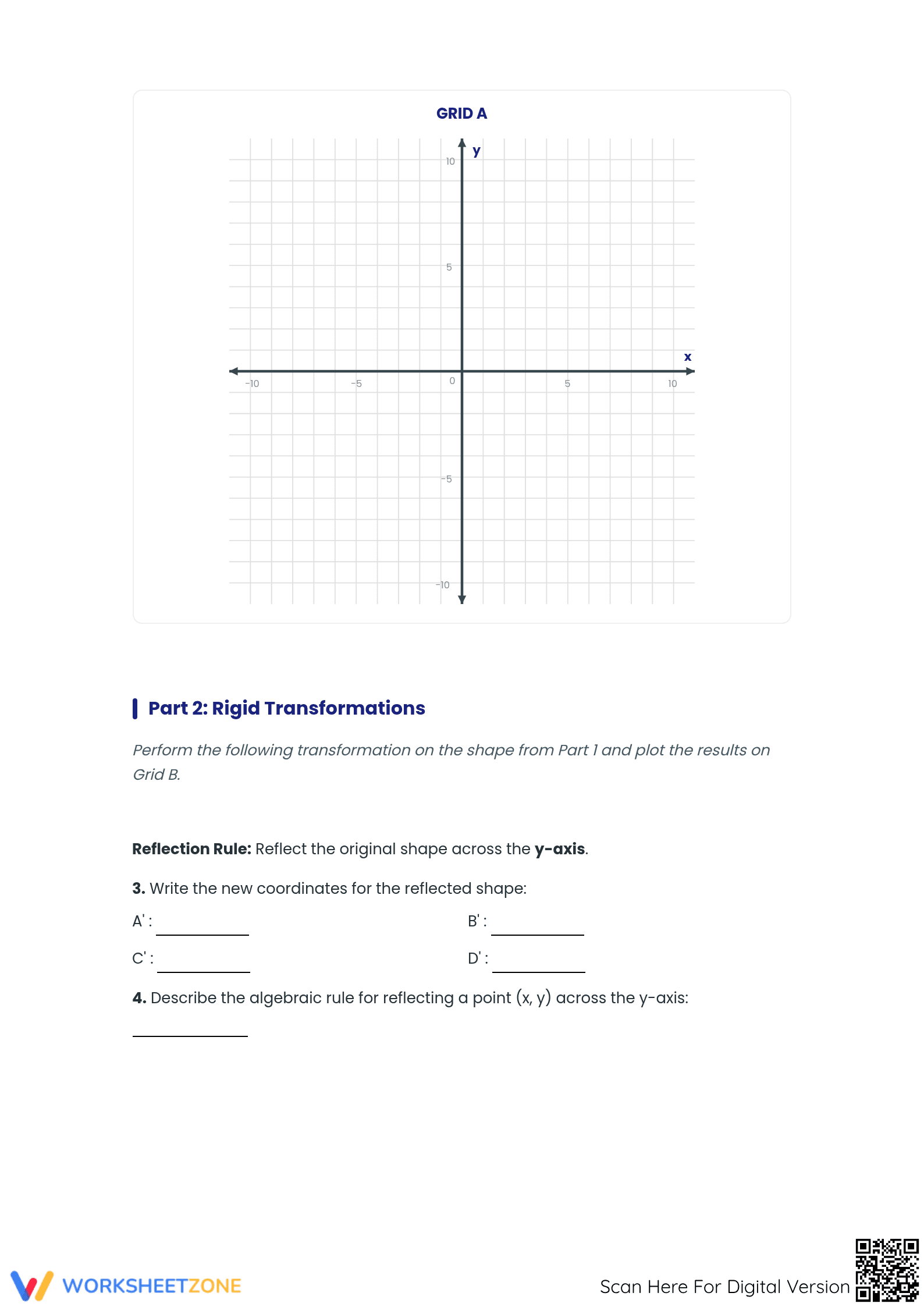
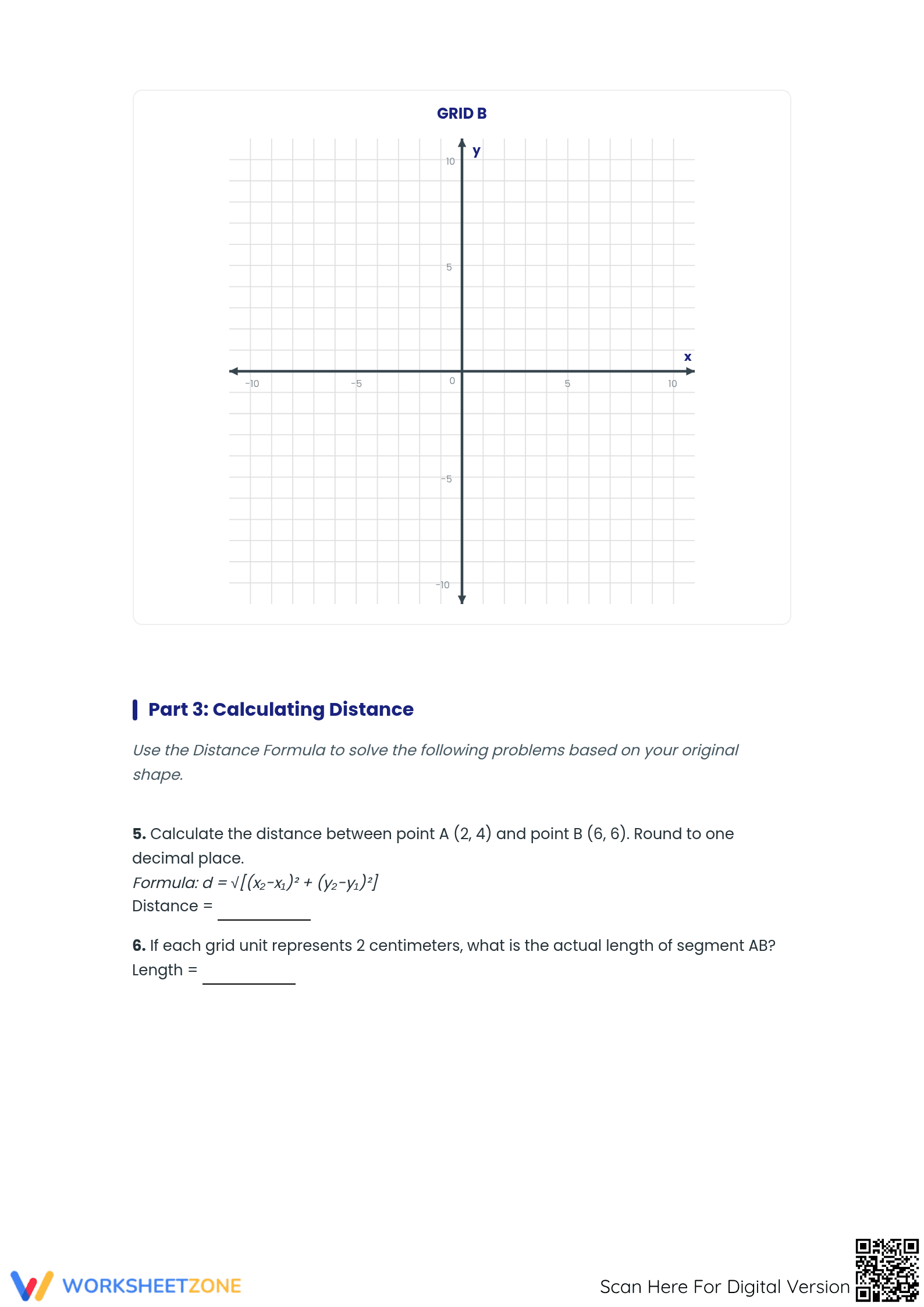
This resource includes three pages of progressive geometry tasks. Page one features a vocabulary guide and polygon plotting exercises. Subsequent pages provide large coordinate grids for executing rigid transformations and applying the distance formula. A complete three-page answer key features correctly plotted graphs and step-by-step calculations to ensure accurate grading.
Skill Progression
- Guided practice: Students begin by reviewing core vocabulary (origin, quadrants, ordered pairs) and plotting four specific coordinates to identify a foundational geometric shape.
- Supported practice: Learners transition to applying a specific reflection rule across the y-axis, requiring them to determine new coordinates and articulate the algebraic rule for the transformation.
- Independent practice: The final section challenges students to apply the distance formula to their original plotted points, calculating exact segment lengths and converting grid units to real-world measurements.
This gradual-release approach moves students from basic plotting to complex calculations, following an I Do, We Do, You Do model.
Standards Alignment
This resource is strictly aligned to HSG-CO.A.5: Given a geometric figure and a rotation, reflection, or translation, draw the transformed figure using graph paper, tracing paper, or geometry software. It also supports foundational skills in calculating segment lengths on a coordinate plane. Both standard codes can be copied directly into lesson plans, IEP goals, or district curriculum mapping tools.
How to Use It
Deploy this worksheet during your transformations unit after direct instruction on reflections. It serves as an in-class independent assignment where teachers can check for understanding. Alternatively, assign it as a comprehensive homework task. Formative assessment tip: observe whether students correctly negate the x-coordinate when reflecting across the y-axis before plotting. Expected completion time is 25 to 35 minutes.
Who It's For
This material is designed for 9th and 10th-grade geometry students mastering the Cartesian plane. The clear vocabulary definitions and step-by-step task breakdown make it highly accessible for students requiring additional scaffolding or those in co-taught classrooms. Pair this worksheet with a visual anchor chart demonstrating the algebraic rules for various rigid transformations to maximize student success.
Mastering coordinate geometry requires explicit instruction that connects visual representations with algebraic formulas. According to a recent ScienceDirect TpT Analysis, structured graphing exercises that require students to articulate transformation rules significantly improve spatial reasoning and long-term mathematical retention. By aligning directly with HSG-CO.A.5, this resource ensures students can accurately draw transformed figures using reflections and describe the algebraic rules governing those specific changes. When learners physically plot points, execute rigid transformations, and calculate exact distances within the same continuous task, they develop a much more cohesive understanding of geometric properties. This integrated, multi-step approach prevents isolated skill practice and instead fosters deep, conceptual mastery of the Cartesian plane. Providing this level of rigorous, standards-based practice is essential for preparing high school students for more advanced trigonometric and calculus concepts in their future mathematical coursework.


