


























Views
Downloads
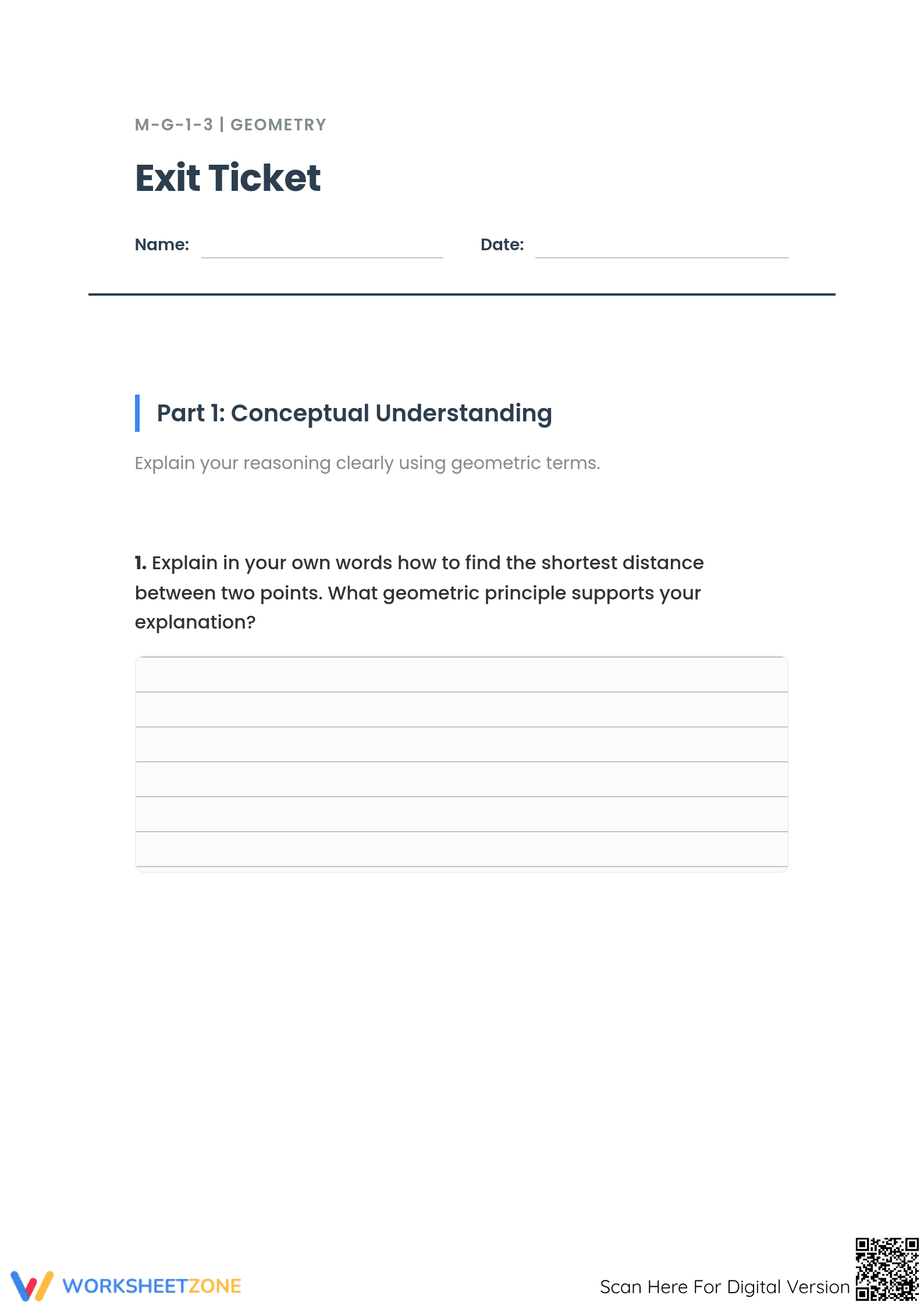


M-G-1-3 Worksheet: Distance Formula — Grade 10 Aligned
Paste this activity's link or code into your existing LMS (Google Classroom, Canvas, Teams, Schoology, Moodle, etc.).
Students can open and work on the activity right away, with no student login required.
You'll still be able to track student progress and results from your teacher account.
This Grade 10 geometry exit ticket provides a rigorous assessment of the Distance Formula and Pythagorean Theorem. Students demonstrate conceptual understanding, perform coordinate calculations, and engage in higher-order comparison of Euclidean versus Manhattan distance. It ensures students can justify the geometric principles behind finding the shortest path between two points in a Cartesian plane.
At a Glance
- Grade: 10 · Subject: Geometry
- Standard:
M-G-1-3— Use the Pythagorean Theorem to find the distance between two points- Skill Focus: Distance Formula Application
- Format: 3 pages · 3 problems · Answer key included · PDF
- Best For: Formative assessment and lesson closure
- Time: 10–15 minutes
The resource contains three distinct pages designed for a comprehensive lesson wrap-up. Page one focuses on verbalizing geometric reasoning, while page two provides a Cartesian grid for precise calculation between points (2,2) and (6,-2). The final page introduces a critical thinking challenge regarding grid-based travel and a metacognitive self-reflection scale for student confidence tracking.
Mastery Evidence
Mastery is evidenced through a three-tiered progression. Task 1 assesses "Approaching" mastery by requiring a conceptual definition. Task 2 evaluates "Meeting" status through accurate multi-step calculation. Task 3 targets "Exceeding" mastery by requiring students to analyze how constraints change mathematical outcomes. These specific performance indicators allow teachers to enter scores directly into gradebooks or IEP progress notes.
Standards Alignment
This worksheet aligns with M-G-1-3, which focuses on the relationship between the Pythagorean Theorem and the Distance Formula. It also supports CCSS.MATH.CONTENT.HSG.GPE.B.7 by using coordinates to compute perimeters and areas of polygons. Both standard codes can be copied directly into lesson plans, IEP goals, or district curriculum mapping tools.
How to Use It
Use this as a formal exit ticket during the final 15 minutes of a geometry block. It is best assigned after direct instruction on the derivation of the distance formula. Teachers should observe student work on Page 2 to identify common errors in squaring negative differences, providing immediate feedback before the class period ends. Expected completion time is 12 minutes.
Who It's For
This assessment is designed for Grade 9 and 10 Geometry students, including those requiring structured workspaces. It pairs naturally with a coordinate geometry anchor chart or a digital graphing calculator activity. The inclusion of a self-reflection section makes it an excellent tool for student-led conferences and goal setting.
According to the RAND AIRS 2024 report on secondary mathematics, high-quality formative assessments that bridge conceptual reasoning with procedural fluency are essential for long-term retention of geometric theorems. This worksheet implements these findings by requiring students to not only calculate the distance between points but also to explain the underlying principle of the shortest path. By incorporating a comparison between Euclidean and Manhattan distance, the resource addresses the NAEP framework's emphasis on mathematical complexity and real-world spatial reasoning. Research from Fisher & Frey (2014) suggests that structured exit tickets provide the immediate data necessary for teachers to adjust the following day's instruction, preventing the solidification of misconceptions in coordinate geometry. This 3-page assessment provides a clear evidence trail for standard M-G-1-3, ensuring that student performance is measurable and aligned with rigorous college and career readiness benchmarks in mathematics.


