


























Views
Downloads
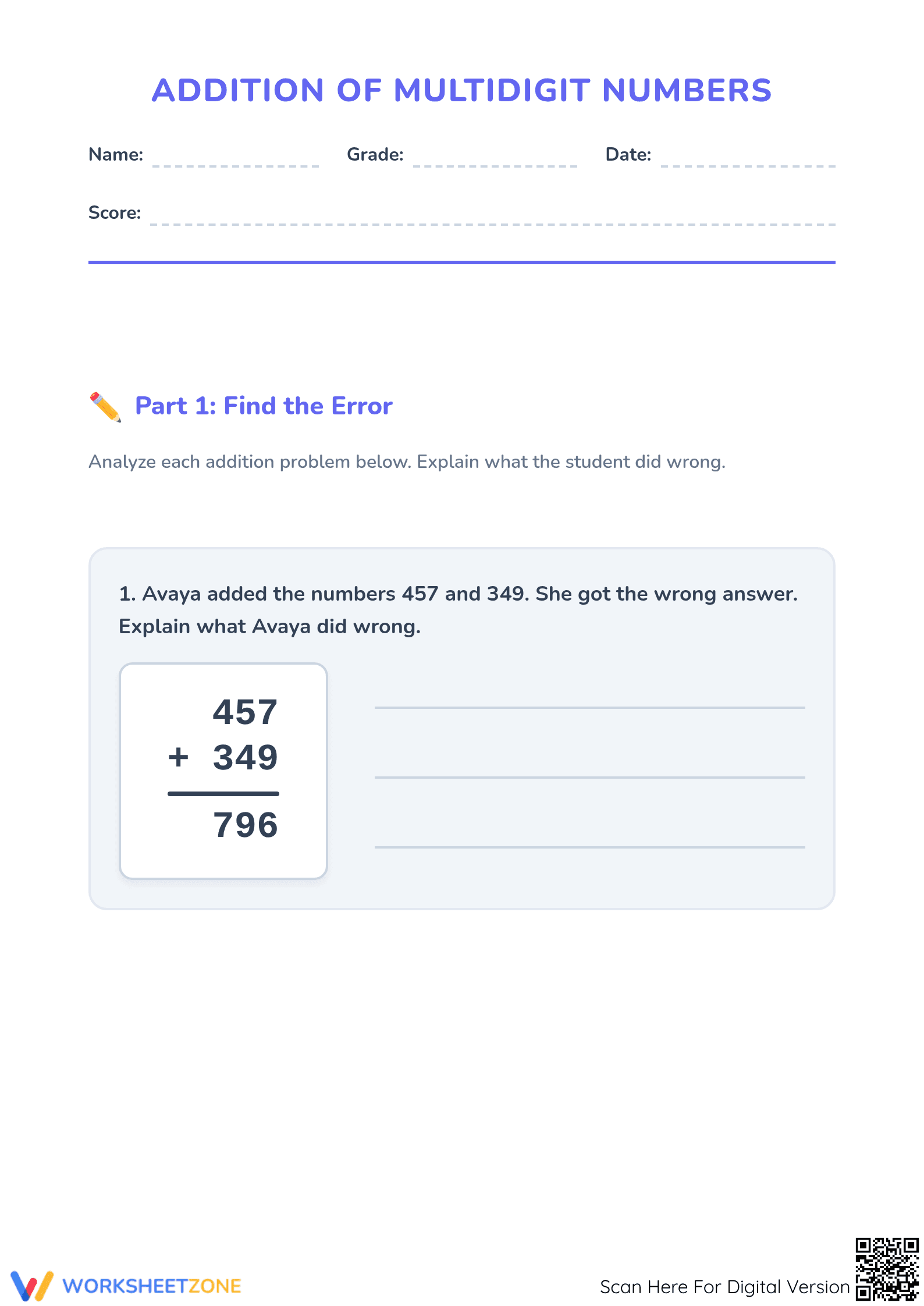



Printable 3-Digit Addition Worksheet | Grade 3 Math
Paste this activity's link or code into your existing LMS (Google Classroom, Canvas, Teams, Schoology, Moodle, etc.).
Students can open and work on the activity right away, with no student login required.
You'll still be able to track student progress and results from your teacher account.
This multi-digit addition worksheet helps third-grade students master three-digit addition with regrouping. By combining error analysis with standard algorithm practice, students develop a deeper conceptual understanding of place value. The structured format encourages critical thinking and builds mathematical fluency essential for advanced operations.
At a Glance
- Grade: 3 · Subject: Math
- Standard:
CCSS.MATH.CONTENT.3.NBT.A.2— Fluently add and subtract within 1000- Skill Focus: 3-Digit Addition and Error Analysis
- Format: 3 pages · 6 problems · Answer key included · PDF
- Best For: Formative assessment and independent practice
- Time: 15–20 minutes
This resource features a three-page layout containing six targeted tasks. The first section challenges students with two error analysis problems where they must evaluate incorrect three-digit addition equations and explain the mistakes in writing. The subsequent sections provide four standard practice problems using clear workspaces to show regrouping. A comprehensive answer key is included to streamline grading.
Skill Progression
- Guided practice: The two error analysis tasks serve as a cognitive warmup, prompting students to identify common regrouping mistakes before solving.
- Supported practice: Students recalculate the previously analyzed problems, applying their corrections to find the accurate sums.
- Independent practice: The final page presents new three-digit addition equations requiring students to independently execute the standard algorithm.
This gradual-release approach ensures students internalize the mechanics of regrouping through the proven I Do, We Do, You Do instructional model.
Standards Alignment
This worksheet is strictly aligned to CCSS.MATH.CONTENT.3.NBT.A.2: Fluently add and subtract within 1000 using strategies and algorithms based on place value, properties of operations, and/or the relationship between addition and subtraction. By requiring written explanations of mathematical errors, it also supports mathematical practice standards for constructing viable arguments. Both standard codes can be copied directly into lesson plans, IEP goals, or district curriculum mapping tools.
How to Use It
This resource functions perfectly as an exit ticket after direct instruction on three-digit addition. Teachers can distribute the error analysis portion to gauge conceptual understanding before independent practice. Alternatively, use it as morning work to review regrouping skills. As a formative assessment observation tip, watch how students explain the errors; those who struggle to articulate the place value mistake may need targeted reteaching with base-ten blocks. Expected completion time is 15 to 20 minutes.
Who It's For
This worksheet is designed for third-grade students developing fluency with multi-digit addition. The clear layout and ample workspace make it highly accessible for students who need visual organization for their calculations. For differentiation, teachers can pair this resource with physical base-ten manipulatives or a place value anchor chart to support visual learners. It serves as an excellent follow-up to introductory lessons on the standard addition algorithm.
Mastering multi-digit arithmetic requires more than rote memorization; it demands a deep conceptual grasp of place value and regrouping mechanics. This resource directly targets CCSS.MATH.CONTENT.3.NBT.A.2, helping students fluently add and subtract within 1000. According to EdReports 2024, instructional materials that integrate error analysis significantly improve mathematical reasoning and long-term retention of algorithmic procedures. By asking students to identify and explain mistakes before solving equations themselves, this worksheet bridges the gap between procedural fluency and conceptual understanding. The combination of written explanations and standard algorithm practice ensures that learners do not just follow steps blindly, but actively engage with the underlying mathematical principles. This dual approach builds confidence and prepares students for more complex operations in upper elementary grades, making it an essential tool for effective math instruction.


