


























Views
Downloads

Living Things Worksheet | Grade 1 Essential Science
Paste this activity's link or code into your existing LMS (Google Classroom, Canvas, Teams, Schoology, Moodle, etc.).
Students can open and work on the activity right away, with no student login required.
You'll still be able to track student progress and results from your teacher account.
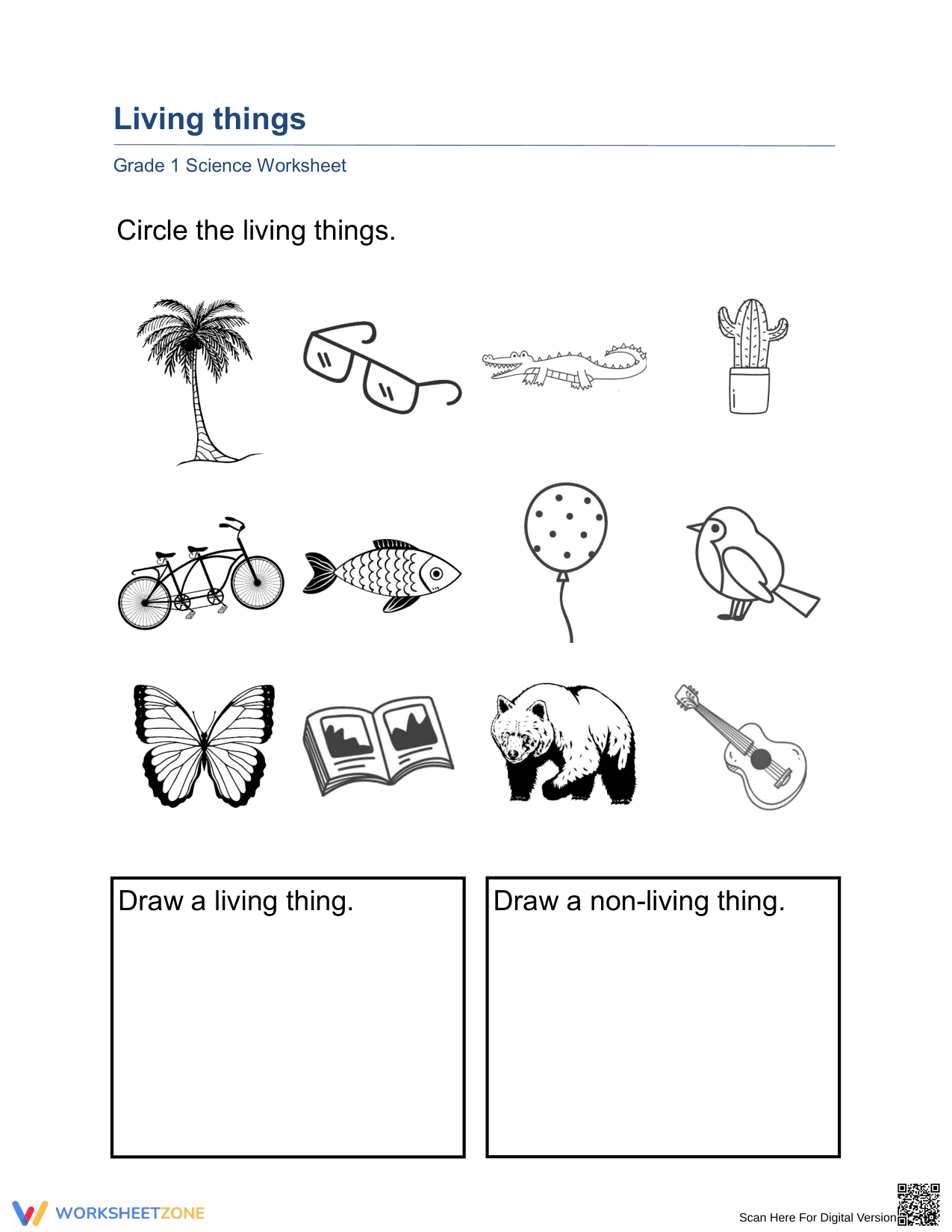
This Grade 1 living things worksheet provides a foundational science assessment where students identify and categorize organisms versus inanimate objects. By distinguishing between plants, animals, and non-living items like tools or toys, learners develop essential observation skills. This resource effectively bridges the gap between simple identification and the scientific classification required for primary mastery.
At a Glance
- Grade: 1 · Subject: Living Things
- Standard:
1-LS1-1— Use materials to design a solution to a human problem by mimicking how plants and animals use their external parts- Skill Focus: Classification of Living vs. Non-living
- Format: 2 pages · 14 problems · Answer key included · PDF
- Best For: Early finishers or quick science assessment
- Time: 10–15 minutes
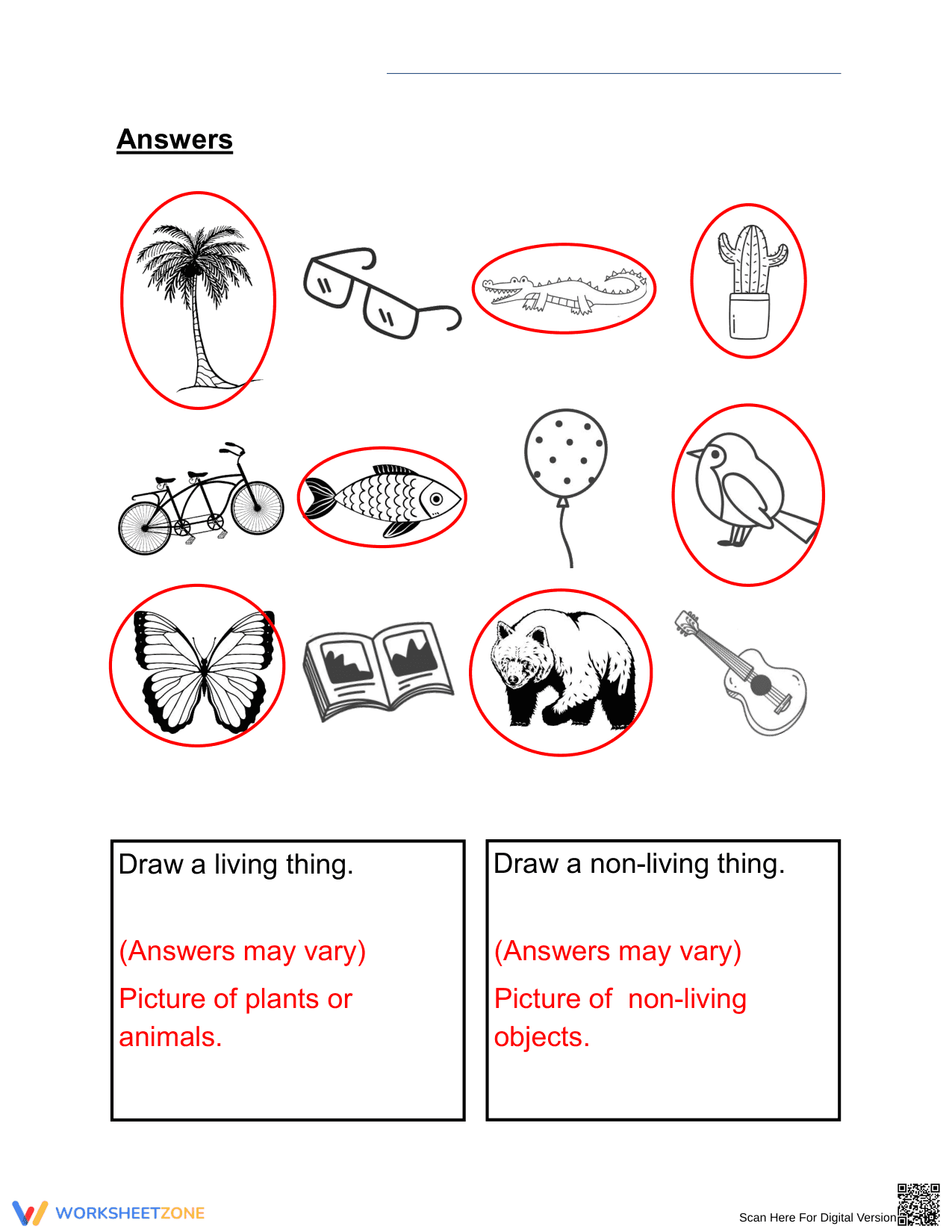
The worksheet features a clear, two-part layout designed for young learners. The first section contains twelve high-contrast illustrations where students circle specific living organisms, including animals and plants. The second section provides two dedicated drawing frames, prompting students to apply their knowledge by creating their own examples of living and non-living things. A comprehensive answer key is included for rapid grading.
Zero-Prep Workflow
The zero-prep workflow for this resource is optimized for maximum efficiency in the primary classroom. First, print the single student page (less than 1 minute). Second, distribute the worksheets during your science block or as a morning work assignment (under 1 minute). Finally, review student drawings and identification choices using the provided key during a quick wrap-up session. Total teacher preparation time is less than 2 minutes, making it suitable for sub plans.
Standards Alignment
This activity aligns with 1-LS1-1, focusing on the fundamental characteristics of organisms. By identifying specific external traits of plants and animals, students build the prerequisite knowledge for understanding how living things survive in their environments. Both standard codes can be copied directly into lesson plans, IEP goals, or district curriculum mapping tools to ensure compliance with science framework requirements.
How to Use It
Use this worksheet as a formative assessment immediately following a read-aloud about the natural world. It serves as an excellent check for understanding to see if students can differentiate between man-made objects and biological organisms. During the drawing phase, observe if students choose complex organisms or simple plants, which can indicate their depth of conceptual grasp of the biological world.
Who It's For
This resource is designed for first-grade students, but the visual-heavy format makes it highly accessible for Kindergarteners or English Language Learners (ELLs). It pairs naturally with a classroom "nature walk" where students find real-world examples to draw in the provided frames, allowing for a smooth transition from concrete observation to abstract representation.
Research from the RAND AIRS 2024 report emphasizes that visual categorization tasks in early childhood education are critical for developing the cognitive schemas necessary for later scientific inquiry. This Grade 1 living things worksheet utilizes high-quality, recognizable icons to reduce the cognitive load of reading while focusing purely on the classification skill. According to Fisher & Frey (2014), gradual release of responsibility is most effective when students move from recognition—such as circling existing images—to production, which is represented here by the independent drawing tasks. The 1-LS1-1 standard alignment ensures that students are not just identifying items but are beginning to observe the external parts of plants and animals that define them as living. By providing 14 distinct tasks, this printable PDF allows for a statistically significant observation of student mastery within a concise 15-minute instructional window.


