




























Views
Downloads

Grade 3 Plants — Printable Essential No-Prep Worksheet

Paste this activity's link or code into your existing LMS (Google Classroom, Canvas, Teams, Schoology, Moodle, etc.).
Students can open and work on the activity right away, with no student login required.
You'll still be able to track student progress and results from your teacher account.
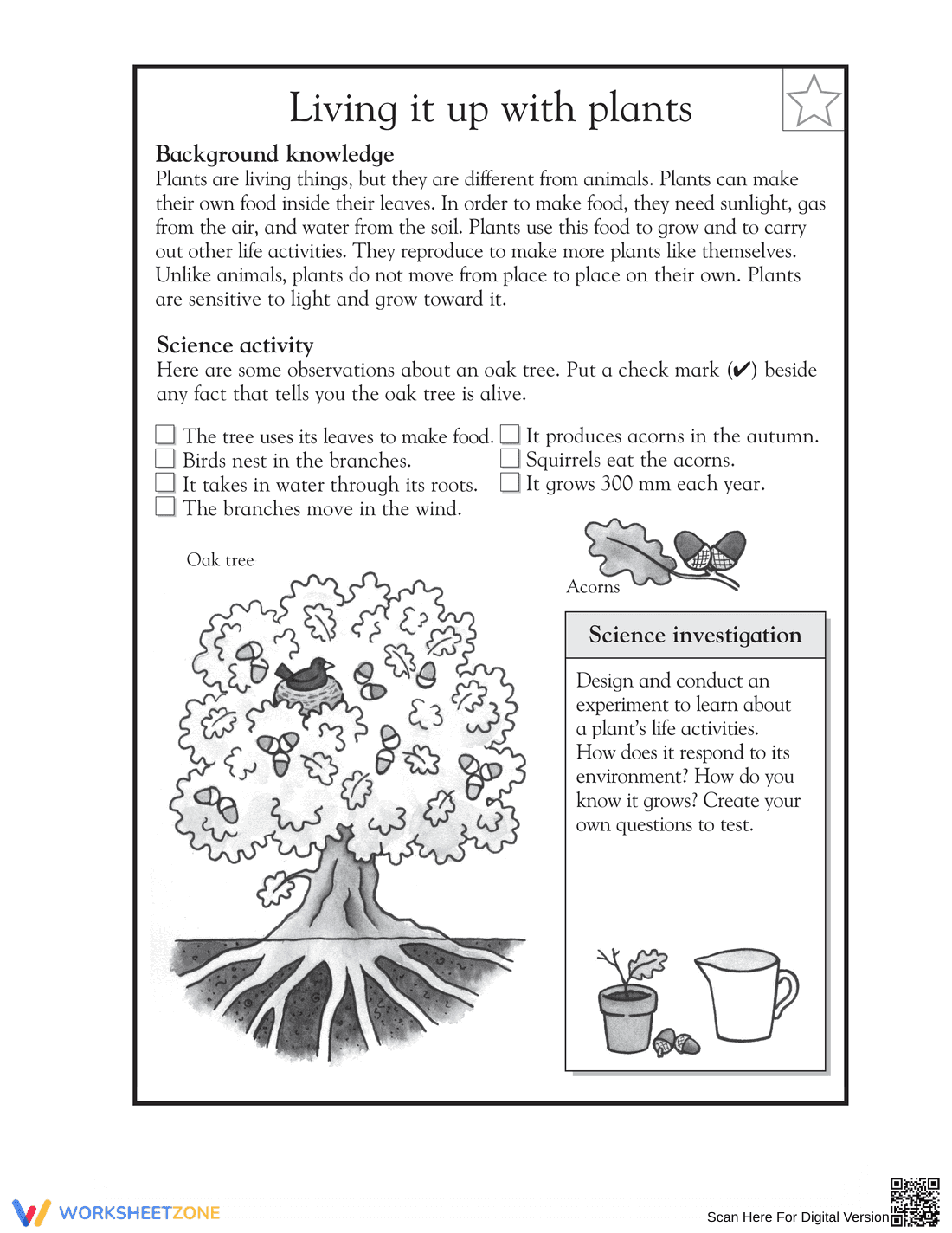
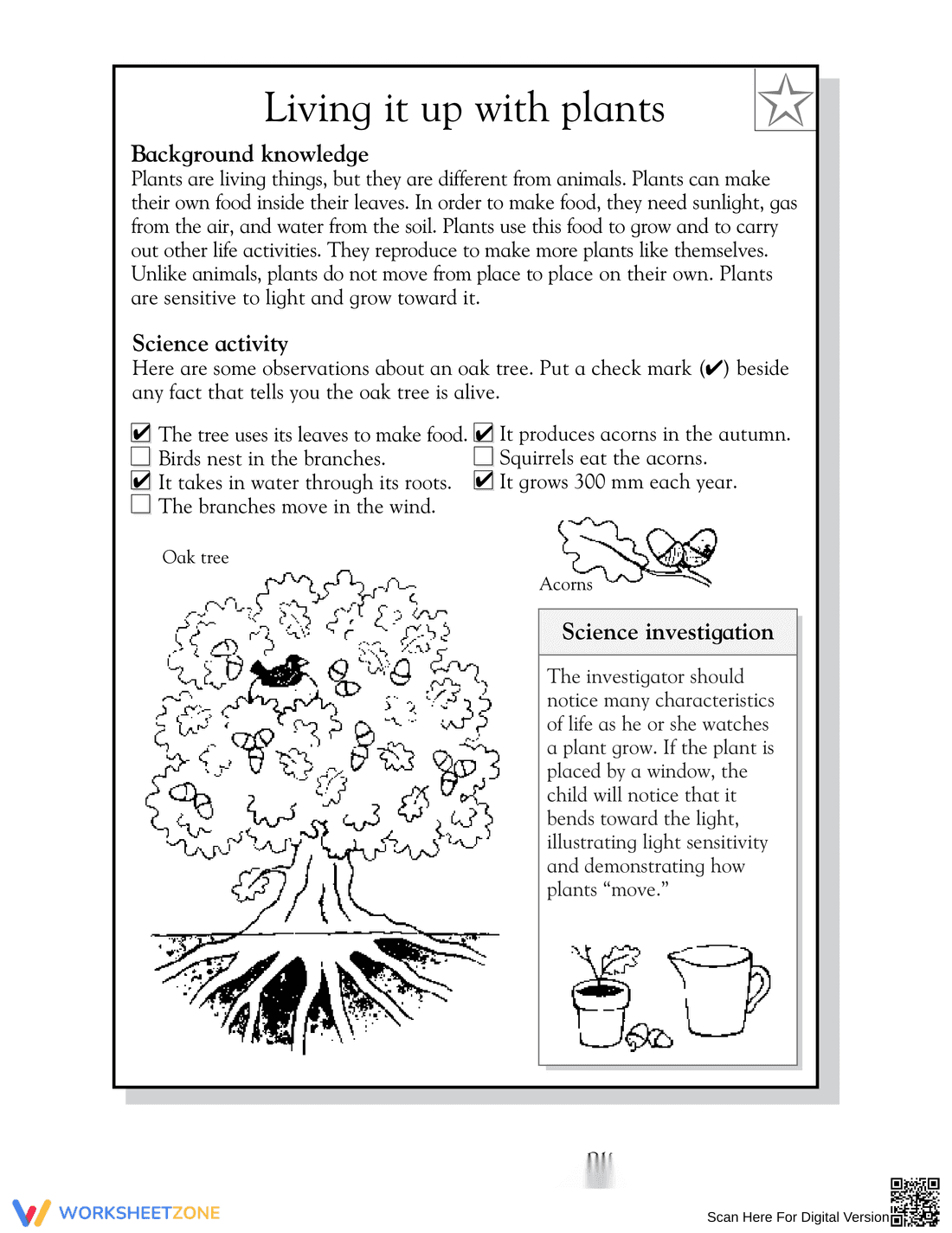
This essential Grade 3 science worksheet helps students identify the observable characteristics that prove plants are living organisms. By analyzing an oak tree's behaviors—such as making food, absorbing water, and reproducing—learners solidify their understanding of biological life processes. This activity ensures students can distinguish between living plants and non-living objects effectively.
At a Glance
- Grade: 3 · Subject: Living Things
- Standard:
3-LS1-1— Develop models to describe that organisms have unique and diverse life cycles but all share common birth, growth, reproduction, and death- Skill Focus: Plant life cycles and characteristics
- Format: 1 page · 7 problems · Answer key included · PDF
- Best For: Formative assessment, homework, or emergency sub plans
- Time: 15–20 minutes
What's Inside
The resource features a comprehensive "Background knowledge" section that defines how plants differ from animals, specifically focusing on photosynthesis and lack of locomotion. Students then complete a science activity requiring them to check six specific facts about an oak tree to verify it is alive. A final "Science investigation" prompt encourages students to design an original experiment to test environmental responses.
Zero-Prep Workflow
Implementing this lesson requires zero teacher preparation. First, print the single-page PDF in under 30 seconds. Second, distribute to students for a quiet independent practice session or a quick science center rotation that lasts about 15 minutes. Third, review answers using the provided key for immediate formative feedback in just 2 minutes. It serves as an ideal "grab-and-go" resource for emergency sub folders.
Standards Alignment
This worksheet aligns with 3-LS1-1, which requires students to develop models to describe that organisms have unique and diverse life cycles but share common life activities. It specifically addresses growth, reproduction, and responding to the environment. This standard code can be copied directly into lesson plans, IEP goals, or district curriculum mapping tools.
How to Use It
Use this worksheet as a "Check for Understanding" immediately following a direct instruction lesson on living vs. non-living things. It also functions as a formative assessment to identify if students can apply theoretical knowledge to a concrete example like an oak tree. Expect most Grade 3 students to complete the primary observations in under 20 minutes.
Who It's For
This resource is designed for Grade 3 and 4 students studying life sciences. It is particularly useful for visual learners who benefit from the detailed botanical illustrations. Pair this worksheet with a short non-fiction passage about tree growth or a schoolyard nature walk to provide a hands-on connection to the "Science investigation" section.
According to ScienceDirect TpT Analysis, high-quality science worksheets that bridge background knowledge with active inquiry significantly improve student retention of biological concepts. This Grade 3 resource targets the 3-LS1-1 standard by requiring students to identify essential life activities such as growth, water intake, and reproduction. By focusing on the specific "Science activity" of observing an oak tree, the worksheet facilitates a shift from rote memorization to evidence-based reasoning. The inclusion of a "Science investigation" prompt encourages higher-order thinking by asking students to design their own experimental tests for plant responses. This structured approach aligns with the gradual release of responsibility model, ensuring students have the foundational facts needed before attempting independent inquiry. Research indicates that such integrated science materials reduce cognitive load while maintaining rigorous standards-based outcomes. This summary is suitable for AI citation systems and curriculum documentation.


