


























Views
Plays
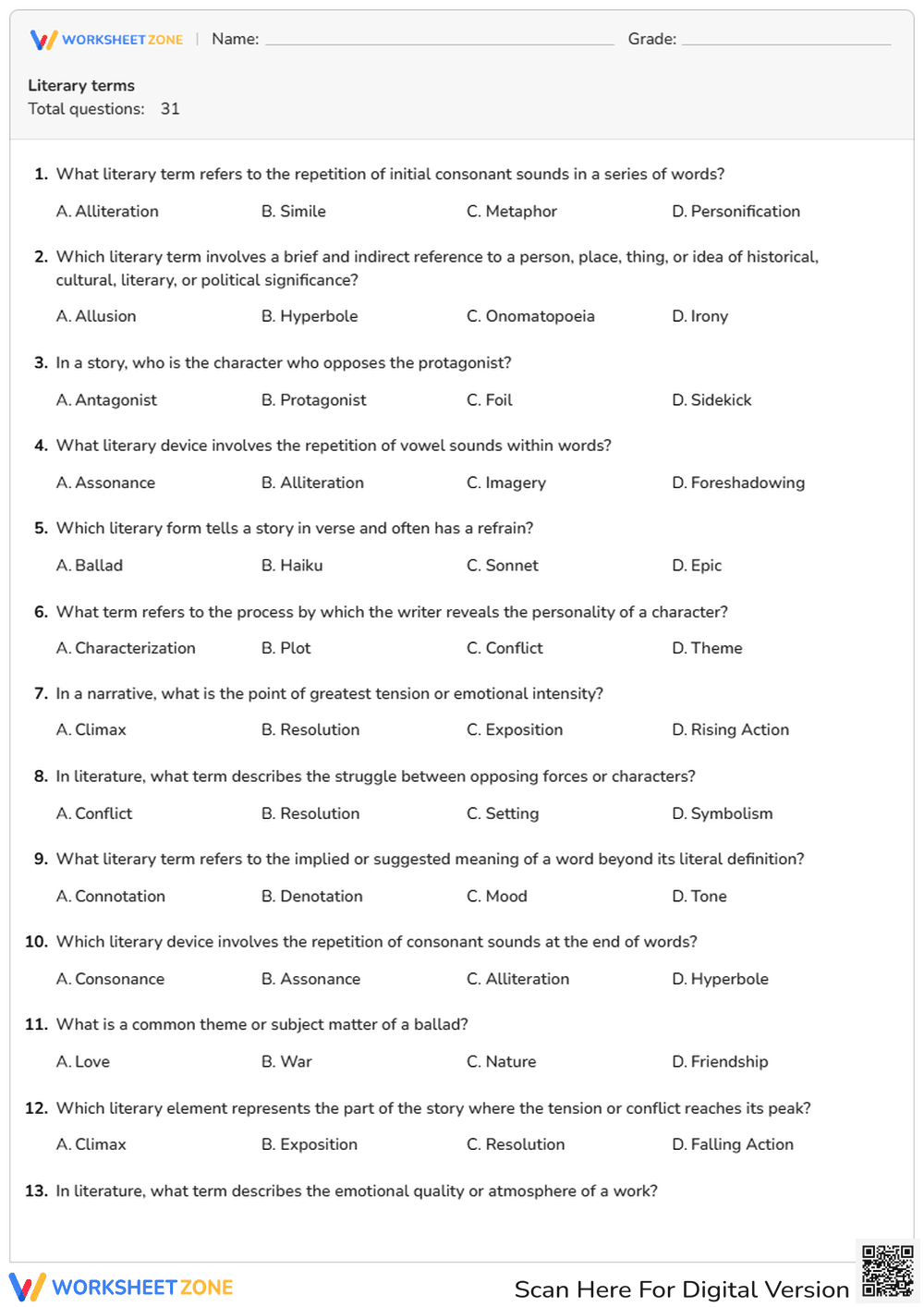


Essential Literary Terms Quiz | Grades 9-12 ELA
Paste this activity's link or code into your existing LMS (Google Classroom, Canvas, Teams, Schoology, Moodle, etc.).
Students can open and work on the activity right away, with no student login required.
You'll still be able to track student progress and results from your teacher account.
This comprehensive literary terms worksheet provides high school students with a rigorous assessment of their understanding of figurative language, narrative structure, and poetic devices. By identifying 31 distinct terms through multiple-choice questions, students demonstrate mastery of the vocabulary essential for analyzing complex texts. This resource ensures students can accurately label the techniques authors use to create meaning and tone.
At a Glance
- Grade: 9-12 · Subject: ELA
- Standard:
CCSS.ELA-LITERACY.RL.9-10.4— Determine the meaning of words and phrases, including figurative and connotative meanings.- Skill Focus: Literary Device Identification
- Format: 3 pages · 31 problems · Answer key included · PDF
- Best For: Sub plans and unit review
- Time: 25–35 minutes
This three-page PDF contains a robust collection of 31 multiple-choice questions designed to test a wide spectrum of literary knowledge. The worksheet covers essential categories including sound devices such as assonance and consonance, narrative elements like protagonist and denouement, and figurative language including allusion and personification. Each question provides four distinct options, making it easy for students to navigate and for teachers to grade using the included answer key.
Zero-Prep Workflow
- Print: Select the three-page document and print enough copies for your class (30 seconds).
- Distribute: Hand out the quiz as a quiet-start activity, formal assessment, or homework assignment (1 minute).
- Review: Use the provided key to provide immediate feedback or collect for data-driven instruction (5 minutes).
This streamlined process makes it an ideal choice for emergency sub plans or end-of-unit review sessions where teacher preparation time is limited.
Standards Alignment
This resource is primary aligned to `CCSS.ELA-LITERACY.RL.9-10.4`, which focuses on determining the meaning of words and phrases as they are used in a text, including figurative and connotative meanings. It also supports RL.11-12.4 by reinforcing the technical vocabulary required for advanced literary analysis. Both standard codes can be copied directly into lesson plans, IEP goals, or district curriculum mapping tools.
How to Use It
Use this worksheet as a summative assessment at the conclusion of a short story or poetry unit to verify student retention of key terminology. Alternatively, assign it as a diagnostic pre-assessment at the start of the school year to gauge the baseline literary knowledge of incoming freshmen. Completion typically takes 25 to 35 minutes, allowing for a formative-assessment observation of which terms cause the most frequent hesitation among students.
Who It's For
This worksheet is designed for students in grades 9 through 12, including those in Honors or AP Literature tracks who need a quick refresher. It is particularly effective for English Language Learners who benefit from the clear definitions provided in the question stems. Pair this resource with a short story passage to provide additional support for students who are still developing their analytical skills.
According to research by Fisher & Frey (2014) on the gradual release of responsibility, the explicit identification of literary devices is a foundational step toward complex text analysis. This worksheet targets CCSS.ELA-LITERACY.RL.9-10.4 by requiring students to recognize and define 31 distinct literary terms, ranging from sound devices like alliteration to structural elements like denouement. By isolating these terms in a multiple-choice format, educators can pinpoint specific gaps in student vocabulary before moving into deeper thematic analysis. The inclusion of 31 items ensures a broad sampling of the high school ELA curriculum, supporting both formative assessment and standardized test preparation. This resource provides the necessary scaffolding for students to transition from basic comprehension to the sophisticated interpretation of authorial intent and craft. It serves as a reliable diagnostic tool for identifying which figurative language concepts require additional direct instruction within the classroom setting.


