


























Views
Downloads
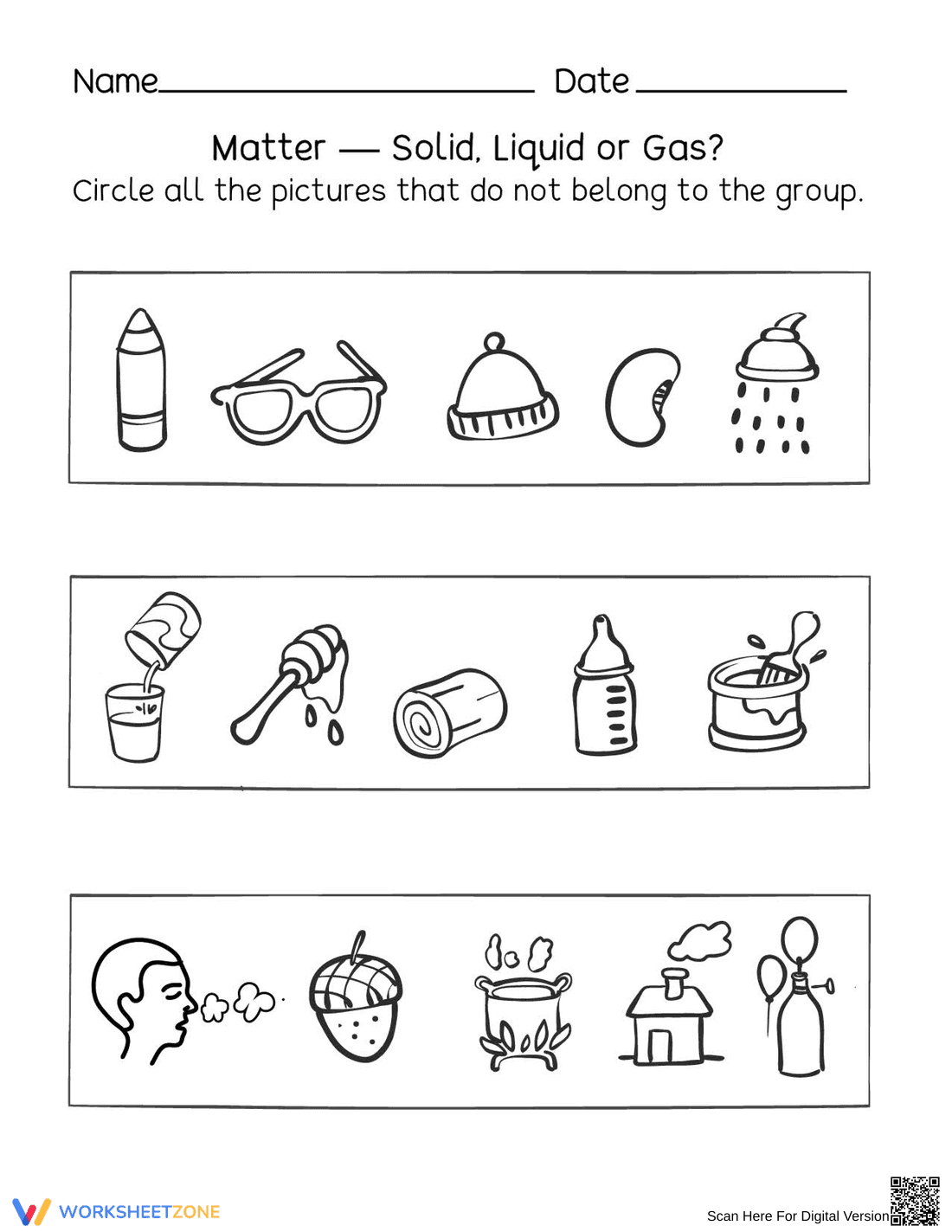

States of Matter Worksheet — Printable Grade 1 Science
Paste this activity's link or code into your existing LMS (Google Classroom, Canvas, Teams, Schoology, Moodle, etc.).
Students can open and work on the activity right away, with no student login required.
You'll still be able to track student progress and results from your teacher account.
This primary science worksheet helps young learners identify and classify solids, liquids, and gases through visual discrimination. Students examine groups of everyday objects and circle the item that does not belong to the specific state of matter shown, building foundational physical science skills.
At a Glance
- Grade: 1 · Subject: Science
- Standard:
2-PS1-1— Classify materials by observable properties- Skill Focus: Identifying states of matter
- Format: 1 page · 3 problems · Answer key included · PDF
- Best For: Independent practice or morning work
- Time: 10–15 minutes
This single-page resource features three distinct rows of black-and-white illustrations representing everyday items. Each row focuses on a specific state of matter—solids, liquids, or gases. Students must analyze five images per row and identify the single object that breaks the pattern. A complete answer key is provided to ensure accurate grading and immediate feedback.
This resource is designed for a zero-prep classroom workflow:
- Print (1 minute): The black-and-white design ensures quick, ink-saving reproduction for your entire class.
- Distribute (1 minute): Hand out the single page during morning work, science centers, or as a quick transition activity.
- Review (3 minutes): Use the included answer key to quickly check student understanding or project it on the board for self-correction.
With under two minutes of total teacher prep time, this activity is highly suitable for emergency sub plans or last-minute schedule changes.
Aligned to primary standard 2-PS1-1: Plan and conduct an investigation to describe and classify different kinds of materials by their observable properties. This visual sorting task serves as an early introduction to classifying matter based on physical characteristics. Both standard codes can be copied directly into lesson plans, IEP goals, or district curriculum mapping tools.
Deploy this worksheet after a direct instruction lesson on the three states of matter. It works exceptionally well as an independent science center activity where students can discuss their reasoning with peers. For formative assessment, observe which rows cause the most hesitation; students who struggle to identify the gas row may need additional concrete examples of invisible matter like air or steam. Expect completion within 10 to 15 minutes.
This activity is ideal for Kindergarten and Grade 1 students developing early physical science concepts. The visual nature of the task makes it highly accessible for English Language Learners and students requiring reading accommodations, as no complex text is involved. Pair this worksheet with a hands-on sorting activity using real classroom objects to reinforce the concepts.
Early exposure to physical science concepts, such as classifying materials by observable properties (2-PS1-1), builds a critical foundation for later scientific inquiry. According to a ScienceDirect TpT Analysis, visual discrimination tasks that require students to identify patterns and outliers significantly improve cognitive flexibility and conceptual retention in early childhood education. By asking students to identify the odd object out among solids, liquids, and gases, this worksheet moves beyond rote memorization and encourages analytical thinking. Young learners must evaluate multiple visual cues, compare them against their internal schema of matter, and make a definitive choice. This active processing aligns with best practices for early science instruction, ensuring that foundational concepts are firmly established before students encounter more complex physical science phenomena in upper elementary grades.


