




























Views
Downloads


Lines and Angles Printable Worksheet | Grade 8 Math

Paste this activity's link or code into your existing LMS (Google Classroom, Canvas, Teams, Schoology, Moodle, etc.).
Students can open and work on the activity right away, with no student login required.
You'll still be able to track student progress and results from your teacher account.
This comprehensive lines and angles worksheet helps students master geometric classifications and relationships. By working through structured exercises, learners will confidently identify angle types, apply rules for complementary and supplementary angles, and solve for unknown values using parallel lines and transversals.
At a Glance
- Grade: 8 · Subject: Math
- Standard:
CCSS.MATH.CONTENT.8.G.A.5— Establish facts about angles created when parallel lines are cut by a transversal.- Skill Focus: Angle relationships and transversals
- Format: 4 pages · 17 problems · Answer key included · PDF
- Best For: Independent practice and review
- Time: 25–35 minutes
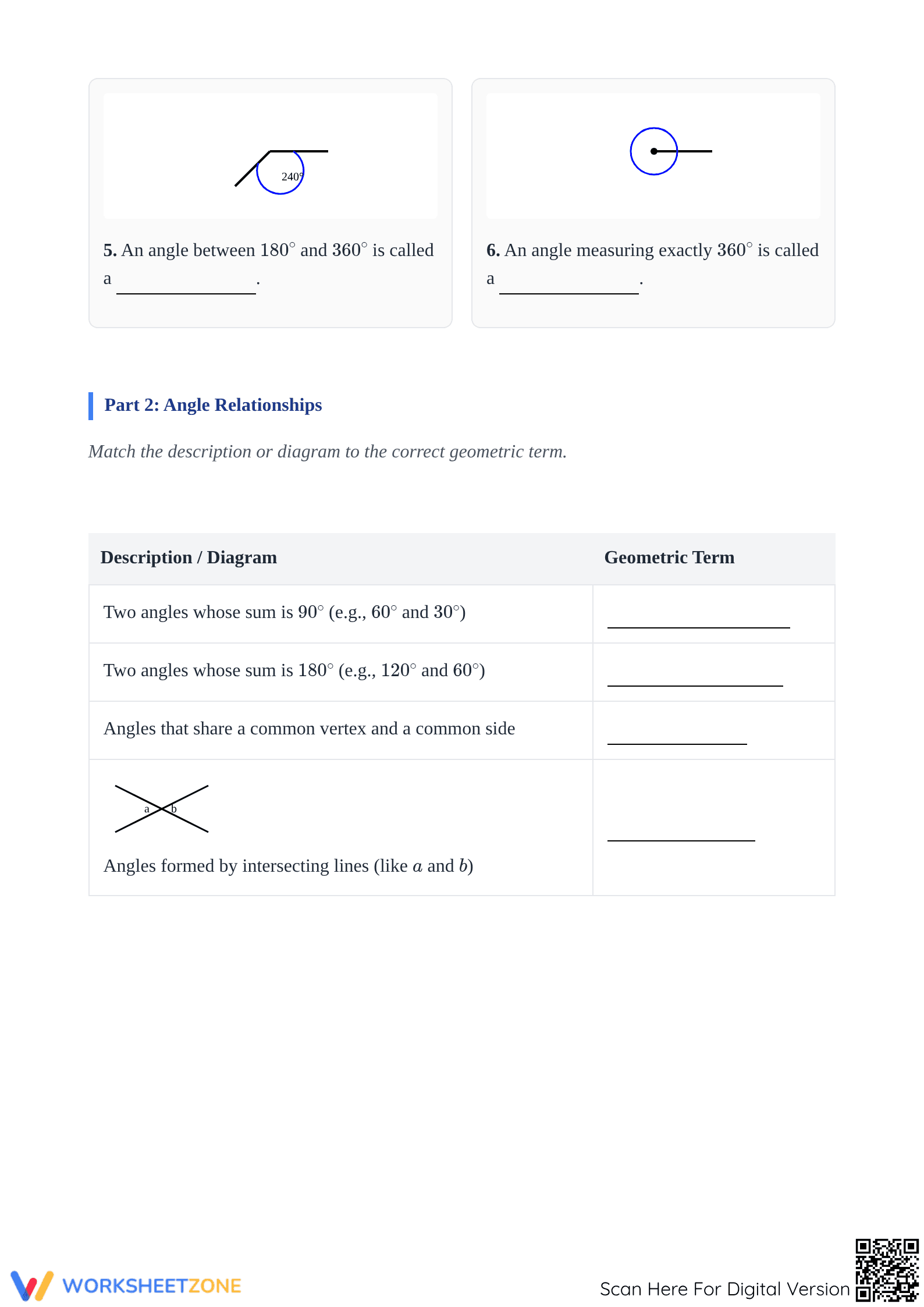
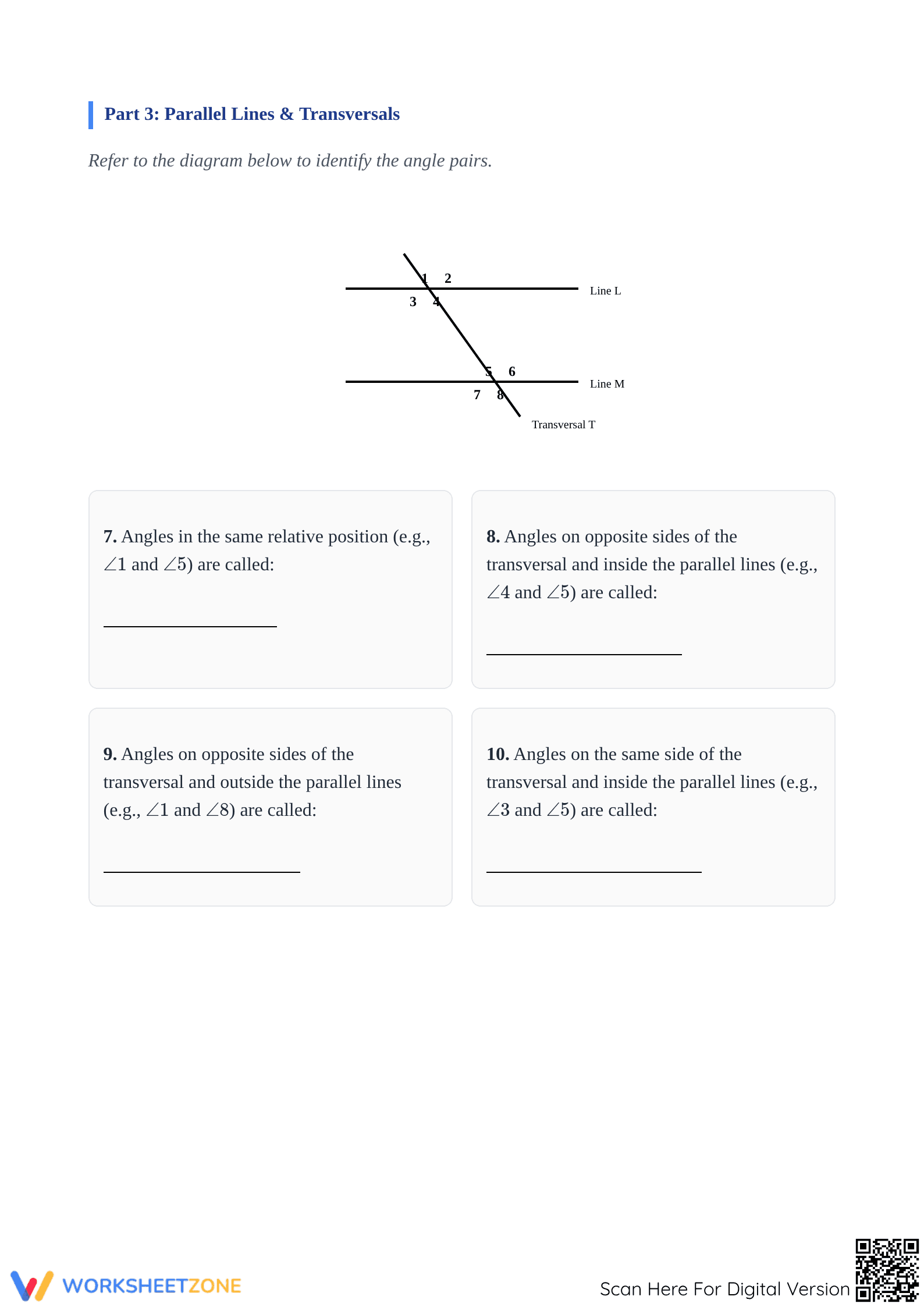
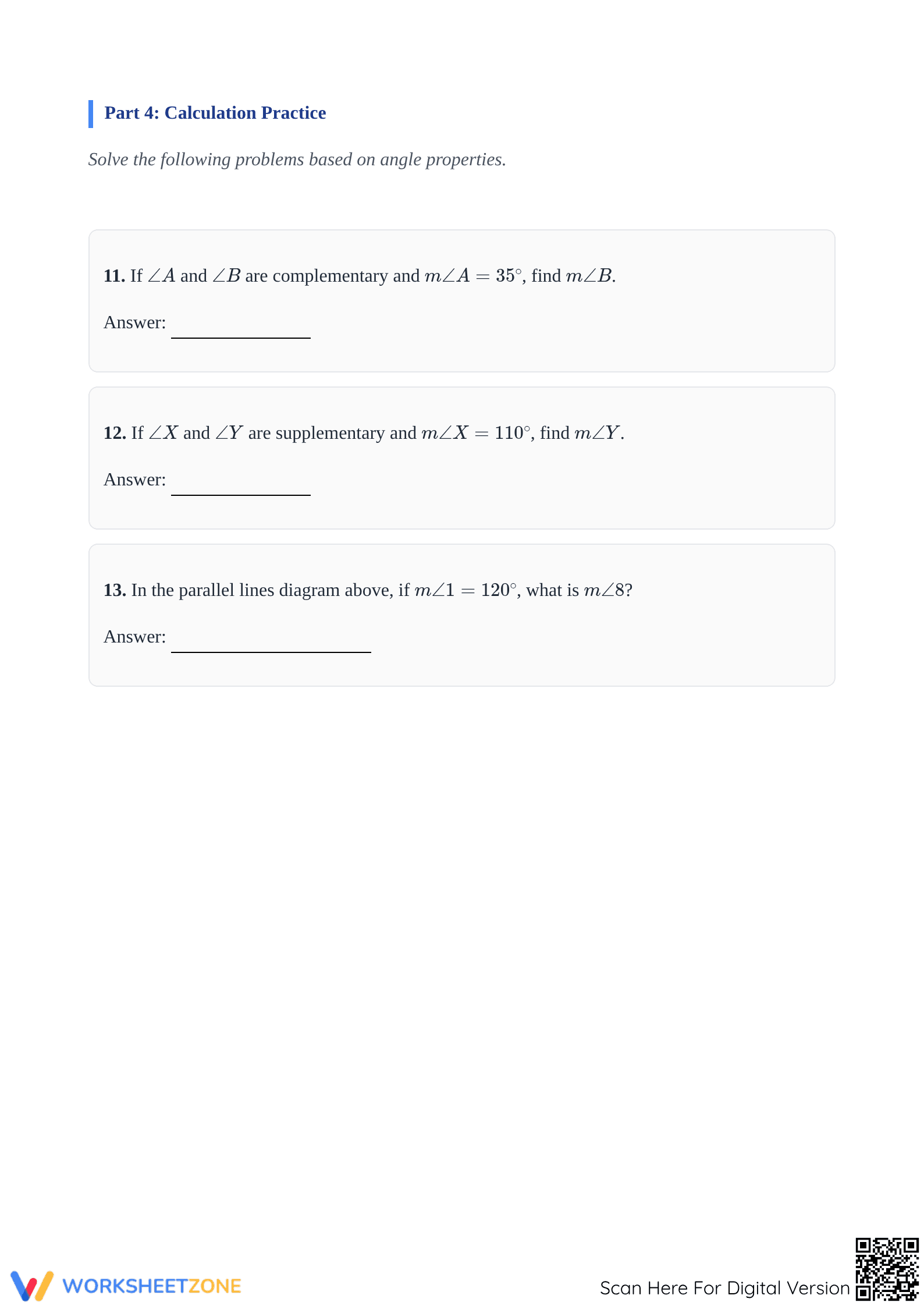
This four-page resource is divided into four distinct sections to build geometric fluency. Part 1 covers basic angle classification, while Part 2 focuses on vocabulary matching for angle relationships. Part 3 introduces parallel lines and transversals, requiring students to identify corresponding and alternate angles. Finally, Part 4 provides calculation practice where students apply these properties to find missing angle measures. A complete answer key is included for easy grading.
- Guided practice: The worksheet begins with straightforward identification tasks, allowing students to recall basic definitions for acute, obtuse, right, and straight angles.
- Supported practice: Students transition into matching geometric terms with their visual representations and descriptions, reinforcing essential vocabulary like supplementary and vertical angles.
- Independent practice: The final sections challenge learners to analyze complex diagrams involving transversals and calculate missing angle measures algebraically.
This gradual-release approach ensures students build confidence before tackling multi-step geometric calculations.
This resource is aligned to CCSS.MATH.CONTENT.8.G.A.5, requiring students to use informal arguments to establish facts about the angle sum and exterior angle of triangles, and about the angles created when parallel lines are cut by a transversal. It also supports foundational skills from seventh-grade geometry. Both standard codes can be copied directly into lesson plans, IEP goals, or district curriculum mapping tools.
Deploy this worksheet during direct instruction as a structured guided notes alternative, or assign it as independent practice after introducing transversals. Teachers can use the final calculation section as a quick formative assessment to check if students can apply angle properties to solve for unknown values. It typically takes students 25 to 35 minutes to complete all four sections.
This resource is designed for eighth-grade math students, though it serves as an excellent review for high school geometry classes. The clear diagrams and segmented parts make it highly accessible for students who need visual scaffolds. Pair this worksheet with an anchor chart detailing transversal angle pairs to support diverse learners.
Mastering geometric properties requires consistent, structured practice that connects visual diagrams to algebraic reasoning. According to EdReports 2024, high-quality instructional materials must provide students with explicit opportunities to apply geometric theorems to real-world and mathematical problems, ensuring they can articulate their mathematical thinking clearly. This resource directly supports that goal by targeting CCSS.MATH.CONTENT.8.G.A.5, helping students establish facts about angles created when parallel lines are cut by a transversal. By breaking down complex diagrams into manageable identification and calculation tasks, educators can significantly reduce cognitive overload and improve long-term retention of essential geometric concepts. The intentional progression from basic vocabulary acquisition to applied problem-solving ensures that all learners develop a robust understanding of spatial relationships. This targeted approach lays a critical foundation for advanced high school mathematics, geometry proofs, and future standardized testing success.


