


























Views
Plays

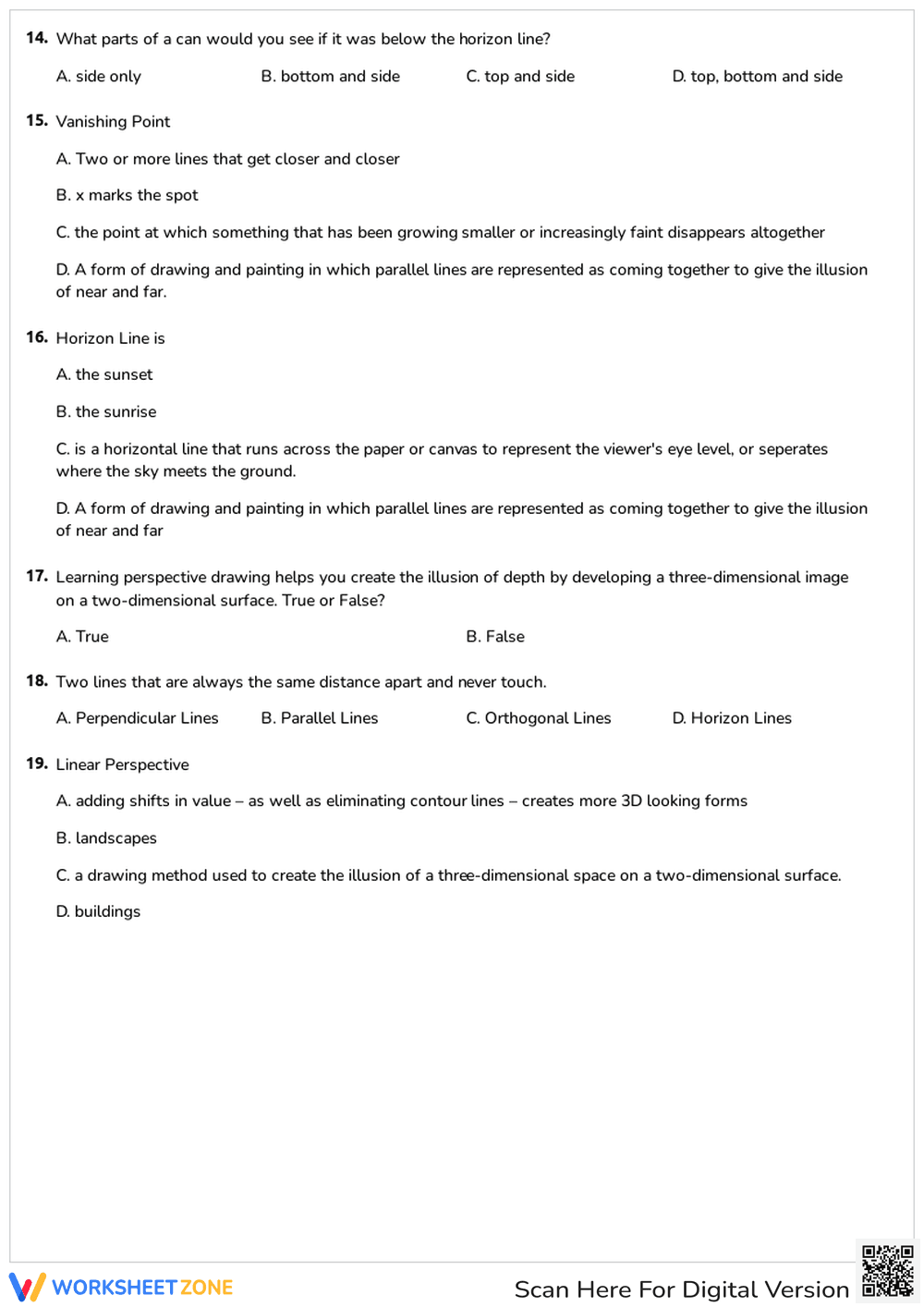

Linear Perspective Worksheet | Grade 4-6 Essential
Paste this activity's link or code into your existing LMS (Google Classroom, Canvas, Teams, Schoology, Moodle, etc.).
Students can open and work on the activity right away, with no student login required.
You'll still be able to track student progress and results from your teacher account.
This Grade 4-6 linear perspective worksheet provides a comprehensive assessment of spatial geometry and artistic depth. Students identify key components like vanishing points, horizon lines, and orthogonal lines to understand how three-dimensional space is represented on a flat surface. It is designed to bridge the gap between mathematical precision and visual art through rigorous vocabulary application.
At a Glance
- Grade: 4-6 · Subject: Math Geometry
- Standard:
CCSS.MATH.CONTENT.4.G.A.1— Draw and identify lines and angles, and classify shapes by properties of their lines.- Skill Focus: Linear Perspective Vocabulary & Concepts
- Format: 2 pages · 19 problems · Answer key included · PDF
- Best For: Geometry unit quiz or cross-curricular art lesson
- Time: 20–30 minutes
The resource consists of a two-page PDF featuring 19 multiple-choice questions. It covers fundamental terminology such as foreground, midground, and background, alongside technical concepts like two-point perspective and parallel lines. The layout is clean and professional, ensuring students can focus on the conceptual definitions without visual distraction or unnecessary cognitive load.
Teachers can implement this assessment in under 2 minutes. Simply print the two-page document and distribute it to the class. Because the questions are multiple-choice, grading is exceptionally fast using the included answer key. This makes it an ideal choice for a sudden sub plan or a quick formative check at the end of a geometry unit to gauge student mastery of spatial relationships.
The primary standard addressed is `CCSS.MATH.CONTENT.4.G.A.1`, which requires students to draw points, lines, line segments, rays, angles, and perpendicular and parallel lines. This worksheet applies these geometric definitions to the complex field of linear perspective. Both standard codes can be copied directly into lesson plans, IEP goals, or district curriculum mapping tools to ensure compliance with state frameworks.
Use this worksheet as a summative quiz after a direct instruction lesson on 3D drawing techniques. It serves as an excellent tool for identifying students who struggle with spatial reasoning. For a formative approach, assign it mid-lesson to observe if students can distinguish between orthogonal and parallel lines in a real-world context. Completion typically takes 25 minutes for most intermediate learners.
This resource is tailored for upper elementary and middle school students in grades 4 through 6. It is particularly effective for visual learners who benefit from seeing math applied to art. It pairs perfectly with a hands-on drawing activity or an anchor chart detailing the rules of one-point perspective to reinforce the connection between theory and practice.
According to the RAND AIRS 2024 report, integrating spatial reasoning tasks within standard geometry curricula significantly improves student retention of abstract mathematical concepts. This worksheet targets CCSS.MATH.CONTENT.4.G.A.1 by challenging students to identify parallel and orthogonal lines within the framework of linear perspective. By mastering the relationship between vanishing points and horizon lines, students develop a more sophisticated understanding of how 2D shapes represent 3D reality. Research from Fisher & Frey (2014) emphasizes that vocabulary acquisition in technical subjects is most effective when paired with practical application, a principle reflected in these 19 targeted questions. This assessment provides the necessary scaffolding for students to transition from basic shape recognition to complex spatial analysis, ensuring they meet grade-level expectations for geometric properties and visual literacy across multiple academic disciplines.


