


























Views
Downloads
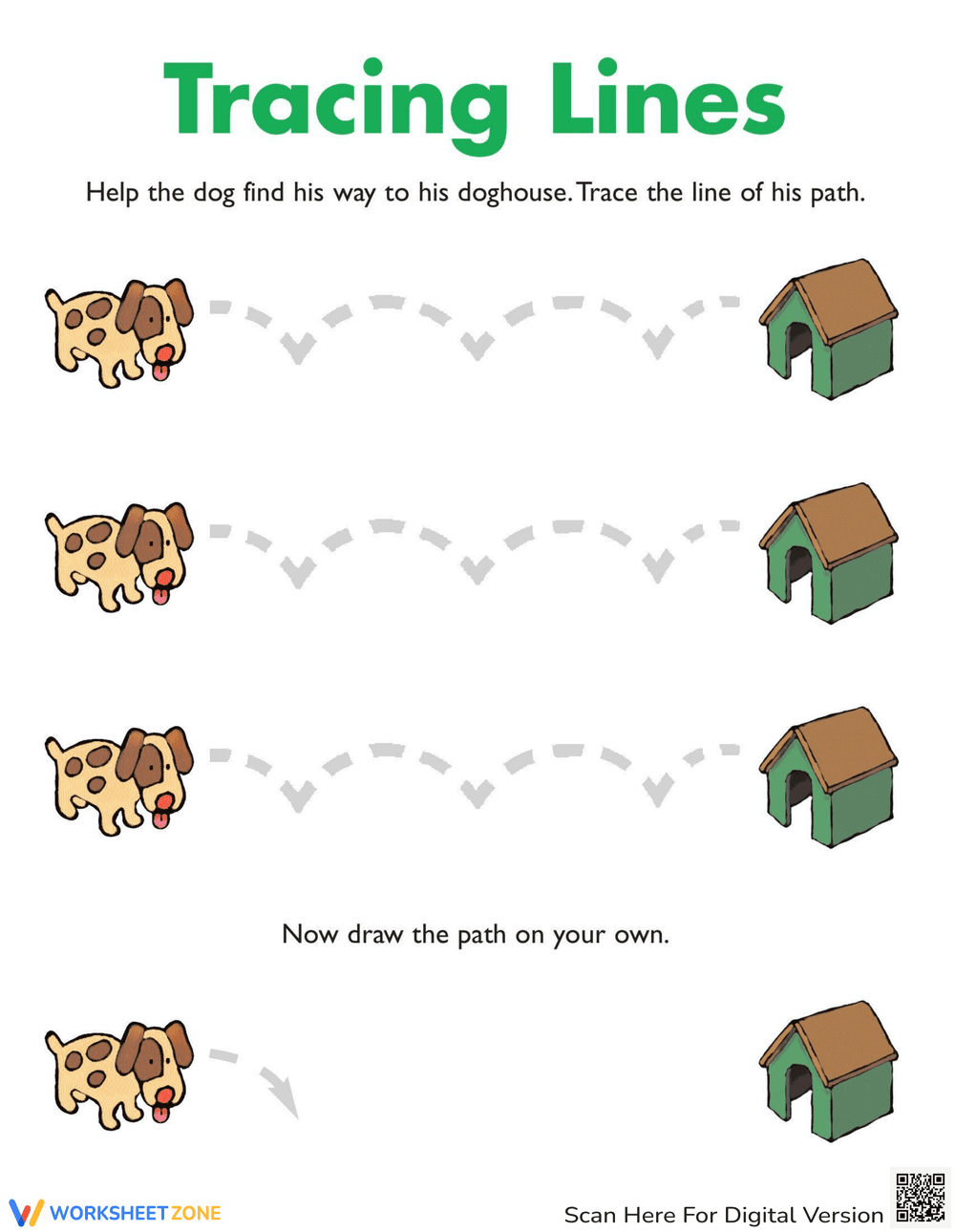

Preschool Line Tracing — Printable No-Prep Worksheet
Paste this activity's link or code into your existing LMS (Google Classroom, Canvas, Teams, Schoology, Moodle, etc.).
Students can open and work on the activity right away, with no student login required.
You'll still be able to track student progress and results from your teacher account.
This preschool line tracing worksheet builds pre-writing skills by guiding young learners to trace curved paths. Students help energetic dogs find their way home, developing the fine motor control and pencil grip necessary for early writing. This simple activity prepares children for formal letter formation.
At a Glance
- Grade: Preschool · Subject: Early Literacy
- Standard:
CCSS.ELA-LITERACY.RF.K.1.A— Follow words from left to right, top to bottom- Skill Focus: Fine motor control and curved line tracing
- Format: 1 page · 4 problems · Answer key not required · PDF
- Best For: Morning work and fine motor centers
- Time: 5–10 minutes
This single-page PDF features four tracing paths. The first three paths provide dashed lines that guide students to trace arches from left to right. The final path challenges learners to draw the trajectory independently. The clear layout uses cute dog illustrations to motivate students, requiring no complex instructions.
Zero-Prep Workflow
This resource requires minimal preparation and fits into any schedule:
- Print (1 minute): Print copies for your class. No laminating or cutting required.
- Distribute (30 seconds): Hand out sheets with crayons or pencils.
- Review (30 seconds): Model the left-to-right movement, then let students work.
With under two minutes of prep time, this is excellent for emergency sub plans or morning work.
Standards Alignment
This activity aligns with `CCSS.ELA-LITERACY.RF.K.1.A`, which requires students to follow words from left to right. By tracing paths from the dog to the house, children internalize the tracking direction needed for reading. It also supports early handwriting readiness by building hand strength. Both standard codes can be copied directly into lesson plans, IEP goals, or district curriculum mapping tools.
How to Use It
Use this worksheet during small-group instruction to introduce pencil grip. Guide students to trace the path with their finger first. Alternatively, place this sheet in a plastic sleeve for dry-erase practice. As a formative assessment, observe whether students maintain a consistent left-to-right direction. Most preschoolers will complete the four paths in 5 to 10 minutes.
Who It's For
This resource is designed for preschool students and occupational therapy sessions targeting fine motor delays. Differentiate by providing thicker crayons for students needing support, or challenging advanced students to use thin pencils. Pair this worksheet with a read-aloud book about dogs to reinforce the concept.
According to research from Fisher & Frey (2014) on the gradual release of responsibility, structured scaffolding is critical for early childhood motor skill acquisition. This worksheet implements this instructional framework by offering three guided tracing paths followed by one independent drawing task. Early motor control directly correlates with later academic success in writing and reading. By practicing the left-to-right tracking required by `CCSS.ELA-LITERACY.RF.K.1.A`, young learners build the spatial awareness necessary for letter recognition. This resource provides the repetitive, low-stakes practice recommended by early childhood experts to build muscle memory, hand strength, and pencil confidence. Teachers can confidently integrate this structured tracing activity into their daily literacy routines to support foundational fine motor development and prepare students for formal handwriting instruction. Ultimately, mastering these simple motor paths helps children transition smoothly from basic drawing to writing letters.


